Mentor text: Slice of life writing for high school students

victoire-joncheray-yJI-zO8ctys-unsplash

Slice of life essays written by elementary students are everywhere; high school slices are harder to find. Here’s one.

Last fall, near the beginning of the school year, I introduced my high school juniors and seniors to slice of life writing. Slices are short narratives that celebrate the ordinary moments in our lives that we may often overlook as worthy of documenting.

To read my post from September about how my students approached Slice of Life writing, click here.

By the way, I learned about slice-of-life writing from this inspirational group of writer-teachers. Teachers write and post their own slices on Tuesdays at this site. For information about this group’s Slice of Life Writing Challenge for classrooms, visit here.

Slice of life writing has few guidelines. Writing a slice is largely a way for students to merge narrative writing with autobiography. Writing slices helps students, especially those who don’t enjoy writing, experience some success within the confines of an essay that runs around 250 words.

Here are the main guidelines that I use when introducing high school students to slice of life writing:

IMG_1498

If your students need a word count,

ask them to shoot for 250-300 words.

I also provide mentor texts so students can read examples of the moments that slice of life writing is intended to document. Because this is my first year teaching at the high school level, I didn’t have any examples written by secondary students; all my examples were written by students at my previous middle school position.

And let’s face it, middle school is middle school.

High school students definitely have more mature concerns, goals, and preoccupations. After all, college and career is on the horizon, social relationships deepen, and many students have jobs.

As a result, I decided to share with you a slice written by Kenna, one of my high school juniors. Feel free to use this as an example when you introduce your own older students to slicing. I especially like this slice because it’s very visual and takes its own sweet time to record an activity that many, if not most, girls can identify with. Curling one’s hair is an oft-repeated task that, while mundane, can come alive when approached creatively.

By the way, this was a third draft that she completed during our Writer’s Workshop weeks last fall. It was nice to see her slice improve gradually over three drafts.

Golden Perfection by Kenna D.

“My hair is long, golden and shiny. It flows through my fingers like the flow of a summer breeze. My hair is flat, and fairly straight. It almost looks like it would be stiff…until you run your fingers through it, and until I decide to style it. When you see it, you can already imagine without touching it, that it is soft and silky like a fleece blanket. 

As the curling iron heats up on the bathroom counter, I look in the mirror to see how all of the lights are aiming down on my hair. They are making it shine like a star in the night sky.

I begin to curl my hair. The beautiful, golden caramel colors, heating up and twisting around and around the hot iron. As the iron gets close to my head, I can feel the heat, beaming off of the iron. It reminds me of the warmth of a fireplace on a cold, snowy winter morning. 

 Ten seconds, twenty seconds, I hold the golden swirl of hair around the iron, and wait for it to give the golden swirl that perfect spiral shape. Thirty seconds pass by and it’s time to release  the hair. I gently let it unravel itself from the iron. Almost as if it’s in slow motion, my hair falls. For a moment I wonder: Is it really going to curl? Will I have to redo this piece of hair?

Fortunately, the golden spiral coils. I stare back at myself in the mirror to see this beautiful, golden swirl of perfection.

I repeat this over and over again. Little pieces of hair at a time. Until every single piece of my hair is curled into a perfect, bouncy coil.

But wait, here’s the plot twist, I’m not a very “girly” girl. After all that work, I end up putting it up into a ponytail of golden, caramel swirls.”

Wasn’t that an awesome slice of life? For a link to a Google Doc file of this slice, click here: Golden Perfection Slice of Life.

I sat up in my chair as I read it, mesmerized by how Kenna zoomed in on a seemingly boring activity and made it come alive with sensory imagery. I loved seeing the “mind movie” as I read.

In addition, Kenna gave us a glimpse into her personality.

Who of us hasn’t put on our best clothes, or spent a lot of time on our hair, only to abandon it all to throw on a pair of jeans or opt for a ponytail instead?

Thanks for reading again this week! I’ll be adding more high school slice of life essays to my blog over the next few weeks. Follow my blog to catch those mentor texts!

Treasured Object Poems: A Favorite Poetry Activity for All Grades

In this post: Treasured Object Poems Mentor Texts and Lesson Tips

Need a fun poetry activity to use with your students? One that will also hone their sensory language and revision skills?

Show them how to write a short free-verse poem about an object they value. Paying tribute to a precious personal item encourages them to think positively about their lives and builds their creative writing skills.

After you first explain the poem, if your students are like mine, one of the very first responses you’ll hear is, “But I don’t have anything that I treasure.”

When that happens, I elaborate. I ask them,

“Okay, if the fire alarm in your house went off, and you had to get out NOW, what two or three things would you grab?”

One of these things might be the perfect thing for a Treasured Object Poem.

To get started, hold a conversation to get students talking about their favorite things. Students of mine have written about a necklace from Grandma, their turquoise Converse, a pocket watch, a fishing rod, a book, a special hoodie, and more.

To help them get ideas, I also provide mentor texts former students have written.

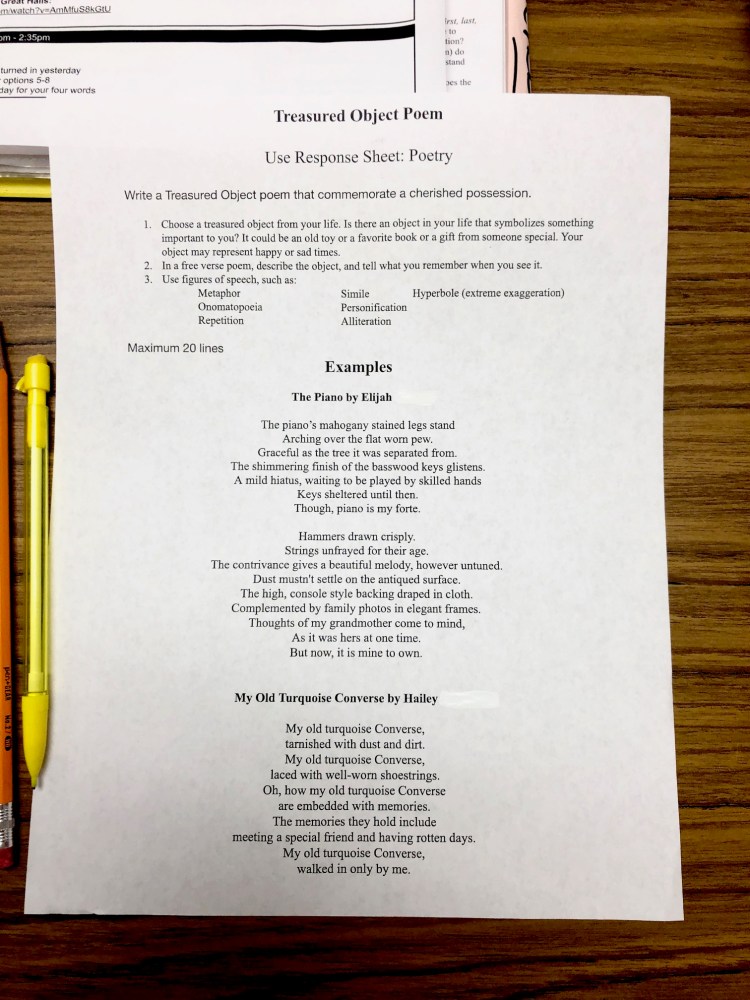
IMG_2497
This is the handout for the Treasured Object Poem project. This handout is kept in a manila folder in the rack of writing projects that students complete during our Writer’s Workshop.

This year, I wrote my own Treasured Object poem and shared it with my classes. I donned my awesome ’90s vintage bomber jacket, and read the following example: 

My ’90s Bomber Jacket

Thick and heavy, warm and supple

Chocolate brown leather, a world map lining

Four pockets to hold:

Gloves, change, Kleenexes, icy fingers.

Oversized,

It clothes me in comfort

Distressed,

It encloses me in memories from

Years of travel from

Minnesota to Maine,

Vermont to Florida.

Oregon to Kansas.

My trendy friend found years ago

In a Phoenix boutique

Is now classic outerwear and

Perfect for…

Ever.

IMG_2480
I couldn’t resist showing you my jacket. It’s exactly thirty years old this year!

Here’s a student-written example of a Treasured Object Poem:

My Old Turquoise Converse by Hailey B.

My old turquoise Converse,

tarnished with dust and dirt.

My old turquoise Converse,

laced with well-worn shoestrings.

Oh, how my old turquoise Converse

are embedded with memories.

The memories they hold include

meeting a special friend and

having rotten days.

My old turquoise Converse,

walked in only by me.

*****

Here’s another:

The Piano by Elijah D.

The piano’s mahogany stained legs stand

Arching over the flat worn pew.

Graceful as the tree it was separated from.

The shimmering finish of the basswood keys glistens.

A mild hiatus, waiting to be played by skilled hands

Keys sheltered until then.

Though, piano is my forte.

Hammers drawn crisply.

Strings unfrayed for their age.

The contrivance gives a beautiful melody, however untuned.

Dust mustn’t settle on the antiqued surface.

The high, console style backing draped in cloth.

Complemented by family photos in elegant frames.

Thoughts of my grandmother come to mind,

As it was her’s at one time.

But now, it is mine to own.

*****

And even though I encourage students to write a free verse poem, occasionally, a student will use rhyme. And that’s fine with me as long as it’s not forced. Here’s one of those:

The Rocking Horse by Devyn R.

Rocking horse, rocking horse, take me away

To faraway places and spaces to play

Farther and farther I knew we went

Across the kitchen and through the vent

Over the hills, galloping we go

When we’ll stop, I’ll never know

Back and back, my head’s in a spin

Nobody else knows the spin that I am in

Taking me places I’ve never been

As high as a bird, as fast as a fish

In the clouds, through the ocean, anywhere I wish

*****


Three ways to beef up this activity

1. Try this revision strategy:

Adding more sensory language will help these poems come to life. After first drafts have been written, have students take their poems and add:

  • one fragrance or smell
  • one sound
  • one texture
  • one taste or flavor

2. Guide your students away from these treasured object ideas:

  • Video games, social media, and other screen-based activities… Honestly, students give enough attention to their screens. I tell students that they’ll have more success with an object that’s tangible — and I don’t mean their phones. It’s important to be able to touch or physically experience their object. However, sometimes I give in and let them attempt a poem about Call of Duty, for example, so they can learn on their own that video games and virtual realities are difficult to describe with physical terms. When they invariably struggle to add sensory language to their poem, they usually change their mind on their own to something that invariably has more poetry potential.
  • Food…There’s always one student who will want to write about a food, as in “But I treasure pizza, Mrs. Yung!”  But unfortunately, such a temporal item will make their Treasured Object Poem feel insignificant. Encourage them to focus on something permanent and precious. Food disappears too quickly to deserve a poem.
    • Of course, you may have a truly hungry student for whom food is their treasured object.  Adjust accordingly because everyone’s experiences are unique. One student a few years back wrote about how cold it was in their house during the winter because their only heat was from the fireplace. Warmth could have been her treasured object I suppose. 

3. Enter these poems in a contest.

In fact, on the handout in the photo above (it was used with my middle school students in my previous teaching position), you can see that my students limited their poems to twenty lines. This limit was placed so the students could enter their poems in Creative Communication’s Poetry Contests.  Read my blog post about this publisher here.

I hope you enjoy sharing this poetry idea with your kids. It’s always been a favorite with my own students. In addition, it’s a poem they can return to again and again as they think of other objects they treasure. Most of my students, even my high school students, surprise themselves with how much they like their final product.


Thanks for reading again this week! If you try this in your classes, feel free to let me know in the comments how it goes or drop me an email in the “Contact” menu.

Sometimes Poetry Can Teach Better than I Can

Take word choice, for example

Last December, when I read a student’s second draft of their Treasured Object poem and saw that it contained the word “get” four times, I thought Really? Get? Four times? 

It surprised me because I thought I had taught not only sentence variety, but word variety as well. It’s good to vary our words. Yes, a writer can repeat certain words in order to:

However, many times using the same word repeatedly —- especially a vague one like “get” — is simply a sign of lazy writing.

Here’s the second draft that a student turned in during our fall writer’s workshop:

IMG_2179
“Get” is a weak, vague verb as it is. And then to have four in the same short poem! Arghghgh!

In our writer’s workshop process, I simply make a few suggestions for revisions and edits on a student’s second draft. I address the most glaring issue that will help the writer improve for his or her third (and usually final) draft. In this case, the most glaring issue was the overuse of  “get.”

I circled the four “gets” and in the margins, I wrote “Replace weak verbs.” When I returned it to the student, we talked briefly. I suggested his poem would be stronger with a variety of powerful verbs mainly because the reader wouldn’t be distracted and pulled out of the poem by all the “gets.”

Here’s the student’s third and final draft:

IMG_2180

The poem is much stronger, don’t you think?

Sometimes it just takes a little more time to think of a better word. 

I also wondered to myself how this poem was the student’s second draft. How did the student who gave him feedback on his first draft not catch this obvious issue? Lazy editing?

Probably, I thought, acknowledging that enabling students to provide effective feedback is still one area in my high school writer’s workshop process that needs improvement.

This poem allowed a quick fix for a common problem. And it caused the unnecessary repetition to be readily recognized and quickly and effectively repaired. This is yet another reason I like teaching poetry. It truly does teach some concepts more efficiently than I can.


Thanks for reading again this week! How is your poetry practice? Do you encourage and/or assign students to write poems? Do tell. And by the way, my next post will focus on the “Treasured Object” poem. I love this easy-to-write poem that allows students to get personal and write about a belonging they wouldn’t part with for the world. Follow my blog to catch my next post!

New Year, New Units: Beowulf and The Old Man and the Sea

Lots of planning comin’ up!

Now that the new year has started, I thought I would write a short post about the units I’m starting with my juniors and seniors next week.

My junior classes will begin Ernest Hemingway’s The Old Man and the Sea on Wednesday  and my senior classes will start Beowulf on the same day. (In addition, my Composition class will begin brainstorming ideas for their I-Search papers on the same day, while my Novels classes begin their independent reading books.)

These lit units are the first ones of the school year for both grades. Last fall, we wrote memoirs, poetry, short story analysis essays, and a variety of pieces for Writer’s Workshop.  We also wrote poetry and entered writing contests, such as the Scholastic Art and Writing Awards.

Of course, we also read. Between nonfiction articles for Article of the Week assignments and various books we “tasted” on First Chapter Fridays, we did expose ourselves to new reading. Still, in-depth and extended study of selected literature was not on the menu.

Until now.

I’m excited to experience these literature studies with my students. I’ve read The Old Man and the Sea before, but not Beowulf. And to be honest, I’m a little embarrassed that I haven’t read this foundational text before. In fact, I’m not sure how I missed reading it until now.

I’m fairly well prepared to get started with these new units, but at the same time, I know that teaching them will be challenging and probably dominate my planning time.

For me, tackling anything new in teaching requires patience, planning, and an expectation that for these first attempts, I’ll be learning right alongside my students. I’ll be…

  • exploring new vocabulary
  • answering study questions
  • designing writing projects
  • creating summative assessments, and
  • planning cumulative activities.

It’s quite a handful to create daily lessons for two new texts. Compound that with the fact that at my small rural high school, I’m the only English teacher for juniors and seniors.  That has its positives (I have autonomy and choice when planning), but it also has its negatives. For example, while I do have a general curriculum to follow, I do not have unit specific materials beyond the textbooks and novels.

As such, I’ll be creating and designing lessons as I go. Thank goodness for ready-made unit plans, which provide me a basic framework that I can tweak and adjust for the future.

I’ll update you on how these new units progress in some future posts.


Thanks for reading again this week! What are you gearing up for now that the holidays are over? Feel free to leave a comment and follow my blog to catch those follow-up posts.

Teaching transitions in writing, part 2

This student-written essay illustrates transition ideas

A few weeks ago, I wrote a post about how the nonfiction author James Swanson’ transitions from paragraph and from chapter to chapter in his nonfiction narrative Chasing Lincoln’s Killer. The post discussed transitions words (such as therefore, however, in contrast, nonetheless, and others) that we all know and love and teach. However, the post also discussed a more subtle form of transition… transition ideas. Read that post here. 

Below, I’ve shown a student-written example of  the same primary technique, repetition, that Swanson used to carry the reader from one paragraph of her text to the next.

This student’s term that she chose to guide the reader through her essay was “moving on.” In the photo below, I’ve underlined the five times that the writer repeated the words “moving on” or “move on.”

IMG_1842 (1)
In the photo above, I’ve underlined in red the repetition of key words a student used in her personal essay about how she learned resilience and perseverance amid negative circumstances. 

The student told me that she didn’t realize she was using repetition to create her transition ideas. Once I called her attention to it, however, she could see how using those words could help a reader navigate her argument’s reasoning and follow her ideas from one paragraph to the next.

We also discussed how repetition can backfire because it’s possible to overuse words and phrases in a piece of writing.

How to tell the difference?

It’s often a judgment call… a judgment call that requires lots of reading and re-reading (especially aloud!) to determine whether the repetition connects ideas and builds the argument, forming a continuous thread through the piece or merely distracts the reader, pulling them away from the argument.

It’s fun to see students making effective moves in their writing, especially when it comes to writing transitions and working hard to make their ideas carry through a piece smoothly, seamlessly, and unobtrusively.

I’ll have a few more examples to show you in a future post or two. Become a follower to catch that post!


How do you teach transitions? It’s one of the more challenging aspects of the craft. Feel free to leave a comment with your experiences and thoughts on the subject.


Need a new poetry lesson?

Enter your email below and I’ll send you this PDF file that will teach your students to write Treasured Object Poems, one of my favorite poem activities. I know your students will enjoy it!

Image shows readers the paper I'll send for signing up for my email list. The handout gives instructions for a Treasured Object poem.
Treasured Object Poems

Processing…
Success! You're on the list.

Dear Teachers: The Church of Scientology is one click away from your students

IMG_1697
My laptop screen that shows the Youth for Human Rights curriculum sign-up form.

Be careful: the church’s Youth for Human Rights lessons are now available online.


A lot can happen in two years.

Two years ago, I wrote on Medium.com about a variety of educational materials offered by Youth for Human Rights International, a Los Angeles, Calif.-based human rights advocacy group. Back then, after doing some quick online research, I discovered that Youth for Human Rights International is actually a front organization of the Church of Scientology.

Note: In this story, I have intentionally omitted links to websites owned by the Church of Scientology or its front organization; however, here’s the link to the article I wrote two years ago: Dear Parents: Scientology Wants to Get Inside Your Child’s Classroom

IMG_2282
Read this story on Medium.com here.

Recently, I checked back on the Youth for Human Rights website to see if it was still there, and if so, I wondered if it still offered the same materials and other propaganda extolling the virtues of the organization and its questionable humanitarian work.

What did I find?

A full online course. An app. A teacher dashboard so teachers can monitor student progress in the course.

Instead of sending away for the printed materials I wrote about two years ago, teachers can now instantly open an account, register as a teacher, and enroll their students to deliver human rights content from the Church of Scientology.

But don’t.

And don’t order the printed materials either.

Despite lots of United Nations name-dropping, the Church of Scientology has no business proclaiming itself as a human rights leader.

un
United Nations, New York City | Photo: Pixabay

After all, there are several human rights that the Church of Scientology policies violate, which discredit its claim of being a leader in the field. I’m not an expert on the Church of Scientology, but if one reads even a moderate amount on this so-called religion, you’ll discover many questionable, unethical activities.

For now, here are three that I’m aware of: 1) the cult’s Rehabilitation Project Force, a forced-labor camp where cult followers are imprisoned to perform hard labor to compensate for violations they have allegedly committed; 2) the cult’s disconnection policy, which requires followers to separate themselves from friends and family members who criticize the Church of Scientology, and 3) the documented charges of physical violence and assault by David Miscavige, the church’s “ecclesiastical leader,” and other higher-ups.

Teachers beware: The Church of Scientology doesn’t make it obvious that it’s the force behind Youth for Human Rights International. Visit the YHRI website and you’ll find no connection to Scientology; however, visit Scientology.org and you’ll find numerous mentions of YHRI, its partner front United for Human Rights, and a heavy dose of grandiose language extolling the progress being made globally to advance human rights.

To be honest, human rights violations or not, when a cult is making inroads into American schools – even to promote an innocuous and noble cause – it’s unacceptable and dangerous.

In addition, providing a way for students to sign up for a Church of Scientology online human rights course is even more disturbing.

Despite negative publicity accrued over a few seasons of Scientology and The Aftermath, the Church of Scientology and its myriad front organizations are still operating.

SH1246-Leah-Remini-Scientology-and-the-Aftermath-2000x1125

The Church of Scientology’s attempts – including its new online course – to provide a curriculum to schools and to sign up students online is underhanded and dishonest… not qualities I would expect from an organization supposedly dedicated to the advancement of human rights around the world.


I keep tabs on the Church of Scientology and how it attempts to connect with classrooms. Thanks for reading again this week. And please let me know via email (marilynyung@gmail.com) if you are ever contacted by the Church of Scientology or its front organizations. I still receive emails from their offices regularly regarding their human rights curriculum.


A Christmas Memo: Madeline, Me, and the Cathedral of Notre Dame

This Christmas, for the first time in more than 200 years, Christmas Mass will not be held at the Notre Dame Cathedral in Paris. Since last April’s fire, services at the famous cathedral have been held at the Eglise Saint-Germain l’Auxerrois, a church near the Louvre. This week, I’ve decided to reblog a post I wrote last spring; this post originally appeared on my travel site, http://www.marilynyung.wordpress.com.

I wrote the post below the week after the cathedral fire last spring; it pays tribute to the children’s book, Madeline, by Ludwig Bemelmans. By the way, I still have not located the copy of the book mentioned in the post. Darn.

Thanks for reading! If you’re a Madeline fan, please leave a comment!

Four-day weeks are the worst… said no teacher ever


What a four-day school week means to me

Last summer, my husband and I moved to a new city. Since we had learned about our upcoming move way back in January, I began searching for a new position about a month later. The local school district in our new hometown didn’t have any positions available. As a result, I decided to explore the many small rural school districts in the surrounding area.

One of the very first openings I noticed was at a school district about forty minutes away from our new home. I noticed the listing and checked out the school’s website. It looked like a promising possibility, but the forty-minute commute gave me pause. Still, I made a mental note to keep it in mind as I continued my search.

A couple more openings soon showed up in other schools. One was about thirty minutes away. Another was a tempting fifteen minutes away. Of course, a few more with forty-minute commutes similar to that first listing popped up in my search results as well.

I continued to prepare my resumé, samples of student work, and other materials that I knew I’d need when I would eventually start interviewing. And just about everyday, I logged on the job search website provided by my state’s department of education and looked for openings in the area.

One day about two weeks later, the listing at that first school I noticed was flagged as being recently revised. Hmmm… I wonder what’s changed, I thought.

I clicked the listing. A significant change had been made: the district’s school board had, a few days earlier, approved a four-day week for the 2019-2020 school year.

The four-day week is a relatively new concept that more than 500 districts across the country are exploring. Small schools, especially those in rural areas, can reduce operating costs and, in lieu of higher salaries, better attract and retain teachers by offering a shorter work week instead.

Well, that definitely changes things, I thought.

Without looking further on the site, I quickly assembled a resumé and emailed it to the school’s principal. Within a week, I had an interview scheduled. About an hour after my interview, I received an offer, which I accepted the next morning.

That four-day week stopped my search cold. Yes, it would mean school days that run about thirty minutes longer, but it would also mean one fewer day of making that forty-minute drive each way, which was the main drawback for me since I was transferring from another rural district with a comparable salary schedule. And now, with the prospect of a four-day week, saving time and gas were just the beginning.

After all, what teacher doesn’t fantasize about what an entire extra day each week would mean for their life? 

  • That extra day means I can schedule a doctor or dental appointment without taking time off from work (and, by the way, costing the school the wages for a sub).
  • It means I can do my grocery shopping on a quiet Monday morning instead of a hectic Saturday afternoon when everyone else is roaming the aisles, too.
  • It means I can hang around the house and redo that cabinet I’ve been needing to paint, but just haven’t found the three or four solid hour it requires.
  • It means I can burn a pile of leaves if I feel like it.
  • Or bake a loaf of bread.
  • Or read a book.
  • Or write a blog post.
  • Or exercise.
  • Or volunteer.
  • Or yes, even do some grading and lesson planning. (Yeah, it happens.)

And think about what an extra day means to younger teachers with small children. That’s one fewer day of childcare to pay for and one more precious day to spend with their infant or preschooler. As a mother (my kids are grown now), that extra day would have meant the world to me.

And yes, logistically, I understand how difficult it might be to schedule childcare on a four-day calendar. However, after-school clubs and other community programs have been known to revise their hours and services to accommodate the change.

And mind you, I don’t have every Monday off at my new school. Of about forty Mondays in the school year, twenty-two are actual “no school” days where both students and teachers stay home. On the remaining sixteen Mondays, only teachers attend school to plan and take part in professional development (PD) activities, such as first aid workshops, a suicide prevention session, and technology training.

Fortunately, my district doesn’t pack these Mondays with PD sessions; I usually have four to five hours of time to spend in my classroom preparing for the weeks ahead. I accomplish so much on those days completing work that I would normally just take home in a bag anyway.

I love the four-day week my new school district voted to adopt last spring. The district plans to evaluate  the change next semester to learn how it’s working for students, parents, and school personnel. Everyone’s needs must be considered, for sure, but we must remember that educating students must remain the number one priority.

For me, however, the four-day week means my weekends are long, luxurious, and wonderfully rejuvenating. Yes, I could earn more in a larger, better resourced suburban district closer to my home, but my smaller paycheck is more than offset by that one glorious extra day.


Thanks for reading! Have you heard of any districts in your area considering the switch to a four-day week? What are your thoughts? Let me know with a comment. And don’t forget to become a follower for more ELA posts. Here’s a link to a recent post

My “Article of the Week” rubric for middle and high school

john-schnobrich-2FPjlAyMQTA-unsplash

Plus rubrics you can tweak  to fit your classroom

Last February, I wrote this post about what I consider to be my most effective writing assignment: Kelly Gallagher’s Article of the Week (AOW).

I still use this assignment on a weekly basis, but I’ve added narrative writing to the mix by assigning what I call Essays of the Week (EOWs) every other week. These narrative assignments use prompts provided by The New York Times Learning Network. I select a grouping of prompts from the list and let students choose one to respond to.

Here are some photos of the rubric portions of my AOWs and EOWs. 

IMG_2138
This is the rubric I made for the first AOW of the school year.
IMG_2140
This AOW rubric contains less explicit instructions for citing of the article. I use this rubric on AOWs so students have a little more leeway with how they set up, cite, and interpret their quotations from the article. Some students work best with this format; some need more structure. 
IMG_2136
This EOW rubric specifically asks students to begin their essays with dialogue. It also asks students to ground their dialogue with narration. On this same day, we also discussed dialogue punctuation and how to narrate dialogue with detail and elaboration about the characters who are speaking.
IMG_2137
This EOW rubric specifically asks students to use  a semicolon in their writing. On the day this was assigned, we also watched this video by Shmoop about how to use semicolons. 
IMG_2139
This EOW rubric specifically asks students to use an em dash in their writing. On the day this was assigned, we also watched this video by  Shmoop about how to use an em dash.

To purchase an editable Microsoft Word document that contains these five rubrics, visit this page of my site shop.

I usually assign a new AOW or EOW on the first day of the week with a hard copy due one week later. AOWs usually take a little more time to go over. For example, after a bell-ringer activity and a mini-lesson that addresses a specific skill required in the rubric (such as using semicolons), these take the better part of the class period when we complete these steps:

  • introducing the assignment
  • going over the rubric and its specific requirements
  • discussing the writing prompt
  • reading the article aloud
  • watching any related video on the news story

EOWs don’t take as much class time, since there’s no article to read. We might go through each prompt choice, however, and do some discussion to help students come up with writing ideas.

Let me know how these rubrics work for you.

My adaptation of Kelly Gallagher’s AOW is a mainstay in my teaching. The AOWs build nonfiction reading skills, improve writing stamina, and increase students’ prior knowledge of the world around them. My EOW simply adds variety to our routine while giving them opportunities to write narratives.


For more ELA teaching ideas and lessons, enter your email below and I’ll add you to my list pronto — THANK YOU!

Processing…
Success! You're on the list.

Thanks for reading again this week! I appreciate any and all comments. In fact, this post was created in response to a comment posted just last week about this article.

Student writers learn their power at Missouri State

The Write Now! High School Writing Conference at Missouri State University

Shaun Tomson explains his metaphorical “I Will” statement, “I will always paddle back out.”

Here are some quick photos of the high school writing conference hosted by the Missouri State Center for Writing in College, Career and Community. I took these just a few minutes ago during the 2019 Opening Session. World champion South African surfer Shaun Tomson spoke about the power of “I Will” statements, part of his Surfer’s Code, an empowering personal creed that he challenged each student in attendance to write and apply to their own lives.

A student in the audience shouts out his “I Will” code.

Near the end of the session, Tomson asked students to share their “I Will” statements via a texting poll and from their seats in the auditorium inside Plaster Student Union.

I attended the conference with these four fantastic students from my school. They each attended two different creative writing sessions. I am very proud of these girls for taking a chance and attending this conference to grow their writing skills.

I’ll be writing another post about this conference and the specific sessions offered in a future post. I’ll also write about getting to see some former students who met me for a quick photo and catch-up session in the aisle.

In the meantime, the conference is actually just getting started. After lunch, students will attend another session, and then we’ll head back home.


Thanks for reading! Become a follower for more teaching resources and reflection.