Baz Luhrman’s Great Gatsby: Chapter 2 Problems

What to watch & what to skip

If you’re like me, you cringe a little inside whenever Chapter 2 of Baz Luhrman’s 2013 The Great Gatsby begins. Thankfully, (or regretfully?) it happens only fourteen minutes in from 14:27-22:50, so you can get it over with and proceed with the movie that overwhelmingly every student looks forward to watching.

But here’s the deal: Chapter 2 is tricky.

Luhrman’s creative vision for Chapter 2 was over the top. To put it simply, you may want to avoid the awkwardness and potential controversy that the approximately eight minutes presents.

In fact, Luhrman’s Chapter 2 should probably be rated R since it pushes the PG-13 boundary so strongly.

After all, Chapter 2 contains:

  • strong innuendo (Mr. McKee’s “artistic game” leaves few doubts that he photographs erotica.)
  • questionable comments (Tom: “Nick, I know you like to watch.”)
  • drug use (Catherine’s nerve pills)
  • seemingly unlimited alcohol

It’s a Jazz Age Festival of Bacchanalia that is almost startling in its intensity; therefore, it might be crossing the line for your students and school environment.

Sure, if they’ve read the book, students know there’s a party in Tom and Myrtle’s apartment in Chapter 2, but Luhrman leaves nothing to the imagination with what is depicted in those scenes from 14:27 to 22:50. In fact, since students aren’t expecting Luhrman’s filmed version to heighten the action in the chapter to such an extreme degree, it can take them aback, so you may feel like skipping it altogether.

However, if you skip all of Chapter 2, you do miss these all-important moments from the first three minutes:

  • introduction of the Valley of Ashes
  • introduction of Dr. T. J. Eckleburg
  • the first appearance of George and Myrtle Wilson
  • a couple foreshadowing shots of Michaelis
  • the furtive conversation between Tom and Myrtle about heading to town

Yes, the opening three minutes of Chapter 2 are helpful, but the rest of the chapter contains some questionable moments that you may wish to avoid.

Use this post to decide what to skip and what to show your students.

Here is the Chapter 2 play-by-play:

  • 14:27: The first three minutes include, as stated above, the Valley of Ashes, T.J. Eckleburg, Wilson’s Garage, Nick meeting Myrtle and George, Tom arranging the party in town,
  • 17:16: As Myrtle’s new dog eats from a china plate, sexual activity between Tom and Myrtle escalates in the bedroom while Nick awkwardly tries not to hear.
  • 17:50 Catherine arrives at the door asking, “Ain’t we havin’ a party?”
  • 17:57: The McKees arrive followed by greetings all around. Myrtle emerges from the bedroom followed by Tom adjusting his suspenders
  • 18:33: Tom goads Nick to stay by urging, “Listen, Nick, I know you like to watch.”
  • 19:11: Catherine asks Nick, “Do you live on Long Island, too?” She then builds mystery around Gatsby by asking Nick if he’s ever heard of a man by the name of “Gatsbys” who she describes as “a cousin of Kaiser Wilhelms.”
  • 19:25: Tom shouts to McKee to “Take a picture of that!” and swats Myrtle’s backside.
  • 19:37: Glancing to Myrtle and Tom, Catherine tells Nick, “Neither of them can stand the person they’re married to.” Nick then asks, “Doesn’t she like Wilson either?” Myrtle’s reply, described by Fitzgerald as “violent and obscene” is heard offscreen when Myrtle says, “He’s a dirty little scumbag.”
  • 19:50: Catherine slips Nick a “nerve pill” as she kisses him seductively.
  • 20:00: Catherine helps Nick wash down the pill with an alcoholic drink, and it’s at this point that the party takes off for the next minute and a half. Champagne sprays around the apartment, pillow stuffing falls through the air, and McKee photographs the whole drunken gang splayed across the couch. Catherine removes Nick’s dress shirt, and soon nearly everyone is clad only in their under clothes, dancing, writhing on coffee tables, and partaking in what Nick calls a “chemical madness.” We see Nick drinking from a large pedestal bowl and a fizzing bottle. We see Catherine dressed in skimpy lingerie, kissing Nick’s chest, and rolling with him on Tom and Myrtle’s bed.
  • 21:35: Nick walks over to a window, and looks down on the city. In voiceover, we hear him paraphrase, “High over the city our yellow windows must have contributed their share of human secrets. The casual watcher in the street. And I was him too looking up and wondering. I was within and without, enchanted and repelled by the inexhaustible variety of life.” Nick then returns to the party where the McKees sleep on chairs and couches.
  • 22:29: From the bedroom, Tom tells Myrtle she has no right to say Daisy’s name. Myrtle repeats, “Daisy! Daisy! Daisy!”
  • 22:34: Tom violently strikes Myrtle. The action is shown in slow-motion.
  • 22:40: Nick climbs out the window onto the fire escape and the camera pans out as we see Mrs. McKee and Catherine tending to Myrtle. The camera speeds away from the building, eventually encompassing a sparkling nighttime panoramic view of the city, punctuated by construction workers straddling iron beams and striking at metal, sending sparks flying.
  • 22:50 Chapter 2 officially ends with Nick waking up on his front porch the next morning.
The Great Gatsby
Enter Gatsby in my search bar at the bottom of this post for a slew of posts all about teaching The Great Gatsby.

Here’s what Common Sense Media has to say about Luhrman’s version of The Great Gatsby:

Parents need to know that director Baz Luhrmann‘s (Moulin Rouge) take on The Great Gatsby is a decadent, dizzying version of F. Scott Fitzgerald’s classic American novel. The movie is true to the book, featuring scenes with lots of drinking — often to excess — and smoking. There’s not too much swearing (though some soundtrack song lyrics include infrequent use of “s–t” and “f–k”), but expect some violence (a man punches another, a car hits a woman head-on, and a character shoots another) and sexuality. Couples — including people married to others — are shown kissing and in bed (bare shoulders). Leonardo DiCaprioTobey Maguire, and Carey Mulligan star; that, plus the movie’s hip soundtrack and lush style, are likely to make it very appealing to teens.

common sense media

Despite this warning, Chapter 2 contains a good portion of the explicit questionable content in the film. It’s the main chapter to be wary of.

Marilyn Yung

I hope this post helps you plan for showing The Great Gatsby by Baz Luhrman as part of your Gatsby unit. This movie is a student favorite and I wouldn’t want your students to miss out on this exciting film. Use this post to select what to show and what not to show. You know your students better than anyone.

Leave a comment below or on my Contact Page to throw in your two cents on this post. How do you approach Chapter 2 of Luhrman’s The Great Gatsby?


Need a new poetry idea?

Enter your email below and I’ll send you this PDF file that will teach your students to write Treasured Object Poems, one of my favorite poem activities. I know your students will enjoy it!

Image shows readers the paper I'll send for signing up for my email list. The handout gives instructions for a Treasured Object poem.
Treasured Object Poems

Processing…
Success! You're on the list.

Looking for something specific?


ELA Brave and True


Featured Photo at Top of Post: by Brooke Cagle on Unsplash

True Crime Unit: Elizabeth Holmes and Theranos

Planning for next year? Check out these multi-media resources

If your students are into True Crime as a reading genre, or if you’re needing a “ripped from the headlines” unit to breathe new life into your upper-level high school ELA classes, do I have an idea for you!

And the best thing about this idea is that it’s so topical! In fact, the woman at the center of this Silicon Valley crime tale receives her sentencing bright and early in the fall semester on September 26, 2022.

Photo: Theranos, Public domain, via Wikimedia Commons

If you’re unfamiliar with Elizabeth Holmes, here’s a brief backstory.

Elizabeth Holmes, a Stanford University engineering student, dropped out of college at the age of 19 in 2003 and used her tuition money to form a company called Theranos Corporation, a Silicon Valley biomedical blood diagnostics company located in Palo Alto, Calif.

Holmes’ company eventually attempted to “change the world,” as Holmes boasted, with its portable blood testing device that could perform hundreds of tests using only one drop of blood–instead of the typical vial-full taken from an arm.

After years of false starts, inaccurate and unreliable tests, and after gaining the trust and millions of investment funding from a well-known board of directors, including former U.S. Secretary of State George Schultz and former U.S. Secretary of Defense James Mattis. In January, Holmes was found guilty on four counts of fraud that each carry a possible 20-year prison sentence.

Before the company was dissolved in 2018, Theranos blatantly misrepresented its testing abilities, tricked major pharmaceutical companies to invest, and worked out a deal with Walgreens to establish in-store wellness centers that used the Theranos technology. The wellness centers rolled out to forty Phoenix, Ariz. stores before the company was shut down.

In 2014, Theranos was declared to be worth $9 billion. Today, it’s worth nothing.

And that’s just the basic story.

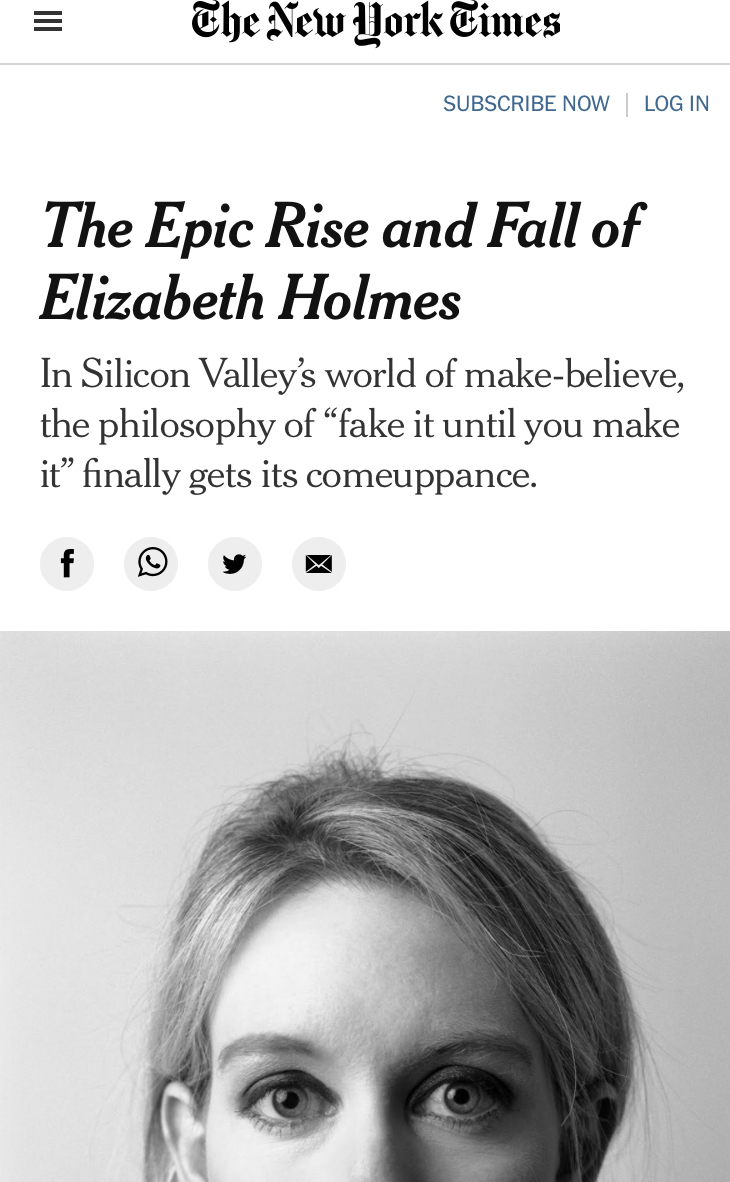
I’ve been following this story ever since Elizabeth Holmes’ criminal trial ended in January. At that time, the New York Times published this incredible story complete with interesting connections between Holmes and Jay Gatsby of Fitzgerald’s classic novel. I had just been finishing up Gatsby with my juniors, and I created this Article-of-the-Week (AOW) assignment with this article.

Ever since then, this story has been on my radar.

And by that, I mean I’ve been devouring anything and everything about Elizabeth Holmes and the entire Theranos debacle.

With the hunch that this story has the makings of a great curriculum or at least a unit for a True Crime class, I started keeping a list of various articles, videos, documentaries, TV series, movies, and more about the Elizabeth Holmes and Theranos story.

So, for your convenience and possible future use, here’s that list of multi-media resources to check out about the Elizabeth Holmes and Theranos case.

The original podcast: The Dropout

This is the original podcast from ABC Audio that inspired the hit TV series The Dropout on Hulu featuring uncanny performances by Amanda Seyfried (see below). I watched the Hulu series not realizing it was inspired by this podcast, and I gotta tell ya’, the podcast is even better than the Hulu series.

And that’s mainly because, with 27 episodes, there is obviously more time to delve into the inner workings of Theranos and Holmes’ intelligent, yet deceptive, mind. The podcast, hosted by ABC News chief business, technology and economics correspondent Rebecca Jarvis, examines the saga from its earliest days up to brand new episodes created during and after Holmes’ court trial.


The Hulu series: The Dropout

Get ready for a ride! This excellent series on Hulu stars Amanda Seyfried as Holmes, and let me tell you, she nails the presence, gestures, voice, mannerisms of Holmes. It’s truly amazing to watch Seyfried make this transition. The series, comprised of eight episodes, takes you through the entire story, from Elizabeth’s childhood right up to the dissolution of her company.


The news doc: The Theranos Deception

I showed this 14-minute segment from 60 Minutes to my students when I assigned the AOW mentioned earlier in the post. This video will bring anyone up to speed pronto with the Holmes and Theranos case. Again, this is a quick prior knowledge activity you may want to use.


The book: Bad Blood

This is the ground-breaking book by former Wall Street Journal investigative reporter John Carreyrou, who revealed first the fraudulent activity at Theranos, including the fact that only one blood test performed by Theranos — for herpes — ever received FDA approval. This book is excellent. It’s packed with strong reporting and, based on everything I’ve read about the case, this book is THE definitive record of the entire saga. Carreyrou is a major character in Hulu’s The Dropout series, which goes to show how integral his reporting was to the entire case against Holmes.


The feature film: Bad Blood

There’s not a lot published so far on Bad Blood, the feature film. John Carreyrou is listed as a screenwriter for the movie, so that bodes well for accuracy and authenticity. A brief summary on IMDb reads, “Entrepreneur Elizabeth Holmes creates a bio-tech company that skyrockets her to fame with an estimated value in the billions. When federal agencies begin investigating the company, her integrity is called into doubt.


The video: Forbes Magazine’s Most Powerful Women Summit

This video shows Holmes featured at Forbes Magazine’s Most Powerful Women Next Gen Summit in 2014. There are lots of videos and recordings of Holmes during the heady days of her success. This is just one of them. It’s fascinating.


The audiobook: Thicker than Water

Listen to this audiobook on Audible.com to hear the whole story from one of the original Theranos whistleblowers, Tyler Shultz, grandson of Howard Shultz. (Here’s his LinkedIn profile.) It was Tyler, along with other employees, who became addled at the misrepresentation and incompetence he saw happening behind closed doors at Theranos.


Numerous articles from multiple news organizations:

Here are 10 more articles to consider for a Theranos True Crime unit :

Theranos uses key technology in just one test: WSJ

Hot Startup Theranos Has Struggled With Its Blood-Test Technology

Elizabeth Holmes wrote personal notes to herself about ‘becoming Steve Jobs’ as Theranos collapse began

The Elizabeth Holmes Trial Is a Wake-Up Call for Sexism in Tech

Ethics Unwrapped from Univ. of Texas at Austin: Theranos’ Bad Blood

Theranos: A cautionary tale of ethics and entrepreneurship

The Powerful Impact of the Theranos Whistleblower

George Shultz Brought Big Names to Theranos Board

Theranos Founder Elizabeth Holmes Found Guilty of Investor Fraud

How ‘Lean In’ Feminism Created Elizabeth Holmes and the Toxic Ladyboss

Thanks for reading this week! School is wrapping up so quickly and I know that even though summer is right around the corner, you’re probably already thinking of units for next fall. Since I’ve been so obsessed with this story, I thought it only made sense to pass along the numerous resources I’ve read, watched, and listened to. Feel free to leave a comment or shoot me a question on my Contact Page. I’ll be glad to hear your questions or thoughts about the Elizabeth Holmes and Theranos case and its coverage in the media.

Need a new poetry idea?

Enter your email below and I’ll send you this PDF file that will teach your students to write Treasured Object Poems, one of my favorite poem activities. I know your students will enjoy it!

Image shows readers the paper I'll send for signing up for my email list. The handout gives instructions for a Treasured Object poem.
Treasured Object Poems

Processing…
Success! You're on the list.

Looking for something specific?


ELA Brave and True


Featured Photo Credit: Tali Mackay at English Wikipedia, CC BY-SA 4.0 https://creativecommons.org/licenses/by-sa/4.0, via Wikimedia Commons

The Sonnet for High School (part 2)

Use these student-written mentor texts inspired by Terrance Hayes

Two weeks ago, I posted about a unique sonnet writing exercise inspired by poet Terrance Hayes that I tried with my junior-senior poetry class. Click here to read that post.

Hip Logic by Terrance Hayes

This new exercise took repetition to an extreme degree, and in so doing, demonstrated the literary technique’s effectiveness. For background, I had stumbled upon this article on Slate.com about African-American poet Terrance Hayes and his 2002 poetry collection titled Hip Logic. In that book, he has included a sonnet aptly titled “Sonnet” that repeats its one iambic pentameter line fourteen times.

Here’s what Hayes’ poem looks like on the page:

Sonnet by Terrance Hayes

We sliced the watermelon into smiles.

We sliced the watermelon into smiles.
We sliced the watermelon into smiles
.

We sliced the watermelon into smiles.

We sliced the watermelon into smiles.

Hayes’ subject matter focuses on a stereotype aimed at African-Americans. For more analysis, read this post on This Frenzy.com, including how the repetition denies power to the turn or “volta” that is usually found before the final couplet. In addition, the effect one hears when reciting the stereotype fourteen times presents many questions.

Here are some of those questions:

  • What happens to the stereotype when we repeat?
  • When we repeat the stereotype fourteen times?
  • Does it minimize the stereotype’s meaning?
  • Does it emphasize the meaning?
  • Does it otherwise distort meaning and how exactly does it distort?
  • When does repetition distract from meaning?
  • When and how does it inform meaning?
  • Does fashioning a sonnet whose message, effect, and power rest on the repetition of a stereotype work to reinforce the stereotype, causing the reader to feel and experience its absurdity and dishonesty?
  • Or does the repetition of a stereotype work to destroy the stereotype?

To explore repetition further and create our own change-up of the contemporary sonnet form a la Terrance Hayes, I created a quick assignment. Click here for the post with the basic instructions.

First, here’s the example that I created for my students as a mentor text:

Rural Racket by Mrs. Yung

We hang our politics on our gun racks.

We hang our politics on our gun racks.

We hang our politics on our gun racks.

We hang our politics on our gun racks.

As promised, below you’ll find some examples written by my students:

Indie Game Developers by Hannah

People paid just to play games all day

People paid just to play games all day

People paid just to play games all day

People paid just to play games all day

Christ Was One Of Us Too by Eva A.

We must walk hand in hand with the devil.

We must walk hand in hand with the devil.

We must walk hand in hand with the devil.

We must walk hand in hand with the devil.

Expectation by TayLynn

Teenagers are our lazy prodigies.

Teenagers are our lazy prodigies.

Teenagers are our lazy prodigies.

Teenagers are our lazy prodigies.

Crunch Culture by Meadow

Unpaid overtime is fine


Fabulous sonnets, right?!

Since my focus was on exploring the effects of repetition, I didn’t require students to use iambic pentameter. Most did, but like Meadow’s above, some didn’t. That’s okay. My goal was to try something totally new and give my students a new way to look at the sonnet utilizing a stereotype they have observed in their lives.

And then we presented.

I thought it would be interesting to not only write these sonnets, but recite them before the class, like we have done with every assignment we have completed this year.

Keep in mind that “presenting” in my poetry class is much more formal than the picture below show. While I do have a lectern that kids can use, they usually just stand before the class. Sometimes, I project their poem on the whiteboard and have them read from that. Other times I print a paper copy off from the assignment they submitted in Google Classroom.

Photo by Werner Pfennig on Pexels.com

This time, I printed out a copy to each student and even though that wasn’t necessary, I thought it might make this poetic performance as much like our others as possible.

Students did feel a little weird saying the same line fourteen times, but they also experienced repetition not just by reading it, but by voicing and hearing it.

It was fun, different, and yes, a little weird — but in a good way.

  • Some students varied the words they stressed with each line.
  • Some just read it clear through, saying every line the same.
  • Some lost their place and didn’t know it they were reading, for example, the line for the tenth or eleventh time. But that didn’t matter because others were listening intently and knew exactly what line they were on.

Questions, questions, questions…

We talked about how it felt to read the poem aloud.

  • Did it reinforce the stereotype?
  • Defeat it? Give further voice to it and/or amplify it?
  • Did it make the stereotype seem silly? Trivial?
  • Did it make the stereotype seem more audacious and inaccurate?

I would say not one overall conclusion was reached in our brief discussions after each sonnet was read. And to be sure, some students asked the reader for context if they didn’t understand. It’s funny how, for as obvious as we believe a stereotype’s meaning to be, there is usually someone who doesn’t understand.

One thing that was apparent: repetition as a technique was seen as powerful in a variety of ways.

With this Terrance Hayes-inspired project, I would say we’ve explored the sonnet in a sufficient way for this, my first year, with this poetry class. I hope that next year the new teacher in my position (I’m changing gears next year and I’ll fill you in on that in a post very soon) plays around with this lesson as well.

Terrance Hayes’ stereotype sonnet subdues the traditional technicalities of the sonnet, brings it into contemporary times and sensibilities, and highlights the rhetorical power of repetition.


Thanks for reading again this week! I hope I’ve inspired you for the next time you tackle the sonnet with your poetry students.

Feel free to comment below or on my Contact Page with your questions and requests.

Happy Teacher Appreciation Week!


Need a new poetry idea?

Enter your email below and I’ll send you this PDF file that will teach your students to write Treasured Object Poems, one of my favorite poem activities. I know your students will enjoy it!

Image shows readers the paper I'll send for signing up for my email list. The handout gives instructions for a Treasured Object poem.
Treasured Object Poems

Processing…
Success! You're on the list.

Looking for something specific?


ELA Brave and True


Featured photo credit: John D. and Catherine T. MacArthur Foundation

Hexagonal Thinking and The Great Gatsby

My first attempt with hexagonal thinking

Dear Teacher-Friends: If you’re here for Part 2 of my “Teaching the Sonnet” post, please bear with me. I am still in the process of obtaining permission from a few students to post their wonderful sonnets. As soon as I have those permissions rounded up, I will publish that post! In the meantime, ever tried hexagonal thinking? Read on about my first attempt with it as a culminating activity for The Great Gatsby.


Last December, I concluded the first semester with chapter six of The Great Gatsby. I intentionally timed my unit out like this so, upon returning to class on January 4, we would know exactly where we were: right on the cusp of that gut-wrenching climax of the novel (duh-duh-DUH) CHAPTER SEVEN.

Gatsby’s Chapter 7 is such a ride!

This single chapter includes:

  • the tense and emotional lunch at the Buchanans
  • the hurried drive to the Plaza Hotel
  • the jaw-dropping confrontation between Tom and Gatsby
  • the admission of Gatsby’s and Daisy’s affair
  • the wreck
  • the final moment where Gatsby watches “over nothing” while Daisy and Tom dine on beer and cold chicken.

It’s a roller coaster of a chapter. In fact, it’s pretty much the highlight of the book and, for that matter, the 2013 Baz Luhrman film.

Anyway, we started back on Jan. 4 by watching Chapter 7 and then digging into the text. (Yes, this year, I decided to watch first and read second. Actually, this was a request from a student, who told me he would be able to visualize the story better if he had the characters in mind from the movie. I was open to any suggestions, especially since I knew this student was especially engaged with the unit.

So, in short, we finished the book a week or so later, and then it was suddenly time for assessment.

However, this year, I opted to try a new final assessment: hexagonal thinking.

Yes, I would finally try using hexagonal thinking, the brainchild of Spark Creativity’s Betsy Potash. I had previously downloaded Potash’s hexagonal thinking handouts and downloads from her website, but that was my only familiarity with the new visual thinking technique.

Hexagonal Thinking
Photo: Pixabay.com

But suddenly, with Gatsby in our rearview mirrors, I wanted students to do some critical thinking on their own, to make connections between the big ideas of the text, and to invent their own new ways of thinking about the characters, the time period, and F. Scott Fitzgerald.

In other words, it was finally the perfect time to try out hexagonal thinking.

I decided to have students independently show their Gatsby knowledge via hexagonal thinking. I could have had them work in partners, or small groups, — and honestly, I think that kind of collaboration is where hexagonal thinking can really shine — but for this first attempt AND since it would serve as my culminating activity for the unit, I opted to make this an independent project.

Student working on hexagonal thinking.
Photo: Erin Li on Unsplash

I created a Google Slides Presentation to explain the project with directions, a mentor project, an explanation of the concept of hexagonal thinking, and a sample rubric.

Below are photos of a few of the nine slides I created to explain the project. (And yes, you can buy the entire set of slides, if you’re interested, from my TpT store. Since these slides worked pretty well for me, I figured I might as well offer them in my store.)

Anyway, as you can see above, the slides include:

  • a colorful cover slide you can project as students enter the room
  • a two-page intro that answers the question, “What is hexagonal thinking?”
  • a single slide of directions, which I also printed off as a handout for students to use as they worked at home.
  • a slide with a variety of categories and concepts for students to choose from. (I asked students to think of two to four of their own ideas for their hexagons.)
  • a mentor… These slides that showed my expectations for the project. I did the assignment at home to make sure I knew exactly what I was asking students to do. Since hexagonal thinking was TOTALLY new to my students, I felt I needed to provide them some guidance. The slides included a photo of my own hexagonal thinking map plus two more slides with my written explanations for the connections I made.
  • a form that served as my rubric. It’s not a rubric in the traditional sense, but it provided me with a good way to assess student work.
  • and finally, a sheet of three hexagon templates
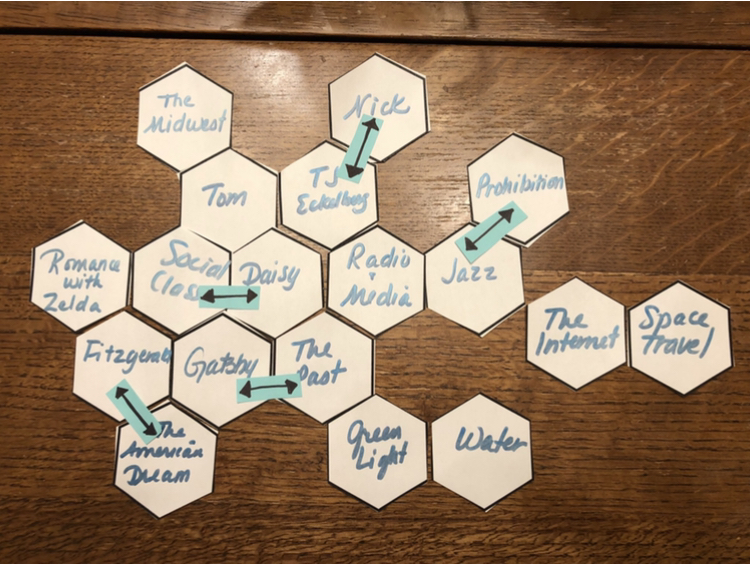
Hexagonal Thinking Web
This is a photo of the example I made for my students as a reference. This was the first time for my students to try hexagonal thinking.
The Great Gatsby by F. Scott Fitzgerald

As you can tell from the slideshow above, after students determined their categories, arranged and cut out their hexagons, and wrote their explanations for their connections, the assignment was a wrap!

Using Google Classroom, students submitted only two things to me:

  • the photo of their hexagonal web
  • a Google Doc that ran about two to three pages in length, which explained each of their five connections

Here’s what I like about hexagonal thinking:

Hexagonal thinking lets students do their own analytical thinking, weighing their options as they make connections between Tom Buchanan, for example, and the Rise of the City or the Valley of Ashes, as another example, and social class.

The categories and the connections students can make are endless, as long as they remember that their writing must defend, justify, or otherwise explain the five connections they made and labelled with arrows or connectors in the photo of their hexagonal web.

Student-made hexagonal thinking web
Some students had trouble uploading their photos to Google Classroom, so I took a quick pic of their he

Hexagonal thinking was something new for my students to mentally muddle through, and I must admit, I think it presented a challenge for several simply because they seem to be so accustomed to standardized and/or objective testing as a cumulative activity.

Hexagonal thinking web

As for my students, most of them experienced success with this project.

True, I did witness some students who explained their ideas and connections in a minimal way, and their initial grade suffered. However, I decided to highlight or otherwise make notations on their Google Docs (I had printed their papers out to avoid screen time) those areas where they needed to better clarify their thinking. Then, I allowed time in class to revise and edit their writing to improve their score. I felt that was only fair on this new assessment method.

In the end, my first attempt with hexagonal thinking was a winner. It gave me enough success to definitely use hexagonal thinking again.

Marilyn Yung

Thanks for reading again this week!

Have you tried hexagonal thinking yet? Leave a comment below this post or use my my Contact page to let me know your experience with this innovative, student-driven assessment method.

Have a great week!

Become a follower, subscribe, or sign up to receive a Treasured Object poetry printable handout you can use with your students tomorrow!


Need a new poetry idea?

Enter your email below and I’ll send you this PDF file that will teach your students to write Treasured Object Poems, one of my favorite poem activities. I know your students will enjoy it!

Image shows readers the paper I'll send for signing up for my email list. The handout gives instructions for a Treasured Object poem.
Treasured Object Poems

Processing…
Success! You're on the list.

Looking for something specific?


ELA Brave and True


Featured Photo Credit: Megan Bucknall on Unsplash

The Sonnet for High School (part 1)

The power of repetition in Terrance Hayes’ “Sonnet”

If you’ve ever worked with students and sonnets, you know how difficult writing a sonnet can be. In a word, it’s complicated. In fact, these little box-shaped poems offer all kinds of challenges for young writers (and their teachers–ha!).

For example, when my British Literature students study sonnets in January of every year, we try our hands at using the “rules” below. Traditional sonnets should exhibit:

  • A single theme on love, companionship, or friendship
  • A rhyme scheme, based on which style you choose
  • Fourteen lines (And if we really get specific, we’ll go even deeper. Petrarchan sonnets, a.k.a. Italian sonnets, will contain one octave plus one sestet; Shakespearean or Spenserian sonnets will contain three quatrains plus one rhyming couplet… see what I mean by complicated?)
  • Iambic pentameter
  • A volta and/or closure (a question or “turn” at  lines 8-9 or in the couplet)
  • Summon Your Inner Sonneteer with this traditional sonnet assignment sheet.

As you know, all those requirements can make the sonnet a real turn-off for students. I mean, we all know that a sonnet is one of the most widely-known poetic forms; however, when it comes to writing one, all the requirements suck the fun right out of what could be a satisfying endeavor.

Even so, my poetry class heartily took on the challenge of the sonnet recently. And while they grappled with the form, they performed well with it. Many of them wrote skilled sonnets that ticked all the boxes. However, just so you know, I did relax some of the requirements. For instance, I made the rhyme scheme optional. On the other hand, I did ask that they adhere to iambic pentameter. I figured it was more important to attempt the meter over struggling to force the rhyme.

The result? In short, I was impressed (as usual) with the sonnets my students wrote. Of course, they seemed surprised that the sonnet presented such a challenge. And a few found the form too cumbersome to complete to their liking.

Despite their relative success, though, most were ready to leave the sonnet behind and venture toward more free verse poetic waters.

But then I read an article about poet Terrance Hayes.

Terrance Hayes | Photo Credit: Georgia Popplewell

The article, titled “Voluntary Imprisonment” and written by Stephanie Burt for Slate.com, highlights Terrance Hayes’ work with the sonnet form as revealed in his 2018 collection, American Sonnets for My Past and Future Assassin.

If you’re unfamiliar with Hayes (as I was), he is a 2014 recipient of a MacArthur Fellow and is currently a Professor of English at New York University.

This video from the MacArthur Foundation offers a quick introduction to the poet:

With his recent works, Hayes has transformed the notion of what constitutes a sonnet. I thought that was an interesting idea.

In her article, Burt clarifies this:

“If you know what a sonnet is—14 lines, usually, 10 syllables each; rhymed, usually; divided into two parts, or else four, with a couplet—you probably also know that they’re centuries old. But you may not know how thoroughly modern poets have reinvented the form. And no living American poet has done so more assiduously than Terrance Hayes, whose 2018 book American Sonnets for My Past and Future Assassin amounts to a primer on how to reshape an old form.”

Stephanie Burt in Voluntary imprisonment on slate.com

Burt discussed more points about Hayes’ work, including something I found really intriguing: his poem “Sonnet” from his 2008 collection called “Hip Logic.” What was so intriguing about “Sonnet”?

Get this: it’s fourteen identical lines.

PITTSBURGH-September 8: Poet Terrance Hayes at his home in Pittsburgh, Pennsylvania on September 8, 2014, shortly after being named a MacArthur Foundation Fellow for 2014.

Yes, that seems a little odd… to take repetition to such an extreme degree. But then, I wondered, After their initial experiences writing traditional sonnets, what would happen if my students wrote their own versions of Hayes’ repetition-heavy sonnet? Wouldn’t that possibly spark new understandings about poetry in general, and repetition in particular?

Here’s what Hayes’ poem looks like on the page:

Sonnet by Terrance Hayes

We sliced the watermelon into smiles.

We sliced the watermelon into smiles.
We sliced the watermelon into smiles
.

We sliced the watermelon into smiles.

We sliced the watermelon into smiles.

Hayes’ “Sonnet” recalls Paul Lawrence Dunbar’s “We wear the mask that grins and lies,” writes Burt. | Credit: The African-American Experience in Ohio, 1850-1920, Public domain, via Wikimedia Commons

As to Hayes’ “Sonnet,” Burt writes, “Hayes’s fourteen iterations play on racist stereotypes that associate rural black Americans with watermelon and fixed grins, and on the assumption that all sonnets say or mean the same thing.”

In other words, sonnets aren’t just for lovers anymore. With “Sonnet,” Hayes makes that very clear. And that’s an easy one for students to nix as well. Contemporary sonnets can literally be about anything.

As for all that repetition and its effects…

I love how Hayes takes the centuries-old sonnet form and uses extreme repetition to turn it on its head… all to expose stereotypes, racial and otherwise.

Here are some questions that I snagged on as I considered Hayes’ use of repetition in “Sonnet”:

  • What happens when we repeat?
  • When we repeat fourteen times?
  • Does it minimize meaning?
  • Does it emphasize meaning?
  • Does it otherwise distort meaning and how exactly does it distort?
  • When does repetition distract from meaning?
  • When does it inform meaning?
  • Does fashioning a sonnet whose message, effect, and power rest on the repetition of a stereotype work to reinforce the stereotype, causing the reader to feel and experience its absurdity and dishonesty?
  • Or does the repetition of a stereotype work to destroy the stereotype?

So many questions that the mere act of repetition can spark!

All these lingering questions about repetition and stereotyping begged for exploration. My poetry students would go for this, I thought. And I was right. I gave them the following guidelines for writing a Terrance Hayes-inspired “stereotype sonnet”:

  1. Write a contemporary sonnet on any topic. 
  2. Your sonnet should resemble Terrance Hayes’ “Sonnet”, i.e. your sonnet should be one line that is repeated fourteen times.
  3. Write a line that plays on a stereotype of some sort and then repeat it fourteen times.
  4. Each line should be in iambic pentameter (five pairs of two syllables). Take time to come up with an interesting line that is meaningful to you.
  5. Plan to present these in class so we can gauge the effect of the repetition and how it affects meaning.

I asked students to drop their stereotype sonnets into a shared Google Slides presentation, and then I waited for the magic to happen.

My poetry students always dive right into whatever idea or project I come up with. And predictably, their efforts did not disappoint.

Check back next week for the conclusion of this post, which will include some of the contemporary stereotype sonnets created by my students.

Thanks for reading! Don’t you love it when you discover a poem that just begs for your students to dabble with? In fact, just this morning I found another one, “When I Was Six” by Aimee Nezhukumatathil. I’ll share more in an upcoming post. Please become a follower or subscribe below to catch that post as well.

Have a great week!


Need a new poetry idea?

Enter your email below and I’ll send you this PDF file that will teach your students to write Treasured Object Poems, one of my favorite poem activities. I know your students will enjoy it!

Image shows readers the paper I'll send for signing up for my email list. The handout gives instructions for a Treasured Object poem.
Treasured Object Poems

Processing…
Success! You're on the list.

Looking for something specific?

ELA Brave and True


Featured Photo: Poet Terrance Hayes (Photo Credit: © John D. and Catherine T. MacArthur Foundation. Used with permission.)

Creative high school poetry idea: Poetic Art

Merge objects and verse for a new poetry activity

If you need a fresh and fun poetry idea, try “Poetic Art.”

This is an unexpected idea inspired by a post I saw in a Facebook teachers’ group credited to the Free Verse Project from the Academy of American Poets. Even though the links at the poetry site no longer connect, I’ve provided as much as possible below to get you started.

If you want to give your high school students a new angle on poetry that allows them some hands-on and screen-free time, this might be a good activity to try. It’s rather self-explanatory, but I’ve outlined some tips below.

Here are the basic directions for Poetic Art:

  • Find a published poem with a line or lines that appeal to you.
  • Recreate the line in a creative way using objects and text.
  • The lines cannot be written or typed on paper. Instead, use the poem’s content to determine the materials you use.
  • Photoshopping not allowed.
  • Think outside the obvious. Get creative!
  • Photograph your composition and display.

Using a line from Robert Frost’s “Mending Wall,” I created the example at the top of this post for my students. I literally made it on my desk one afternoon using pine needles from the front yard of our school, some black construction paper, and a couple of apples. Instead of a “O” made of a needle, I opted to go with a round piece of bark instead.

Poetic Art example for the poem, “The Love Song of J. Alfred Prufrock” by T.S. Eliot

Here’s another excellent example courtesy of the internet gods. (Honestly, I can’t determine the photographer or creator, but I’m including it here anyway as inspiration.)

Armed with a few example, my poetry students followed suit by creating their own versions of Poetic Art. Three of their creations follow below.

Enjoy!

poetic art
Notice how this student used her hat in place of the word “hat.” Poetic Art by Ashley C. | “I Want My Hat Back” by Jon Klassen
poetic art
Poetic Art by Eva A. | from “Ode to Red Lipstick” by Megan Falley
poetic art
Poetic Art by Summer M. | from “A Red, Red Rose” by Robert Burns
Marilyn Yung

Since this is National Poetry Month, I thought I’d pass along to you this easy poetry activity. If you decide to try it, let me know how it goes!

Also, check out this post for more interesting poem ideas!

Need a new poetry idea?

Enter your email below and I’ll send you this PDF file that will teach your students to write Treasured Object Poems, one of my favorite poem activities. I know your students will enjoy it!

Image shows readers the paper I'll send for signing up for my email list. The handout gives instructions for a Treasured Object poem.
Treasured Object Poems

Processing…
Success! You're on the list.

Looking for something specific?

ELA Brave and True


Featured Photo: M. Yung Poetic Art

Leaves of Grass Text Pairing

“Weaves of Grass” links Whitman to Native American cultures

If you need a non-fiction text to pair with Walt Whitman’s Leaves of Grass and/or his epic poem Song of Myself, you may want to check out the February 2022 issue of Alaska magazine. Inside you’ll find “Weaves of Grass” by outdoor writer Michael Engelhard. The piece can be found online by the title, “The Art and Utility of Grass Baskets.”

I came across this article while — no kidding — waiting for my dentist appointment about a month ago. I noticed its catchy print title and since I was in the middle of planning new lessons for an upcoming unit on Walt Whitman, I snagged it and started reading.

In a word, this article is fascinating.

The article artistically connects historic and current day native Alaskan cultural traditions to Whitman’s poetry. Engelhard uses allusions to Song of Myself to showcase the craft of weaving with native grasses. The article examines the fiber traditions, still practiced by local artisans such as craftswoman Kathy Ward, to create baskets, buckets, clothing, masks, mats, baby carriers, windbreaks, and other items.

Watch for the lines of the article’s text printed in italic font. This is where Engelhard incorporates phrases and lines from Song of Myself, Whitman’s epic poem, into the narrative.

(Download a PDF of the article from Engelhard’s website here.)

In fact, it’s interesting to see how Engelhard’s allusions to Whitman recall the many allusions to grasses Whitman sprinkles throughout Song of Myself. And what is it with the grasses?

It seems that Whitman chose grass, a ubiquitous element of nature to convey universal notions about humanity in general and Americans in particular, both native and white.

For example, according to The University of Iowa Graduate College’s Whitman Web International Writing Program, “grass is itself a child, always emerging anew from the realm of death into a new life; it is a kind of coded writing that seems to speak equality since it grows among the rich and poor, among black and white. But it is primarily the sign of life emerging from death, and the poet imagines himself walking over graves and imagining the grass as the transformed life of those buried beneath him.” In others words, Whitman’s ideas are true to his transcendental self where nature, in all its energy, is intimate to the human experience.

Six Song of Myself allusions are sprinkled throughout the article

Engelhard quotes Song of Myself using verses 31, 3, 6, 1, 17, 5, 7 in that order. Here’s the first example from the article that begins by describing the craft of Attuan tribespeople way out west on Nunivak Island. Here’s a sample:

“Crowding over 1,000 stitches onto each square inch, the westernmost island’s Attuans fashioned marvels out of Walt Whitman’s hopeful green stuff. He thought a single leaf spear no less than the journey-work of the stars. Native Alaskan straw wares, then, must be cosmic masterpieces.

Weaves of Grass by Michael Engelhard

It’s a captivating article, but I’ll let you read the rest to see if it’s a piece that’s appropriate for your Whitman lesson plans. And as for expository writing skills, if you’ve ever had a hard time showing students how to seamlessly incorporate an author’s quote into their writing, “Weaves of Grass” does it seamlessly six times. For that skill alone, you may want to download Engelhard’s article.

I enjoy finding contemporary articles and such that link to canonical texts. And while poets like Whitman may be out of fashion in some circles, we should know that Whitman did include Native Americans in his work, often using the language of the era. According to J.R. LeMaster and Donald D. Kummings, editors of Walt Whitman: An Encyclopedia, excerpted here on The Walt Whitman Archive, “Whitman was not unaffected by Native American life and events. While his own experience with Native Americans was limited, it was not insubstantial. He encountered American Indians as a boy on Long Island and as a young editor in New Orleans. He admired Indian troops who fought in the Civil War, and he was the only major American poet to work in the Indian Bureau of the Department of the Interior (1865).”

Walt Whitman’s words and ideas continue to honor diverse voices. Thanks for reading!


Need a new poetry idea?

Enter your email below and I’ll send you this PDF file that will teach your students to write Treasured Object Poems, one of my favorite poem activities. I know your students will enjoy it!

Image shows readers the paper I'll send for signing up for my email list. The handout gives instructions for a Treasured Object poem.
Treasured Object Poems

Processing…
Success! You're on the list.

Looking for something specific?

ELA Brave and True


Featured Photo Credit: Alaska Region U.S. Fish & Wildlife Service from Anchorage, United States, Public domain, via Wikimedia Commons

Into the Wild Text Pairing

Bear Meat by Primo Levi

If you’re needing a text to pair with Into the Wild by Jon Krakauer, may I suggest “Bear Meat”, a short story by Primo Levi, the Italian chemist, writer, Holocaust survivor.

Primo Levi | Creative Commons Wikimedia

“Bear Meat” is a story about young men who take to the mountains for adventure and danger. They become stranded, disoriented on a mountainside, and eventually spend the night on a frozen lake. At one point, the friends must sit on their frozen boots “as if we were hatching eggs” just to survive the night.

Find the short story here in the January 1, 2007 issue of The New Yorker.

This particular story is quoted by the character of Chris McCandless in Into the Wild, the excellent 2007 film based on the book of the same title by Jon Krakauer, author of Into Thin Air. The book and movie tell the story of Chris McCandless, a successful college student who took to the road after graduating from Emory University in 1990. He travelled throughout the American West and Midwest on a personal quest to eventually arrive in Alaska to live alone off the land. He eventually perished in August 1992 due to malnutrition and food poisoning.

McCandless’ redemptive story, where he learns that “happiness is only real when shared”, has struck a chord with readers across age groups and demographics.

McCandless was essentially a modern-day Henry David Thoreau. Krakauer’s account and the film directed by Sean Penn include myriad references and allusions to the literary works that informed McCandless’ life.

The short story is quoted in the movie (but not in the book). When McCandless braves the surf to mend a rift between his new friends Jan and Rainey, these beautiful lines from “Bear Meat” accompany the scene:

“…the sea’s only gifts are harsh blows and, occasionally, the chance to feel strong. Now, I don’t know much about the sea, but I do know that that’s the way it is here. And I also know how important it is in life not necessarily to be strong but to feel strong, to measure yourself at least once, to find yourself at least once in the most ancient of human conditions, facing blind, deaf stone alone, with nothing to help you but your own hands and your own head…”

into the wild

I’ll let you read the story to learn the meaning of bear meat, but it’s an uplifting story that causes one to understand the value of new experiences and accepting challenges.

I hope this helps you round out your Into the Wild unit or even gives you another idea of something to read for an upcoming First Chapter Friday.

“Bear Meat” may take some annotating, some explanation, some re-reading, to get the most out of the story. I love the first sentence: “Evenings spent in a mountain hut are among the most sublime and intense that life holds.” Happy reading!


Need a new poetry idea?

Enter your email below and I’ll send you this PDF file that will teach your students to write Treasured Object Poems, one of my favorite poem activities. I know your students will enjoy it!

Image shows readers the paper I'll send for signing up for my email list. The handout gives instructions for a Treasured Object poem.
Treasured Object Poems

Processing…
Success! You're on the list.

Looking for something specific?


ELA Brave and True


Featured Photo by Becca on Unsplash

Enthusiasm in the high school classroom

The power of positive thinking

I can’t tell you how many times students enter my room and say something like “I’m SO tired,” or “Man, I’m exhausted,” or “Mrs. Yung, I’m gonna sleep in class today because I CANNOT keep my eyes open.” This happens not just during my 8 a.m. first hour class, but all day long. I bet I hear someone tell me they’re SO TIRED about nine or ten times a day. And you know what? I’m done with it. I think telling others and ourselves how tired we are all the time is simply a bad habit.

In fact, y’know what I’m tired of? Hearing how tired my students are.

Don’t I care about them? Of course I care. I feel bad that they feel tired and worn out. After all, I know how that feels. But here’s the thing: we can’t do anything about it while we’re at school. I still have something to teach and they still have something to learn. It benefits no one to remind ourselves out loud how tired we are.

Instead, I need to show students how to fight fatigue with the power of positive thinking.

This will totally reveal my age, but I remember the Protestant pastor and author Norman Vincent Peale back in the 1970s and 1980s.

He wrote a book called The Power of Positive Thinking and I remember skimming through a copy my mom had checked out from the public library. Peale also founded a Christian magazine called Guideposts that focused on wellness through inspirational content. My mother subscribed to Guideposts and I read those magazines, too.

As a basic tool for daily life, Peale’s message has its merits and between reading The Power of Positive Thinking and a few issues of Guideposts, I absorbed the minister’s ideas about the power of positive thinking.

Here’s the gist of what I absorbed from Peale in my formative years: If we allow our minds to dwell on positive messages and thoughts, we feel better. We gain energy. We gain optimism and peace.

It is definitely something I’ve ingrained into my being as I have grown older. My students will rarely hear me complaining about how tired I am. I literally don’t allow myself to do that.

Now, this is not to say that we shouldn’t listen to our bodies.

No, of course, if we are indeed tired and exhausted, then we should decide if our schedule or daily routines need to be adjusted to better align our internal clocks and increase our energy levels.

Disclaimer: Some readers may take exception to my advocacy for Peale’s positive thinking claims. For example, Tim Challies, author of The False Teachers: Norman Vincent Peale, labels Peale’s ideas that “all that stands between us and our desires is properly controlling our thoughts” as being too simplistic. And I can see how Peale’s ideas may seem flippant, i.e. if we just think happy thoughts everything will be okay. However, I also know how helpful the power of positive thinking is for me as I navigate through each busy school day.

And, to be sure, many high school students have hectic lives that include after-school jobs and family responsibilities. I know that several of my own students work late… 11 p.m., midnight, and even later! In addition, many aren’t earning money for non-essentials; most kids I know are working for serious concerns, such as money for college or gas money for driving to the vo-tech college fifteen miles away.

So I get it. Sometimes we have to work and no matter how hard we try, we are honestly tired.

Students laughing on a sunny day

However, let’s not talk about it when we can’t do something about it. By all means, a tired, worn-out student should seek out the counselor, talk to me, or visit with a parent or friend. After all, the priority should be to make a plan to prevent exhaustion and fatigue.

But walking around in class voicing our exhaustion is not going to help anyone. In other words, students and teachers shouldn’t give our fatigue the power to dominate our minds and our classes… even if we stayed up too late, worked past midnight, or overslept through three alarms and such.

Instead, let’s summon what energy we can. Let’s not dwell on our fatigue. Let’s get on with learning.

Here are seven super-easy tips to fight fatigue and increase the energy level in your classroom:

  1. Drink enough liquids, but avoid energy drinks that increase your energy only temporarily. Also try a carbonated water drink. Sometimes just the fizziness will perk you up.
  2. Get students moving. With a lengthy or more difficult text, I sometimes have students read it in sections, and then have students move to a different seat after each section. Another idea: “Take a Line for a Walk” to respond to a reading passage with some low-stakes writing.
  3. Have a piece of hard candy. It will last longer than a cookie or candy bar-type snack.
  4. Play some uplifting instrumental music. I quietly play a soft “Jazz in the Background” playlist on Spotify during all my classes. It’s a cross between energetic and relaxing, but it’s definitely uplifting.
  5. Chew gum. Sounds really simply, but it’s an instant “waker-upper.”
  6. Infuse your room with fragrance. Use an essential oil diffuser to make your room smell clean, fresh, and energizing. Peppermint oil is my favorite. Make sure to ask about any students who may be allergic to essential oils.
  7. Perk up with an energizing herbal hand cream. Inhale after you smooth it in! I keep a stash on my desk for students to use.

One last tip: teach what you love

For myself, I try to plan something for class that I am really excited to share with students: a poem that speaks to me, a fascinating essay that I discovered (such as “Our Capacity for Wonder” by John Green), or a few awesome paragraphs from a favorite book (First Chapter Fridays is a good way to do this!). If I’m excited with what I have to share with students, then it naturally energizes me and that energy spreads to students.

Marilyn Yung

In conclusion, encourage students not to dwell on their fatigue so that it dominates their day. Encourage them to ban, “I’m so tired!” from their conversations.

Instead, encourage them to reap the benefits of positive thinking in order to energize their days — and in turn, yours, too.

Have a great week!


Need a new poetry idea?

Enter your email below and I’ll send you this PDF file that will teach your students to write Treasured Object Poems, one of my favorite poem activities. I know your students will enjoy it!

Image shows readers the paper I'll send for signing up for my email list. The handout gives instructions for a Treasured Object poem.
Treasured Object Poems

Processing…
Success! You're on the list.

Looking for something specific?


ELA Brave and True


Gatsby Text Pairing: John Green’s “Our Capacity for Wonder”

Revel in Green’s Gatsby-filled essay in The Anthropocene Reviewed

If Fitzgerald’s The Great Gatsby is your favorite novel to teach, here’s an essay you need to either read or listen to. Titled “Our Capacity for Wonder,” it’s a beautiful five-page reflection on Gatsby, its critique of The American Dream, and how the novel considers and celebrates man’s capacity for wonder.

By initially focusing on one of the most memorable sentences of chapter 12 in The Great Gatsby, Green connects the capacity for wonder, held by Fitzgerald’s Dutch sailors at their first sighting of New York, to his own capacity for wonder as sparked by a simple observation made by his two-year-old son, Henry.

That sentence from the novel, as you well know, is…

“For a transitory enchanted moment, man must have held his breath in the presence of this continent, compelled into an aesthetic contemplation he neither understood nor desired, face to face for the last time in history with something commensurate to his capacity for wonder.”

F. Scott Fitzgerald, The Great Gatsby, Chapter 12

I won’t spoil this Gatsby-focused essay for you, but it’s classic John Green and it’s straight out of his 2021 book, The Anthropocene Reviewed: Essays on a Human-Centered Planet, an assemblage of essays from the WNYC Studios podcast of the same name. (By the way, “anthropocene” refers to the world’s current geologic age and in this book, Green reviews and rates on a five-star scale the topics of each chapter, which, in addition to Our Capacity for Wonder, also include Diet Dr Pepper, the QWERTY Keyboard, Sunsets, Canada Geese and about forty others. He gives man’s capacity for wonder three and a half stars.)

“Our Capacity for Wonder” is a poignant, smart, and meandering mental stroll rich with acute observations and a whopper of a warm fuzzy at the end to bring the stroll to a satisfying conclusion.

Only Green could write an essay that weaves together the following:

Best-selling author John Green
John Green; Hank Green, CC BY 3.0 https://creativecommons.org/licenses/by/3.0, via Wikimedia Commons
  • The Dutch sailors passage Green calls “a hell of a sentence”
  • The initial slow sales of The Great Gatsby and how the U.S. Army played a part in increased readership
  • The novel’s American Dream theme and the confusion that often arises around that theme
  • Fitzgerald’s silky smooth sentences
  • The bias and inaccuracies revealed in the “transitory enchanted moment” passage
  • The exhausting ironies and inaccuracies the novel presents overall, and finally…
  • A story about a walk in the woods and an oak leaf

And that’s the wonder of this essay: Green makes Gatsby personal. @TheAnthropoceneReviewed #gatsby

Those beautiful imagery-filled sentences aren’t just part of an old book from the Jazz Age. They demonstrate the timelessness of Fitzgerald’s ideas. Whether man’s capacity for wonder is recorded in 1925 or 2021, great literature lives within us and whispers to us through our personal experiences.

I’ve needed a book like this for a while. Writing essays is such a dominant activity in my classroom and finding interesting and arresting ones to read takes a lot of time. It’s awesome that there are so many in this collection and, even though I haven’t read them all yet, they’ve all been compelling.

In addition, having a resource like this gives me ideas for other ways to incorporate this book into my classroom routine.

Other Ways to Use This Essay

  1. As an Essay of the Week

“Our Capacity for Wonder” and other essays in The Anthropocene Reviewed would be good candidates for Essay of the Week (EOTW) assignments as discussed on educator Matthew Johnson’s website. Similar to Kelley Gallagher’s Article of the Week assignments, Johnson’s EOTW assignments are “built around the idea that for students to write better, deeper, and more lively essays, they need to have regular exposure to the essay form in its many shapes and styles.” Read Johnson’s in-depth post here about EOTW assignments.

2. As a Mentor Text

I’m thinking of joining students in making a retroactive outline of one of Green’s essays, and then using the outline and the essay to inspire an exploration of our own chosen topics. It will be good to see on the whiteboard how Green employs historical information, narrative, and speculation into a thoughtful essay… and how he employs transitions, repetition, and other techniques to arrive at satisfying conclusions.


Marilyn Yung

Thanks for reading! I’m still reading and listening my way through The Anthropocene Reviewed.

As I make my way through the rest of the collection, I’ll fill you in on what I learn, glean, and take-away.

Have a great week!


Need a new poetry idea?

Enter your email below and I’ll send you this PDF file that will teach your students to write Treasured Object Poems, one of my favorite poem activities. I know your students will enjoy it!

Image shows readers the paper I'll send for signing up for my email list. The handout gives instructions for a Treasured Object poem.
Treasured Object Poems

Processing…
Success! You're on the list.

Looking for something specific?


ELA Brave and True