If you’re not familiar with the DAR, here’s a brief intro from the organization’s website: “The DAR, founded in 1890 and headquartered in Washington, D.C., is a non-profit, non-political volunteer women’s service organization dedicated to promoting patriotism, preserving American history, and securing America’s future through better education for children.”
My students have had great success with the DAR Patriots of the American Revolution Essay Contest. Within the last three years, two of my students have written essays that won at both the local and state level, where monetary prizes were awarded. Needless to say, I’m very proud of those students!
This year’s 2022-2023 contest guidelines sheet details the topic, length (800-1,200 for 6-8 grades), format, and bibliography details. (Note: Each DAR chapter designates their own individual due dates. Check with your local chapter by locating it here on the national DAR website’s chapter locater.)
Here’s the high school essay prompt:
“Select a figure from the era of the American Revolution (1773-1783). Discuss how he or she influenced the course of the American Revolution, who he or she was and his/her contribution to the founding of a new nation. Your figure may be any person, whether a well-known figure or an everyday man, woman or child who supported the American Revolution in ways large or small.”
With that prompt in mind, here’s my advice to your students:
Choose a lesser known patriot. Go beyond the founding fathers to find and write about a patriot whom the judges won’t be as familiar with. My student who won at state last year, for example, wrote about the patriot Nancy Hart.
Download the contest guidelines by clicking the button below:
Tell your students to get creative and go beyond the traditional informative essay. Blend genres, combining, for example, a journal entry with a biographical piece.
I encourage you to try the DAR Patriots of the American Revolution High School Contest with your high school students. It was a mainstay in my classes.
Thanks for reading!
Have you ever tried a DAR contest? Leave a comment below or send me a message via my Contact Page. If you need more info, please ask. I’ll be glad to help you however I can.
I thoroughly believe that writing contests can infuse ELA with relevance and a dash of project-based learning. Whenever students know their words will enter “the real world” and be reviewed by real people, it makes them take the work more seriously.
Need a new poetry idea?
Enter your email below and I’ll send you this PDF file that will teach your students to write Treasured Object Poems, one of my favorite poem activities. I know your students will enjoy it!
Treasured Object Poems
Processing…
Success! You're on the list.
Whoops! There was an error and we couldn't process your subscription. Please reload the page and try again.
Consider The Green Knight: a new movie for British Lit
When you’re teaching a new class, you just can’t do it all. You ease into the new routine, the new texts, the new lesson plans, and activities. For example, even though I taught British Literature to high school seniors for three years, I never taught “Sir Gawain and the Green Knight” (SGGK).
British Library, CC0, via Wikimedia Commons
During my first year, I bit off a considerable chunk, dove in, and taught as many stories, poems, and plays as I was able. During my second year, I added a few more. During my third year, I added still more. However, for some reason, “Sir Gawain and the Green Knight”, didn’t make my cut. Here’s why: I was already teaching Arthurian lore with Le Morte d’Arthur and that, in my mind, was all the questing, sword-fighting, and lady-wooing we could squeeze into the schedule.
However, about two months ago I watched the 2021 film The Green Knight starring Dev Patel (purchased and streamed on Amazon Prime for only $4.99!). It’s an exquisite interpretation of the familiar-yet-idiosyncratic knightly tale. In short, I’ve changed my mind about SGGK. If I were still teaching high school, SGGK would definitely be in my mix. When a quality film exists to readily guide students into a text, it should tip the scale in that text’s favor.
Dev Patel plays Sir Gawain in The Green Knight. | Photo: Triplexace, CC BY-SA 4.0 via Wikimedia Commons
Students today thrive on the visual, and if a film provides connection or a way into a text, so be it. After all, there aren’t enough contemporary films to include in a Brit Lit course as it is. When I find one of quality, I do what I can to include it.
The Green Knight, directed by David Lowery and starring Dev Patel, has the potential to do the same for SGGK.
Notice I said it “has the potential”
I say The Green Knight has the potential because I know it can make the anonymously written poem come alive for students. For example, Patel is a talented and popular actor. The Green Knight is terrifying and reasonable, for a tree-man, that is. Last, a theme of honor, some expected violence, and scenes of curious dialogue between Gawain and key characters contrast well with the language of the poem… all while supporting the original narrative. All these elements shed new light on Gawain’s journey to his destiny.
However, I also know the film has the potential to steer us off course. There are glaring additions, strange inconsistencies, odd implications, and one extremely off-putting and vulgar detail that you’ll want to avoid. (A blog post in the near future will include a guide of when not to watch.)
Generally speaking, though, I believe that the film adheres to the original poem well enough. In short, The Green Knight film deserves a close look. Listen to this podcast episode: Sir Gawain and the Decent Film as an additional resource.
With that in mind, I’ve assembled a list of resources to peruse as you make your decision as to whether the film would be useful for your classes. Rest assured, I’ll be re-watching the film yet again to determine those parts teachers will find most and least useful for their classes. After all, The Green Knight runs two hours and ten minutes, slightly more than my own self-imposed two-hour limit.
In this review, Katy Waldman tackles the narrative accuracy of the movie to the 14th-century text, and she rightly concludes the film downplays Gawain’s inherent gallantry in favor of more modern themes of personal authenticity and “finding one’s self”.
2. Dappled Things, a website dedicated to Catholic art and literature, offers this review:
While conceding that the movie is a good example of how the meanings of old texts can shift over time to reach new audiences, contributor L. C. Ricardo discusses many aspects of the film that were added by the director, including a talking fox, walking giants, and a Green Knight who is not also Sir Bertilak. Ricardo also makes note of the film’s secularization. There is virtually no mention of Christian values, even though the film keeps the Christmas-time setting of the poem.
3. Download this summary and student learning guide from open publisher PressBooks:
Access this summary for student use or to supplement your existing textbook. This webpage provides an easy-to-digest breakdown of the poem in its three acts, a character analysis of Sir Gawain, a brief theme discussion, and study questions.
Read toward the end of this review for how writer Peter Bradshaw discusses the significance of the color green as expressed by the lady of Lord Bertilak, who invites Gawain to stay at his castle midway to his destiny with the Green Knight at the Green Chapel. Does green symbolize the power of nature? The power of immaturity? The power of life itself? Bradshaw writes that green is the color of “the grass that will grow out of the grave and the moss that will cover the tomb, the endless process that will make a mockery of individual heroes and their paths of glory.” To use the poem to discuss symbolism, definitely skim this article first.
Writer Yohana Desta speculates in this related article about the film’s inclusion of St. Winifred of Wales, who was memorialized in the 1500s with a religious site featuring a well with healing powers… healing powers that reattached her decapitated head after her murder by an evil Prince Caradog. It’s basically an interesting mention in the film based on a legend that has lured pilgrimages through the centuries. It’s a curious inclusion in the film, and your students will have questions!
Malgosia Turzanka, the film’s costume designer, won rave reviews. This article includes interesting drawings and discussion about connections between costuming and the narrative’s philosophical themes. From colors to materials to embroidery patterns, students will be intrigued by the creative decisions made to interpret the poem for the silver screen.
Thanks for reading!
Investigate The Green Knight to see if it may be useful in your British Lit classes. It’s rare to find contemporary films to link the current day to the foundational texts of western culture. When one comes along, we should spend some time with it. While I would hesitate to show the entire movie, I suggest watching key parts with the text in-hand.
I’m working on creating a movie guide for The Green Knight. Keep in touch to learn more about that resource by becoming a follower or subscribing by leaving your email below. I’ll send you a Treasured Object Poem handout in return.
Leave a comment below in the comment or on my Contact Page. Have a great week!
Need a new poetry idea?
Enter your email below and I’ll send you this PDF file that will teach your students to write Treasured Object Poems, one of my favorite poem activities. I know your students will enjoy it!
Treasured Object Poems
Processing…
Success! You're on the list.
Whoops! There was an error and we couldn't process your subscription. Please reload the page and try again.
If you’re not familiar with the DAR, here’s a brief intro from the organization’s website: “The DAR, founded in 1890 and headquartered in Washington, D.C., is a non-profit, non-political volunteer women’s service organization dedicated to promoting patriotism, preserving American history, and securing America’s future through better education for children.”
Former student Charlie M. and I at the annual Missouri State DAR Conference in Kansas City, Mo. Charlie won at local, state, and division levels in 2017.
My students have had great success with the DAR American History Essay Contest. Within five years, eight sixth- through eighth-grade former students won at the local level. Of those, two essays placed first at the state level. One of those also won at the division level (comprised of eight states), and then competed at the national level. Recognition and prizes are determined by each local DAR chapter. In fact, my local chapter provided an annual luncheon where the local winners would be celebrated. In addition, the chapter awarded certificates and pins for winners, and certificates for all entrants. At the state and higher levels, monetary awards are distributed.
My students benefited from the emphasis placed on the contest. First, entering the contest was an assignment. I didn’t want only the advanced students to compete, as usually happens when I make a contest voluntary. I wanted everyone to see that I had confidence in their abilities and that they had a real opportunity to win.
I always made a big deal out of the annual contest. I would decorate my room around the theme, hanging posters and decorations to fit the topics. For example, for the year that Women’s Suffrage was the topic, I printed and hung vintage posters, created vignettes for notable women in the movement, and built my room around a color scheme of purple and yellow, the colors of the suffrage movement.
The best thing about this contest? The topic changes every year.
The topics for the contest, all based on a historical event, change from year to year. Past topics have included the National Parks system, Ellis Island, the effects of World War One, the Stamp Act, Women’s Suffrage, and others. (While the topic and prompt changes every year, the general rules and guidelines for the contests remain the same.)
This year’s topic follows:
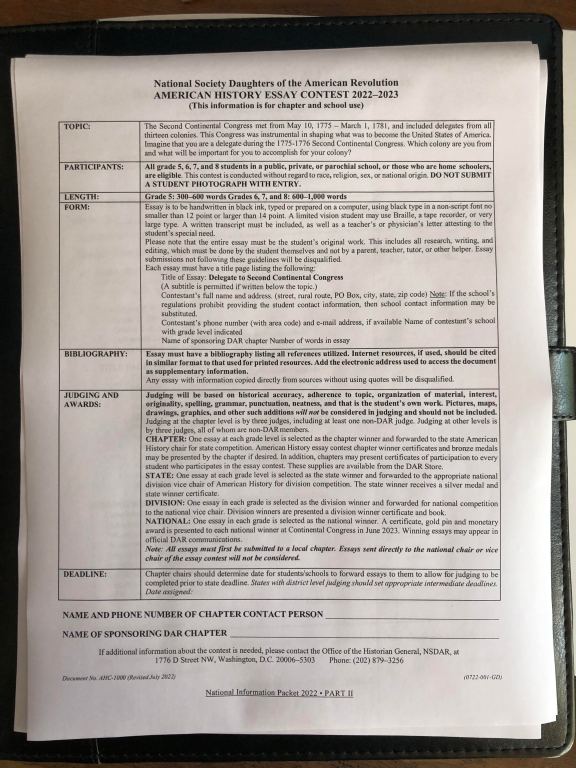
“The Second Continental Congress met from May 10, 1775 – March 1, 1781, and included delegates from thirteen colonies. This Congress was instrumental in shaping what was to become the United States of America. Imagine that you are a delegate during the 1775-1776 Second Continental Congress. Which colony are you from and what will be important for you to accomplish for your colony?”
As usual, the prompts encourage students to write a narrative-style essay. Let your students get creative.
Could they write the essay in the form of a letter?
A journal?
Or would a straight-forward answer to the question in the form of an informative piece be better to their liking?
This year’s prompt could even be written in the form of a persuasive essay, arguing for the passage of a particular piece of legislation unique to the chosen colony.
Download the contest guidelines by clicking below:
This year’s 2022-2023 contest guide sheet outlines the topic, length (600-1,000 for 6-8 grades), format, and bibliography details. (Note: Each DAR chapter designates their own individual due dates. Check with your local chapter by locating it here on the national DAR website’s chapter locater.)
Download this free flyer by clicking the download button above.
I encourage you to try the DAR American History Essay Contest with your fifth- through eighth-graders. It was a mainstay in my middle school classes, as well as the DAR’s high school contest (Patriots of the American Revolution). Check back next week for a post about the high school contest.
Over the years, I’ve developed some ideas to generate success with this contest. Here are those tips:
5 Tips to Help Your Students Succeed at the DAR American History Essay Contest:
Don’t skimp on prior knowledge. Getting kids invested in the contest depends on piquing their interest and building expertise on the topic. Because students are required to write 600-1,000 words on the topic, they need to be confident in the subject matter. In my previous middle school classroom, I would start around October 1 to plan ways to make my students familiar with the topic. I designed AOW assignments using articles that pertained to World War One, Women’s Suffrage, and other topics. We also watched educational videos and documentaries, and made short presentations about characters central to the theme.
Decorate your room. Make the contest an event! I would typically devote an entire room-length whiteboard to the contest. I located war posters, suffragette flyers, national park info, and more to make my room all about the essay topic. Some students even used these visuals to inspire authentic details for their essays.
Encourage students to blend genres. In my experience, I guided my eighth-grade students to take a narrative approach, and then fortify the narrative with informational exposition. This blended genre approach conveniently allowed me to introduce those multi-discourse skills at a relatively early time of the academic year. When testing time came around in the spring, students already had some experience with blended genre writing, thanks to this contest.
Don’t rush the writing process. Start early enough so students have time to brainstorm, draft, peer review, revise, and submit. From start to finish, the DAR contest would typically fill four to six weeks; however, I do know that in some years, we crammed it into three.
Thanks for reading!
Have you ever tried a DAR contest? Leave a comment below or send me a message via my Contact Page. If you need more info, please ask. I’ll be glad to help you however I can.
I thoroughly believe that writing contests can infuse ELA with relevance and a dash of project-based learning. Whenever students know their words will enter “the real world” and be reviewed by real people, it makes them take the work more seriously.
Need a new poetry idea?
Enter your email below and I’ll send you this PDF file that will teach your students to write Treasured Object Poems, one of my favorite poem activities. I know your students will enjoy it!
Treasured Object Poems
Processing…
Success! You're on the list.
Whoops! There was an error and we couldn't process your subscription. Please reload the page and try again.
It’s that time of year again for British Literature teachers. It’s time for Beowulf! Have you started your journey into Anglo-Saxon poetry? My usual early fall Anglo-Saxon routine culminates with a three-week unit on Beowulf followed by a short unit on The Hero’s Journey. I didn’t always enjoy teaching Beowulf. At first, honestly, it was excruciating. But over the next few years, I gained confidence, learned it was okay to not have all the answers, and have grown to enjoy the wonders of this text.
I mean, think about it. Beyond its monstrous, blood-thirsty heroic tale, this epic poem is a glimpse into the mind of a poet who lived nearly 1,300 years ago who, while living without running water, indoor plumbing, or electricity, understood how to craft chain mail armor, forge iron utensils, thrive on a barren plain, and survive at sea.
Seriously, how are we even here?!
If Beowulf amazes you and you can’t wait to start your unit (or whether it bores you to tears and you can’t wait to get it over with!), allow me to offer some ideas to enliven your Beowulf teaching.
Here are some links to my collection of blog posts on teaching Beowulf. I hope they spark your passion for this foundational text!
The Dark Ages discovery builds Beowulf engagement Need an awesome nonfiction text to enhance your Beowulf unit? Look no further! I have a resource for you that you really must check out. It’s titled “Revisiting Sutton Hoo, Britain’s Mythical Ship Burial.” Written by Sam Knight and published in The New Yorker (August 9, 2019), this…
Here’s another way to infuse relevance into Beowulf When you extend your Beowulf unit into a mini-unit on Joseph Campbell’s Hero’s Journey, three things will happen: 1) You’ll build excitement to read an Anglo-Saxon poem so old we don’t even know exactly when it was written or by whom. 2) You’ll open students’ eyes to…
The 1-hour and 52-minute movie is captivating, and builds suspense and excitement around the very culture awash in The Wanderer, The Seafarer, The Wife’s Lament, and Beowulf.
A great supplement to teaching the hero’s journey Have you discovered “The Hero’s Journey” podcast? Subtitled “Books & Films Through a Mythical Lens,” this is a fantastically interesting podcast I used in February to supplement my hero’s journey lessons. Use the monthly show to introduce students to Joseph Campbell’s hero’s journey in popular movies, some…
Thanks for reading! And feel free to click on through to the posts above for fresh ideas on how to connect Beowulf to contemporary life. Despite my initial reluctance to teach Beowulf, I have grown to love its monstrous blend of violence, heroism, defeat, and remembrance.
If you have any questions about the posts above, leave a message below or via my Contact page. I’ll be glad to help!
Enter your email below and I’ll send you this PDF file that will teach your students to write Treasured Object Poems, one of my favorite poem activities. I know your students will enjoy it!
Treasured Object Poems
Processing…
Success! You're on the list.
Whoops! There was an error and we couldn't process your subscription. Please reload the page and try again.
added dynamic, real-world relevance to my poetry class (PBL at its best!)
built student self-confidence
cultivated an appreciation for poetry in my school AND
developed my students’ public-speaking skills
Poetry Out Loud is simply one of the best things I’ve done in my eleven years of teaching.
Note: This year, to eliminate my former two-hour round-trip commute, I have begun teaching freshman-level writing courses at a local college, and since POL serves high school students only, I won’t be participating. However, since I’m a huge fan of this program and the slew of benefits it provides to students, I wholeheartedly encourage you to give Poetry Out Loud a try!
Here’s the gist of Poetry Out Loud
Students memorize and recite three poems from the POL website in front of judges at your school. The student who scores the highest is your school winner and advances to the regional level to compete against other school winners. The student with the highest score at the regional level advances to the state contest. The winner there advances to the national contest.
My single regret with POL is that only one student can represent each school. If only more students had an opportunity to advance to regionals! Still, the excitement is there when everyone realizes that they share the same chance to win.
My poetry class reads and thinks about poetry at the end of a long day.
Furthermore, students shouldn’t assume that the most theatrically-inclined students win. Everyone has an equal opportunity to excel at Poetry Out Loud and that’s the beauty of it. Honed drama skills are not required. In fact, according to contest materials, POL organizers advise students, “Recitation is about conveying a poem’s sense through its language. This is a challenging task, but a strong performance must rely on a powerful internalization of the poem rather than excessive gestures or unnecessary emoting.” Students shouldn’t, as the guide adds, “overshadow” the poem. In other words, successful poetry recitation shouldn’t be distracting and attention-getting; even reserved students can succeed with Poetry Out Loud.
Check out last year’s national winner here:
Last year’s winner, who, by the way, recited one of the same poems my school’s winner competed with at the regional competition.
And, of course, there are prizes to lure students and pique their interest. Here’s a screen grab from the Poetry Out Loud FAQs about available prizes:
“National Level: A total of $50,000 in awards and school/organizational stipends will be given at the Poetry Out Loud National Finals, including a $20,000 award for the National Champion, $10,000 for 2nd place, $5,000 for 3rd place, and $1,000 for 4th-9th places. The representing schools/organizations of each of the top nine finalists receive $500 for the purchase of poetry materials. There will be one honorable mention in each of the three national semifinals competitions. Those students will not advance to the finals, but will each receive a $1,000 cash award and a $500 school/organizational stipend. State Level: Each winner at the state level will receive $200. The state winner’s school/organization will receive $500 for poetry materials. One runner-up in each state will receive $100; their school/organization will receive $200 for the purchase of poetry materials. The Poetry Foundation provides and administers all aspects of the monetary prizes awarded for Poetry Out Loud.”
I’m not even sure where I initially learned about Poetry Out Loud, but it was most likely during an online search for materials and poems to share with my students. In fact, if you google Poetry Out Loud, you’ll quickly find the website. Upon first glance, you may think it’s simply a poetry database resource, much like The Poetry Foundation or Poets.org.
This is last year’s copy of my Poetry Out Loud Teacher’s Guide. This was invaluable and guided me through the entire contest process.
And yes, while the POL site will provide you with loads of quality poems, it also serves as your hub for organizing your school’s contest. Everything is there: materials for teachers (see the guide in the above photo) and/or contest organizers, materials for judges and students, contact info for your state’s POL organizer, regional contest dates, and more.
Last year’s teacher’s guide (above) was invaluable to me as I scheduled activities to help my students prepare for the competition. Click here for a downloadable file for the 2022-2023 contest season. Here are some photos of my teacher’s guide from last year:
So, if all this sounds interesting, read on for how I tackled Poetry Out Loud last year.
My General Poetry Out Loud Timeline with Other Notes Added In
Here’s a timeline of the tasks I aimed to accomplish along with the calendar dates, so I would be sure my students would have plenty of time to select, memorize, and finally, internalize their poems so they would be ready to compete in December.
Sept. 23: We watched more recitations. The more the better!
Oct. 28: I asked students to find a poem to memorize for our POL school contest.
Nov. 4: I showed students this “Get Involved in Poetry Out Loud!” informational video. I also passed out a tentative timeline and copies of evaluation and accuracy judging sheets.
Nov. 9: All students submitted to me the name and author of their chosen poems to recite for the school contest.
Nov. 10: We all, as a class, practiced judging a recitation in order to learn what judges look for. To do this, I recited three Shakespearean sonnets that I’ve committed to memory. While I recited, students judged my recitations and evaluated my accuracy using their copies. This was a very valuable activity and whether you recite from memory or not, it will give your students insight into the quick thinking that is required from judges as they evaluate.
Nov. 16: Each student practiced their poem from memory in front of the class.
Nov. 17: Each student worked independently or with a friend to memorize and practice.
Nov. 30: We practiced our poems for 20 minutes and then we all recited them from memory. I placed a dot on the wall to encourage students to look up and out. (Several tended to keep their gaze toward the floor.)
Dec. 1: Critique time! I made and shared to each student a Google Slide presentation that included each student’s poem on a slide. As students recited from the front of the room, listening students referenced the slides to offer constructive criticism in a critique-like activity. After a student recited, listeners circled errors and later gave the sheets back to the reciters as feedback.
Dec. 7: We held an all-class “run-through” where all students recited before me as I filled out a judge’s evaluation form while also carefully following along on a printed copy of student poems. It’s a lot for one person to do, but again this was just a “run-through.”
Dec. 8: More recitation practice.
Dec. 9: School ContestPreliminaries: Everyone recited their poem in the classroom again before me, but this time also with an accuracy judge (another teacher). The five top scorers would compete in our School Contest Finals later in the week. (I also confirmed that my judges and accuracy judges would be available later in the week for the school contest.)
Dec. 16: Our five top-scoring finalists from the preliminary recited their poems in front of the class.
Dec. 17: School Contest Finals: In the school cafeteria, the five top-scorers recited before judges, who included our school counselor and two teachers. The student with the highest score won. We announced the winner over the intercom and celebrated our school’s first-ever Poetry Out Loud school champion.
Jan. 13: I asked our school winner to choose two more poems by the end of class this day. These two additional poems, plus the one he recited in the school contest finals, would be the three poems he would recite at the regional.
Jan. 14: I posted a sign-up sheet and details for class to attend the POL Regionals on Feb. 9 at a location about an hour away from our school. (The regional contest was ultimately held virtually due to Covid-19.)
Jan. 18: I took a headcount for the Feb. 9 regional “field trip” and turned in my bus transportation request.
Jan. 25: In class, our winner rehearsed two of his poems before the class.
Jan. 27: Our winner rehearsed his third poem, which was required to be published before 1900.
Feb. 1 -8: Our school winner continued to memorize and practice.
Feb. 8: We planned for the virtual regional the following night held in my classroom and a computer connection via Zoom.
Feb. 9: The Regional Contest!
No, we did not win our regional contest in this first attempt, but we had a fantastic time trying our best at Poetry Out Loud. Our state organization provided a $250 stipend for school organizers, which I used to provide an ekphrastic poetry field trip in April for the entire class. From that stipend, each student received ten dollars to purchase their lunch while on the trip. It was a well-earned field trip and a fun way to culminate our first experience with Poetry Out Loud!
My awesome poetry class visits a local art museum to write ekphrastic poetry.
What I would do differently next time
Have students memorize three poems from the start
I thought having students memorize three initially would be too daunting, so I required them to memorize only one for the school contest. However, our school winner then had to memorize two more poems between middle December and the regional contest in early February. To memorize a poem to the point where the student fully internalizes it and “owns” it really requires more time. If I were to do POL again, all students would memorize three poems to recite in the school contest finals. It’s a lofty goal, but by starting our preparations about a month earlier in the fall, I know they could do it!
Thanks for reading! I absolutely love Poetry Out Loud and wished I could do it again.
In a world that too often prioritizes athletic endeavors over the artistic, POL provides an engaging opportunity in which all students can thrive, excel, and gain recognition.
Consider adding POL to your schedule to infuse project-based learning into your ELA classes, not to mention the extra boost of building your students’ confidence and public speaking skills. And of course, poetry… there’s always the benefit of having more poetry — language at its most sophisticated — in our lives.
Leave a comment below if you have any questions for me about POL or message me using the form on my Contact page. I would love to hear from you!
Need a new poetry idea?
Enter your email below and I’ll send you this PDF file that will teach your students to write Treasured Object Poems, one of my favorite poem activities. I know your students will enjoy it!
Treasured Object Poems
Processing…
Success! You're on the list.
Whoops! There was an error and we couldn't process your subscription. Please reload the page and try again.
Let students reconnect as they transition from summer to school
Need a fun way to ease into the new school year? One where students can catch up with their friends, get to know you, and share a little about themselves at the same time? I’ve got four awesome, low-tech activities to help your kids reconnect before you start your first unit. I’ve used each of these activities to help students make the transition from summertime to school, so use these with confidence. They’ve worked well for me!
Headline poetry is my “go to” way to start the school year. Students enjoy collecting 75-100 words (adjust that number if it doesn’t work for you) from magazines, junk mail, discarded books, or newspapers. They can talk and socialize while they clip, and when they begin to feel a “theme” or “message” reveal itself in their clippings, the room becomes a little quieter, and students discover the magic of found poetry.
The key: having enough magazines on hand. Scour your library, ask the neighbors, visit a dentist or doctor’s office for castaways, or ask around your building. Try to have one magazine for each student to start. They can switch magazines every five minutes or so to find a variety of words.
I have a toolkit to help you get started in my site shop and on TpT.
This is one of my best activities ever thanks to young adult author Kate Messner, who shared this awesome lesson that transforms a student’s short narrative about a favorite place into a beautiful, expressive poem. Messner’s own poem, “Sometimes on Mountain in April” is used as a mentor text. While this lesson will work well with 9-12 grades, the presentation that you can download free from this post is geared more for middle grades. The lesson incorporates easy revision strategies using highlighters and peer review to add imagery, sensory language, and a theme to student work.
This activity will resonate with grades 6-12. It’s simple: take your favorite childhood book to school and share it with your students. Show them the illustrations, recap the gist, explain why the book is special to you. Then, invite students to do the same by bringing in their book or just finding a photo of it online. Collect print-outs of everyone’s favorite storybooks and scatter them on a bulletin board. Read more ideas about this activity at this post.
It’s definitely fun learning interesting things about your students. You’ll learn that you have quite a bit in common with several of them with this “all about me” one-pager. Download free one-pager templates from this page at Spark Creativity. Then get out the markers and have students fill in the areas of the template with details about themselves. Here are some things we’ve shared about ourselves in my classes: Favorite Quote, Favorite Movies, Favorite Books, Favorite Places, My Family/Friends, Things I Collect, Favorite Musical Artist, Favorite Hobby.
Another tip for this idea: enlarge the template to 145% and photocopy onto 11″ x 17″ paper. I’ve found the larger size encourages better, more careful work.
Thanks for reading! I hope one of these ideas will work to help you ramp up to your first unit. Giving students a day or two of casual, social activities has always been a great way for me to re-establish camaraderie in the classroom.
Got a question or need more ideas? Drop a comment below or send me a message via my Contact page. I’ll be glad to help.
Have a great first week of school!
Need a new poetry idea?
Enter your email below and I’ll send you this PDF file that will teach your students to write Treasured Object Poems, one of my favorite poem activities. I know your students will enjoy it!
Treasured Object Poems
Processing…
Success! You're on the list.
Whoops! There was an error and we couldn't process your subscription. Please reload the page and try again.
Share your favorite childhood storybook with students
One way to get to know your students is by sharing with them a glimpse into your own personality. Do exactly that by sharing with them your favorite childhood storybook. If you’re lucky enough to still have a copy of that favorite book (you’ve no doubt moved a few times since then!), pull it out, dust it off, and take it to school.
Think of it as a Day One show-and-tell activity that will resonate with sixth-graders through seniors. Share with your students what elements of the book resonated with you as a child. Read a few pages, or depending on the length of the book, you may want to read it in total. All ages enjoy a read-aloud.
As you hold up your book and pass it around the room…
Show your students the drawings or photographs.
Tell them about where you remember reading the book.
Under a blanket with a flashlight?
At a grandparent’s house?
Was there a particular illustration that you remember poring over?
Was there a page you quickly sped past in fear?
Was there a particular character you cheered for or despised?
Explain how you connected with your book.
In short, engage your students in the magic of reading and literature.
And, it might be a good idea to purchase an extra copy if you can. I have two copies of my favorite storybook just in case one ever becomes lost, since I always take a copy to keep and show in my classroom.
Here’s my favorite childhood storybook: Arm in Arm by Remy Charlip
Arm in Arm by Remy Charlip turned my childhood reading time on its head. The book is artistic-psychedelic-mystical-poetic and just plain weird. I loved it.
Arm in Arm by Remy Charlip helped me fall in love with reading. Every other page or so contains a fanciful little story that often involves repetition, rhyme, humor, and nonsense. The book contains about thirty of these whimsical tales that captivated me as a child and held me spellbound with their funky imagery, quirky conversations, and tricky wordplay.
Here’s a sneak peek:
This book taught me to dream. I would spend so much time looking at these strange, whimsical illustrations.
The facing page is shown in the next picture.
See what I mean?
Arm in Arm by Remy Charlip gave me a world of reading to fall into that didn’t always make sense, that was colorful, and full of possibility. And best of all… absurdity was allowed. @marilyn_yung
During the years since childhood, I’ve learned a little about Charlip. His work was so avant garde that it didn’t usually make the best-selling reading lists or the high-trafficked areas at the popular bookstore of the time, Walden Books. However, Arm in Arm did win designation as one of the Ten Best Picture Books of the Year in 1969 by the New York Times.
According to The Remy Charlip Estate website, Charlip (1929-2012) enjoyed a long, prolific career in the arts that earned him the titles of painter, dancer, calligrapher, author, illustrator, costume designer, and more. Other notable honors include:
Guggenheim Fellowship (2005)
Lifetime Achievement Award from the San Francisco Bay Guardian (2001)
I guarantee that if you share your favorite childhood book with your students, you’ll be well on your way to establishing strong relationships with your kids. In fact, if you ask volunteers to share their favorite childhood book (and hopefully bring in a copy of it as well), I bet your first day activity will carry over into the next.
Build on “Your Favorite Storybook” with these add-ons:
Build a student-made bulletin board
A fun add-on would be to make copies of students’ favorite book covers to post on a bulletin board with each student’s name written alongside their book. (If students don’t have copies of their books, have them print out a cover image they find online.)
Assign “author study mini-presentations“
Another fun add-on would be to have students do a little research on their book’s author. For this activity, I would be totally fine with students using Wikipedia to find the basic info. However, make sure they also investigate their author’s website, if they have one. Tell students to search, for example, “Remy Charlip author website”.
To finish off the activity, have students create Google Slide presentations of three to four slides, as follows:
Slide one: cover image of the book
Slide two: author’s biographical info
Slide three: career info
Slide four: recap or summary of the student’s favorite book
Have students share their presentations with you and project them to the whole class. Kids can present either in front of the class or from their chairs if that’s more comfortable or more suitable this early in the year. That’s your call… you’ll know how to approach it when you get there.
Thanks for reading! Getting out favorite books and sharing them with students shows them a glimpse of your personality and those things and ideas you personally value. Use the first days of the semester to get to know your students with the help of your favorite books.
What’s your favorite childhood read? Leave a comment below or drop me a message at my Contact page.
Have a great first day of school!
Need a new poetry idea?
Enter your email below and I’ll send you this PDF file that will teach your students to write Treasured Object Poems, one of my favorite poem activities. I know your students will enjoy it!
Treasured Object Poems
Processing…
Success! You're on the list.
Whoops! There was an error and we couldn't process your subscription. Please reload the page and try again.
Bell-ringer activities are a great way to start class, get kids settled in, and ready to learn. And I should probably clarify that perhaps I’m not using the term “bell-ringer” accurately. While these five activities could be used as true bell-ringers, with students starting them independently as soon as they walk through your door, you can also use them more like I have done as class-openers or warm-up activities. It’s your call.
Honestly, I’ve used all of these with success, but I will admit that I’ve been okay with changing them out during the year. For example, last year during my juniors’ Gatsby unit, we abandoned bell-ringers so we could get right to the novel and its activities. After Gatsby was complete, we resumed schedule.
Another idea: last year, I modified my First Chapter Friday to read a chapter of the same book (Jon Krakauer’s Into the Wild) so we could finish it. I’m aware of one teacher who actually reads a chapter of Gatsby every Friday instead of a different book each week. Bottom line: use your own judgment to decide how best to use bell-ringers.
I’ve included five different ideas below. If you’re on a four-day week, like I was previously, then just nix one… or cycle that one in occasionally to mix things up a bit. Read on to see how I’ve used these bell-ringers to get my classes going.
My Number One Most Effective Writing Assignment: Gallagher’s AOW
I usually made the AOWs homework assignments, and gave students a full week to complete the assignment. Generally, I would assign the AOW on the first day of the week and then have it due one week later. So, the “bell-ringer” on the first day of every week was to print, if needed, and turn in the previous week’s AOW, and also receive and discuss the AOW due the following week.
Tuesday: Poetry Transcription
Have you ever transcribed a poem? I tried this new activity, inspired by this post on Liz Prather’s blog, and absolutely loved it. Total winner! Read New Poetry Idea for High School: Poetry Transcription for more about this fun poetry strategy.
To make this activity work as a bell-ringer, you’ll take ten minutes or so to dictate a short poem word-for-word to students, who copy down the poem as you read. After you’re finished dictating, choose a volunteer to read the poem without interruption.
After the reading, have students discuss their noticings… word choice, unusual punctuation, imagery, white space, enjambment choices, and others. This single activity generated the most engagement and richest conversations about the tools writers use. And while I used poetry transcription with my poetry class last, I think it would be an awesome way to start a regular English class. Try it!
Wednesday: Laura Randazzo’s MUG Shots
I’ve used Laura Randazzo’s MUG Shots ($7.99 on TpT) for two years. The series is a set of nineteen sentences with various grammatical, spelling, and punctuation errors. The error-filled sentences appear on one slide followed by a marked-up key on the next slide.
The MUG Shots are basically a Daily Oral Language activity and that’s what I don’t like about them. While a way to practice skills, the activity often feels like mere proofreading. In addition, the writing always seems disconnected to whatever we happen to be reading or writing in class at the time.
However, even though it feels like DOL, here’s what I do like about Randazzo’s MUG Shots:
They do provide some opportunities for real-time critical thinking.
For instance, it seemed that nearly every MUG shot we worked on in class presented some grammatical conundrum that often contained multiple solutions. Discussing the multiple solutions allowed for some good discussions about voice, word choice, and such. It got us talking about style, writing purpose, and oh-so-important… writing for an audience.
Of course, when you’re talking about standard written English with high school juniors who just want a solid right-or-wrong answer so they can “get it right”, you may want to pull your hair out. Language isn’t always that simple. After all, language is fluid, ever-changing, and often the solution to any given grammar problem may also involve talking with your editor, your publisher, or checking a style guide. In other words, “getting it right” can mean many things.
Here’s MUG Shot number one, the first of nineteen exercises to cover an entire semester with an extra week or two just in case you need it.
In any case, Laura Randazzo’s MUG Shots provided many quick discussions about basic spelling and grammar rules, as well as allowing us to go deeper with those style and usage areas mentioned above.
Thursday: Vocabulary
Vocabulary work is something I’ve always done on Thursdays, the day before First Chapter Friday. For the most part, I’ve always pulled new words from the reading that I find in the first chapter of that week’s book. It’s fun to notice students looking up from their sketchnotes when they hear the word they just learned the day before.
Of course, I really have to have my entire week planned out to do vocabulary this way, so however you plan to introduce vocabulary words to your students, consider exploring those words using one of eight strategies found in my blog post titled, “Eight Ways to Explore New Vocabulary Words.” In this post, you’ll find creative ways or “options” for kids to use to learn about new words. Some of these options include Symbolic Representation, Create-an-App, Haiku Poem, Horror Movie, Word Art, Cartoon Drawing, and more. (Most of these strategies were discovered on one of my favorite websites operated by Corbett Harrison and The Writing Fix at www.corbettharrison.com.)
This activity takes me about fifteen minutes total. I spend about five minutes discussing the new word, its meaning, and how it’s used in the real world followed by ten minutes of kids exploring the words using one of the options.
I make a Google Slide with the word, its definition, synonyms, antonyms and some photos of the word found “in the wild”. To find the words out “in the wild,” I google the word with another word such as “politics”, “sports,” or “entertainment.” This will usually yield a news story with the headline or a phrase that contains the word. Then I take a screen shot of the news story or article and add the screen shot to the Google slide.
Here’s an example of the “symbolic representation” option. Students draw an object to symbolize a word’s meaning. They also need to explain their symbol in a sentence of two.
Also: I usually have to stress that this activity isn’t an art project, and that the goal is to make sure they understand the word and how it’s used… not to win an art contest.
Friday: First Chapter Friday
This is a now well-known idea inspired by Betsy Potash at Now Spark Creativity. First Chapter Friday involves you choosing a different book to read from every Friday at the beginning of class. If you can find time to read the whole first chapter, go for it.
However, in my experience, I’ve often had to read parts of a chapter or extend a first chapter over two weeks. Last year, I changed things up a big and read one chapter for several consecutive Fridays from Into the Wild by Jon Krakauer. I know some teachers have read entire books in this way. For example, you can carve out nine weeks to read one chapter from The Great Gatsby each Friday. This may allow you to pack more literature into your class if reading one book during FCF works for you.
To do FCF, I read aloud the chapter as students listen and draw or take traditional notes, (their choice). So many students have told me they actually look forward to sketchnotes each week. I think it allows them a low-stakes activity to relax and just listen, knowing their notes will be the only required work to turn in. It’s a treat for them and me.
Check out Potash’s website here for free sketchnotes sheets that you can pass out to students. I usually use the same template each week, but since Potash offers a variety, I often mix things up and pass out different templates from time to time. Also download her posters and use them on a bulletin board as shown in the photo.
Thanks for reading!
I hope these five ideas give you some inspiration for how you want to begin your classes in the upcoming school year. Whether you use them as a warm-up or a bell-ringer, know that these ideas will help you get class started pronto and with focus.
Questions about how to use these ideas in the upcoming year? Drop me a comment below or leave a message on my Contact page. I would love to help!
Enter your email below and I’ll send you this PDF file that will teach your students to write Treasured Object Poems, one of my favorite poem activities. I know your students will enjoy it!
Treasured Object Poems
Processing…
Success! You're on the list.
Whoops! There was an error and we couldn't process your subscription. Please reload the page and try again.
Build excitement for back-to-school with YoungArts
I wish I had discovered YoungArts‘ writing contests a year ago when I was still teaching high school ELA. But now that I’m teaching literature and composition to college freshmen, for the most part, my students are too old for YoungArts, an ultra-prestigious competition for the visual, literary, and performing arts. (Only students ages 15-18 or in grades 10-12 are eligible.)
Deadline for entries for the 2023 cycle is conveniently timed for the middle of the first semester. It’s also perfect timing for all that personal narrative writing many teachers like to start the year with. Submission deadline is October 14, 2022.
But with the beginning of school approaching, you, dear reader, should definitely check out this contest opportunity. We all know how important it is to provide relevance with our content, and contests are a great way to show students that your class isn’t just about commas and academic literary analysis, but it’s also about personal expression, creativity, and finding their place in the world of publishing and productions.
700 winners in 2021
And maybe I shouldn’t be calling this a contest. Students don’t compete with each other per se; they compete on their own merit to receive prizes that recognize their own development and skills. According to the website, “In 2021, YoungArts received approximately 6,000 completed applications and there were over 700 winners. We focus on the quality of each submission and not on the total number of applications received.” That’s a twelve percent win rate!
Skim through this video to see prominent winners reading their entries. The readings begin around 13:00.
Never heard of YoungArts?
If you’re unfamiliar with YoungArts, based in Miami, visit their website to learn more. Click here for a link to the FAQs page of the website. Here’s a snippet from the website’s About page:
For many young people, applying to YoungArts may be the first step in affirming “I am an artist.” YoungArts is one of the only organizations in the U.S. that supports artists across 10 disciplines at all stages of development, beginning with the critical moment when they decide to pursue a life in the arts, and continuing throughout their careers.
The website lists prizes for entrants, but in a nutshell, here’s what your student will win if their works earns a finalist, honorable mention, or merit level recognition:
Cash awards (Merit winners receive $100, and honorable mention receive $250. Finalist winners move on to compete for awards ranging from $1,000 to $10,000.)
Mentoring by accomplished artists
A lifetime of creative and professional support
Networking with a distinguished artistic community
And YoungArts in particular, I’ve learned, boasts real world influence on American culture and creativity. Prove that point by letting your students know about some well-known past winners, which are included in the video below linked above. For example, past winners include Amanda Gorman, who won in 2016 writing prize in the Novel category, and Timothée Chalamet, who won a 2013 theater prize in the Spoken Only category.
Timothée Chalamet recites during the 2013 (theater/spoken only) competition.
How to Apply
After creating their beautiful works, students must create an account and pay a $35 entry fee. (The fee will be waived if a letter from a parent, guardian, teacher, or principal requesting the fee to be waived is enclosed with a student’s application.)
Students submit work in categories across ten literary, visual, and performing arts disciplines. Within the literary/writing category, there are six sub-categories under which students apply. Regardless of the writing category, according to the website, the judges suggest, “The strongest submissions demonstrate a sense of inventiveness, show attention to the complexities and technical aspects of language, and have a clear, original, and distinct point of view.”
In addition, the guidelines PDF sheets suggest that the reviewers and panel members are “looking for command of the tools of language, originality, imagination, depth of ideas, and overall excellence (no spelling errors, please).
The six writing categories include:
creative nonfiction (Two works are judged, and must be a memoir, autobiography, or creative essay.)
novel (Entrants will submit a one-page synopsis and the first twenty pages of a novel.)
play or script (Entrants submit a one-page synopsis and the first twenty pages of a non-musical script.)
poetry (Three to five separate poems not to exceed ten pages.)
short story (One to two separate pieces not to exceed twenty pages.)
spoken word (Two to three separate poems not to exceed ten pages. Separate video of each poem’s performance must be included.)
Find the complete 2023 application directions here.
Thanks for reading!
I hope you learned something new in this post. I’m a big believer in writing contests and now that the COVID-19 pandemic seems to be mostly in our collective rearview mirror, contests are in full swing again.
I invite you to spend some time on the YoungArts website and become familiar with the application process and guidelines. You just never know how your students will perform in the “real world” until you submit an application to a contest. Good luck!
By the way, I am working on a post about my first foray with my students into the national poetry recitation contest known as Poetry Out Loud. Become a subscriber for free below (and I’ll send you a Treasured Object Poetry handout in return) to catch that Poetry Out Loud post. POL is another contest your students need to know about. It’s awesome and one I highly recommend.
Need a new poetry idea?
Enter your email below and I’ll send you this PDF file that will teach your students to write Treasured Object Poems, one of my favorite poem activities. I know your students will enjoy it!
Treasured Object Poems
Processing…
Success! You're on the list.
Whoops! There was an error and we couldn't process your subscription. Please reload the page and try again.
Well, here’s my quick definition: a listening activity where a reader dictates a poem to a listener, who records it as accurately as possible in order to notice and analyze the choices writers make.
Based on the information and details in Prather’s blog post, poetry transcription immediately struck me as one of those wonderfully simple activities that would yield big results. And I wasn’t wrong.
Click here for a multi-modal project that builds poetry from artifacts images and the informational text, 102 Minutes.
Reflecting back on my first attempt with poetry transcription, I’m sold on its value and effectiveness because it not only showcases beautiful poetry, but because it also demonstrates basic writing skills and grammar so well. As In The Atlantic’s “Why Teaching Poetry Is So Important,” Andrew Simmons writes, “Students can learn how to utilize grammar in their own writing by studying how poets do — and do not — abide by traditional writing rules in their work.”
In other words, poetry transcription serves to show the choices that poets make to create their art.
Poetry transcription turned into one of my class’ favorite activities that they looked forward to every. single. time. This was the case especially when I stepped out of the leadership role, and let the students handle the entire activity.
Here’s my poetry transcription routine:
Before class, I found a poem (usually from the Poetry Out Loud website or Poetry Foundation) that I both enjoyed and wasn’t more than twenty lines long.
At the beginning of class, I told students to get out a sheet of paper and a pencil (not a pen, because they’ll probably need to erase at one point) and get ready to transcribe.
Then I read the poem aloud line by line, slowly, signaling for punctuation, capital letters, extra spaces, italics, spelling out unknown words, homonyms, etc. For example, here’s exactly how I would say it: “This is a poem by Emily Dickinson. The poem is untitled, so we are going to use the first line as the title. So the title to write down is Hope is the thing with feathers. The word hope has a capital H. The title one more time: Hope is the thing with feathers. The next line is the byline, which tells who the poem is “by.” So below the title, write by with a lower case b followed by Emily Dickinson. Spell Emily capital E-m-i-l-y and Dickinson capital D-i-c-k-i-n-s-o-n. So let’s start with the first line. Here it is: Hope… with a capital H… is the thing with feathers. There are quotation marks around the word hope. There is a dash at the end of the line. Second line. First word is that with a capital T. That perches in the soul. There is a dash after the word soul.” And then I would continue until the end of the poem.
I would wait for students to write down each line as it was read. Also, based on Prather’s suggestion, I had told students I would repeat the line once, but not more than that. If students didn’t listen, they weren’t able to complete the activity. In addition, if they were unsure of a word’s spelling, they could ask. (It’s amazing how many students don’t know that they don’t know how to spell a word! I remember nearly everyone — like 14 out of 20 — misspelled the word “monstrous” as “monsterous” while transcribing one day.)
When I finished reading the poem, I would choose someone to read it in its entirety. Hearing it without interruption felt like unwrapping a gift! As they listened, students would follow along on their copies, correcting any errors they had made.
After the poem’s uninterrupted reading, then discussion would begin. And this was where it became really fun with…
…the most authentic discussions ever!
For example, students questioned Dickinson’s use of those dashes.
And then someone else asked why are they even there?
Or another would question the quotation marks around the word hope.
Or why the words such as gale, bird, and extremity began with a capital letter.
In return, others would offer their ideas: She probably wanted to emphasize a word’s importance, to offset it maybe.
Or perhaps she intended to personify the bird, for example, in some way.
And then another student wondered about the purpose of the metaphor.
See what I mean by authentic discussions?!
And these were real questions asked by curious, serious students!Slowing down, reading the poem word by word, and pausing to clarify something allowed the poem the time needed to sink in and brew, so we could contemplate the poet’s choices and her reasonings for those choices.
And, for my poetry teaching last year (my first year teaching it, btw), a key objective was to convey to students that poetry is simply this: an endeavor where writers make numerous choices. Yes, my class would often try to determine a poem’s meaning, but, as a general rule, we didn’t become bogged down by that often impossible task. Instead, poetry transcription allowed us to consider the poet’s choices that could indicate meaning. (Read Billy Collins’ Introduction to Poetry to dispel the myth that poetry must be understood.)
The logistics
My school last year operated on a four-day week and once I started doing poetry transcription, my class did it about one or two days a week. After we transcribed a poem, we would make a pot of coffee and then students would work on their weekly poem that they would present later that week (usually on Fridays).
At first, I chose poems in groups of two or three by the same poet to determine if we could detect the poet’s style. I started with Emily Dickinson’s “Hope is the thing with feathers” and “Fame is a fickle food”, before switching to Lucille Clifton’s “Homage to My Hips”, “Blessing the Boats”, and “I Am Accused of Tending to the Past.” (Other poems we transcribed included Shel Silverstein’s “Lazy Jane”; Aimee Nezhukumatathil’s “At the Pumpkin Festival My Lips Burn Bright”. Just for laughs we used two poems from John Kenney’s Love Poems (for the Office): “Team Building” and “Thank you for heating up fish leftovers in the break room microwave again.” We transcribed several more, but as I look back through my plans, I didn’t keep a complete list — darn!)
As for grading, I made this strictly a participation activity. I would collect everyone’s transcriptions and glance through them making sure everyone was taking part. I wasn’t checking their work per se, but I did want to see evidence that students were taking the activity seriously.
After one class period, I noticed that nearly everyone misspelled “monstrous” from the poem we had transcribed that day. The next afternoon, I reminded students to be sure to ask about the spelling of any word they were not completely sure how to spell. In other words, they shouldn’t assume they know how to spell every word. After that day, students started asking more questions, taking the time to get every line written exactly as it was originally conceived by the poet.
Eventually, as the students became accustomed to the poetry transcription, they would volunteer to lead the activity, which was music to my ears!
Isn’t it SO AWESOME when your kids show total buy-in?!
To take their turn leading transcription, I reminded them to take the time to find a poem they truly liked and to make sure it was ten to twenty lines long.
And once the kids took over, I could participate as a student. I would grab a vacant seat alongside them, sit with them, listen, write, notice, question, discuss, wonder, and just love poetry transcription so much!
Marilyn Yung
Thanks for reading!
Have you ever tried poetry transcription? I’m totally sold on it! It really is one of the best things I did during the 2021-2022 school year. The way it calls attention to writer’s choices and gets students talking authentically about grammar and language makes it a winner! Use it as a bell-ringer or class opener and get class off to an awesome start.
For my upcoming post with more bell ringer ideas, subscribe below for free and I’ll send you a Treasured Object Poetry handout in return. Have a great week!
Need a new poetry idea?
Enter your email below and I’ll send you this PDF file that will teach your students to write Treasured Object Poems, one of my favorite poem activities. I know your students will enjoy it!
Treasured Object Poems
Processing…
Success! You're on the list.
Whoops! There was an error and we couldn't process your subscription. Please reload the page and try again.