Into the Wild: A Movie to Read

Literary allusions in the movie Into the Wild

Did you know that the 2007 movie, Into the Wild, directed by Sean Penn and based on the book by Jon Krakauer, is FULL — and I mean FULL — of literary allusions? Granted, the movie’s inclusion of literature mirrors Krakauer’s book, especially when you consider that nearly every chapter is preceded by an excerpt from the literature that was found with Chris McCandless’ belongings after his death.

To be sure, all those literary references were thankfully and thoughtfully added to the movie, but upon a recent viewing I started to pay particular attention to several lines in the movie… some especially beautiful lines that made me think, Wow, Chris McCandless would have been one heckuva writer! Sure, I noticed a few references to Thoreau, plus a few others from passages read aloud by McCandless (played by Emile Hirsch) from novels such as Boris Pasternak’s Doctor Zhivago. However, I also noticed some especially poetic passages that piqued my curiosity.

And then I started to do some googling while I watched. And guess what?

I discovered SO MANY MORE literary references packed into this brilliant film!

Into the Wild Opening Title Sequence
Photo: from Into the Wild Title Sequence | License: Public Domain

There are no fewer than nine instances where beautiful literature takes center screen… from the very opening minute to the final moments of Chris McCandless’ life.

Here’s a quick rundown of those literary allusions:

  1. Childe Harold, the 1812 poem by Lord George Gordon Byron
  2. “I Go Back to May 1937” by Sharon Olds, written in 1987
  3. The American West as Living Space by historian Wallace Stegner, written in 1987
  4. Ch. 18 (Conclusion) of Walden by Henry David Thoreau, published in 1854
  5. “Bear Meat,” the 1961 short story by Italian-Jewish writer and chemist Primo Levi
  6. War and Peace, the 1859 masterpiece by Leo Tolstoy
  7. The Maine Woods by Thoreau, published in 1864
  8. Family Happiness, the 1859 novella by Tolstoy
  9. Doctor Zhivago, by Boris Pasternak, written in 1957, but banned in the USSR until 1987

If you’re unfamiliar with Into the Wild by Jon Krakauer and the 2007 movie directed by Sean Penn, read this post.


How to read a movie

There’s a definite structure to the film. For example, the movie is divided into five chapters: 1) My Own Birth; 2) Adolescence; 3) Manhood; 4) Family; and 5) Getting of Wisdom.

The nine literary allusions are interwoven seamlessly into the narrative and in some instances form the narration. For example, in Chapter 1, Chris recites the entire thirty-line poem, “I Go Back to May 1937” by Sharon Olds.

Chris reads the poem as he imagines his parents’ graduation days and the life events that occur after. It’s easy to mistake the narration for his own writing (especially when details in the scenes echo imagery in the poem), but when his sister Carine (played by Jena Malone) asks, “Who wrote that?” Chris responds with, “Well, it sounds like it could have been one of us.”

Into the Wild movie (Emile Hirsch and Jena Malone)
Jena Malone plays Carine McCandless and Emile Hirsch plays her brother, Chris, in this Into the Wild scene from graduation day at Emory University in Atlanta.

If there was ever a movie to “read,” Into the Wild is it. It’s the perfect movie to extend and deepen your Into the Wild unit and even though it’s 2-1/2 hours long, with so many literary gifts to explore, it’s time well spent. In other words, this is not a movie one uses merely as a reward for students having read the book. If you teach Into the Wild, spend more time than usual with the accompanying film. This movie lets you dig deeper into Krakauer’s book. Don’t miss its literary gifts!

Into the Wild Movie Guide
I’ve made a viewing guide for Into the Wild, the movie. Check it out here: Into the Wild: A LIterary Allusions Odyssey | Or scroll to the bottom of this post for more details.

Links to the Nine Texts Featured in the Movie

  1. Childe Harold by Lord Byron

“There is a pleasure in the pathless woods.

There is a rapture on the lonely shore,

There is society, where none intrudes,

By the deep sea, and music in its roar;

 I  love not man the less, but Nature more.”

This 1812 poem by Lord George Gordon Byron tells the story of a young nobleman who seeks distraction from his aimless life by going on a solitary pilgrimage to foreign lands.

Lord Byron
Lord Byron | Wikimedia Commons

2. I Go Back to May 1937” by Sharon Olds

“I see them standing at the formal gates of their colleges,

I see my father strolling out

under the ochre sandstone arch, the

red tiles glinting like bent

plates of blood behind his head,  I 

see my mother with a few light books at her hip…

…I want to go up to them and say Stop,

don’t do it — she’s the wrong woman, 

he’s the wrong man,…

Sharon Olds
Sharon Olds | Photo: <a href=”http://Csabalete, CC BY-SA 4.0 Wikimedia Commons

This 1987 poem, recited by Chris in its entirety on the way to a restaurant after his graduation ceremony, describes the mistakes he believes his parents made and the misery they caused. The poem contains thirty lines; nine are included in this post. Sharon Olds’ website tells more about her career and work, including her latest honor: the 2022 recipient of the Frost Medal for distinguished lifetime achievement in poetry.

3. The American West as Living Space by Wallace Stegner

“It should not be denied… that being footloose has always exhilarated us. It is associated in our minds with escape from history and oppression and law and irksome obligations, with absolute freedom, and the road has always led West.”

This book by novelist and historian Stegner is based on his series of lectures about the region and state of mind that is the American West.

4. Ch. 18, the Conclusion of Walden by Henry David Thoreau

“Rather than love, than love, than faith, than fame, than fairness, give me truth.”

This foundational text of American Transcendentalism documented the ideas and philosophy of Thoreau when he lived at Walden Pond from 1845-1847.

Walden

5. “Bear Meat” by Primo Levi

“…the sea’s only gifts are harsh blows and, occasionally, the chance to feel strong. Now, I don’t know much about the sea, but I do know that that’s the way it is here. And I also know how important it is in life not necessarily to be strong but to feel strong, to measure yourself at least once, the find yourself at least once in the most ancient of human conditions, facing the blind, deaf stone alone, with nothing to help you but your own hands and your own head.”

This is excerpted from a short story published in 2007 in the New Yorker magazine. It can be accessed here. Written by Italian-Jewish chemist and Auschwitz survivor, this story contains an inspiring piece of advice for young people (or really anyone at any age). This text, while used in the movie during Chapter 1, does not appear in the book.

Primo Levi
Primo Levi | Photo: <a href=”http://Monozigote, CC BY-SA 4.0 Creative Commons Wikimedia

6. Doctor Zhivago by Boris Pasternak (1957)

“For a moment she rediscovered the purpose of life. She was here on earth to grasp the meaning of its wild enchantment and to call each thing by its right name.”

From the Amazon description, “This is a novel based on Doctor Zhivago is the story of the life and loves of a poet/physician during the turmoil of the Russian Revolution” of 1917. Although it was originally published in 1957, it was banned in the Soviet Union (USSR) until 1987.

Boris Pasternak
Boris Pasternak, author of Doctor Zhivago

7. War and Peace by Leo Tolstoy

 “If we admit that human life can be ruled by reason, the possibility of life is destroyed.”

A masterwork of Russian literature, Tolstoy’s War and Peace (1867) is a novel that tells the stories of the many diverse portions of Russian society during the early 19th-century. 

8. The Maine Woods by Henry David Thoreau

“It was a place for heathenism and superstitious rites, — to be inhabited by men nearer of kin to the rocks and to wild animals than we.

The Maine Woods comprises three essays Thoreau wrote during his explorations of the rugged land of Maine between 1846-1857.

9. Family Happiness by Leo Tolstoy

“I have lived through much, and now I think I have found what is needed for happiness. A quiet secluded life in the country, with the possibility of being useful to people to whom it is easy to do good, and who are not accustomed to have it done to them; then work which one hopes may be of some use; then rest, nature, books, music, love for one’s neighbor — such is my idea of happiness.”

This is a 1859 novella about a seventeen-year-old woman who marries an older man and must evolve in order to adjust to her new married life among the elite of St. Petersburg, Russia. 

Tolstoy
Tolstoy

And that’s it! Nine classic literary allusions packed into a beautiful movie to accompany your next unit on Into the Wild by Jon Krakauer.

I’ve created a Into the Wild Movie Viewing Guide built around the idea of a Literary Allusion Odyssey. The viewing guide is also available on TpT at this link. If you’re interested in showing the movie to your students, check out this product on my TpT store page.

Here’s how I describe this new resource:

I created this Into the Wild “literary allusions odyssey” movie guide for my students to use while watching the excellent 2007 film based on the book by Jon Krakauer about the life of Christopher Johnson McCandless.

Did you know there are eight passages from a variety of texts sprinkled throughout the movie? There are references to works by Thoreau, Tolstoy, Pasternak, Wallace Stegner, Lord Byron, and contemporary poet Sharon Olds, the 2022 recipient of the Frost Medal for distinguished lifetime achievement in poetry.

For this “literary allusions odyssey” movie guide, I knew that I did NOT want to create a movie guide that would occupy so much viewing time that students wouldn’t have the opportunity to simply watch and take in this beautiful Sean Penn-directed film.

Instead, I chose to focus on the literary allusions and the structure of the movie by having students notice how the film is broken into five chapters; students fill in the name of each chapter as it appears. Each chapter contains one to three thought-provoking and inspirational literary allusions. When students hear McCandless (played by Emile Hirsch) reading the quote, they fill in the missing words. I have included the locations of each chapter’s beginning and of each literary allusion on the key, so you can easily find them if needed.

Below each quoted allusion, the guide also includes the name of the text, author, publication date, and a brief description of each literary allusion. It is my hope that the additional information about each text will foster deeper-level discussions with your class about some well-known pieces of literature and how those texts were woven into the screenplay, similar to how they formed the spiritual fabric underpinning Christopher McCandless’ restless being.

Into the Wild: Literary Allusions Odyssey Movie Guide

Marilyn Yung

I’m swamped with school, but wanted to crank out a post on this fabulous movie that accompanies one of my all-time favorite books by one of my all-time favorite writers, Jon Krakauer. The rich discussions, deep thinking, and life-affirming optimism complement perfectly your units on wilderness reading, Transcendentalism, and American Identity. Have you taught Into the Wild? How did it go?

Feel free to leave a comment below or on my Contact page! Have a great week!

Need a new poetry idea?

Enter your email below and I’ll send you this PDF file that will teach your students to write Treasured Object Poems, one of my favorite poem activities. I know your students will enjoy it!

Image shows readers the paper I'll send for signing up for my email list. The handout gives instructions for a Treasured Object poem.
Treasured Object Poems

Processing…
Success! You're on the list.

Looking for something specific?

ELA Brave and True


Ukrainian Poetry: Words for War

Videos and texts for poetry from Ukraine

I’m old enough to remember the waning days of the Cold War. Unfortunately, with Putin’s invasion of Ukraine about ten days ago, it feels as if “everything old is new again.” The uneasiness and apprehension has returned and I find myself checking my Associated Press news app much more often than I should for the latest from Eastern Europe.

It goes without saying that students are also aware of the invasion. I even overheard students last week discussing the draft and how it works. (Here’s a good article for that, by the way.)

However, I don’t want students to worry. I want them to instead feel fully informed.

Could poetry help students in this regard?

It reminds me of when I was in high school forty years ago. As a young person, I remember feeling very uninformed about the USSR. So, I took control and educated myself by reading and writing about it. I researched Russian and Soviet history, the structure of the Communist Party, and the Politburo.

This was around 1984 — WAY before the Internet — and I didn’t have a lot of sources at my disposal. However, I did have a set of World Book encyclopedias in our home, so that was my teacher. I read, took notes, and typed those notes onto about ten pages of typing paper. Then I bound those pages into a three-ring binder. It was my own little project and learning about the USSR gave me power and control. (I wish I still had it, but it has since disappeared.)

Ukraine war protesters
Photo by Katie Godowski on Pexels.com

Flash forward to Feb. 23 and Putin’s invasion of Ukraine.

Yes, students are reading, watching, and hearing news from myriad news sources… and unfortunately, not all of them are accurate or reliable. So, as far as news goes, students are saturated with it.

But poetry is another story.

Might poetry help students better understand the Ukrainian people and the conflict… even just a little? Can reading the poems written by those directly involved with the war empower us to feel more educated about or more in control of the conflict? If nothing else, can Ukrainian poetry — such as that in Words for War: New Poems from Ukraine — be a unifying and empowering force as we watch events unfold?

Words for War: New Poems from Ukraine is published by Academic Studies Press, described by the ASP website as a “scholarly publisher devoted to advancing knowledge and understanding in the humanities and social sciences, with an emphasis on Jewish Studies and Slavic Studies. Find the book at ASP or on Amazon.com.

Last week, I purchased Words for War: New Poems from Ukraine. Published in 2017, the book shows the emergence of a new poetry genre: war poems.

According to the publisher, Academic Studies Press, “The armed conflict in the east of Ukraine brought about an emergence of a distinctive trend in contemporary Ukrainian poetry: the poetry of war. Directly and indirectly, the poems collected in this volume engage with the events and experiences of war, reflecting on the themes of alienation, loss, dislocation, and disability; as well as justice, heroism, courage, resilience, generosity, and forgiveness. In addressing these themes, the poems also raise questions about art, politics, citizenship, and moral responsibility. The anthology brings together some of the most compelling poetic voices from different regions of Ukraine. Young and old, female and male, somber and ironic, tragic and playful, filled with extraordinary terror and ordinary human delights, the voices recreate the human sounds of war in its tragic complexity.”

While the anthology recorded the experiences of Ukraine’s eastern troubles in 2014 (learn more here on vox.com), the poems within the book resonate and can be applied to the situation today.

…people carry explosives around the city in plastic shopping bags…
The anthology Words for War includes sections with poetry from sixteen Ukrainian writers.

Here’s one poem from Words for War written by the Russian-language poet Boris Khersonsky:

people carry explosives around the city
in plastic shopping bags and little suitcases
they trample the cobblestone we learn their secrets
only the day after and even then it's just checking the facts

how many windows shattered how many collapsed balconies
did anyone die or is everyone alive and kicking
only frightened that there is no more peaceful life perhaps
war happens and the laws of war are a cruel thing

or perhaps there are no more laws and explosions are now the norm
we don't get up from the table just shiver and shed some hope
an enemy chooses weapons as a thief finds the pick for a door
when in fact the door is already open

-Translated from the Russian by Olga Livshin and Andrew Janco

Words are not needed to follow up Khersonky’s verse, and videos on the publisher’s website clearly add an immediacy to the works.

Videos add another dimension to poems

Visit YouTube or the publisher, Academic Studies Press, to find these videos and other resources.

A poem a day

As a runup to National Poetry Month in April, (and because I’m falling more in love with good poetry by the day!), I’ve been reading a poem just about every other day as a bell-ringer in my junior American Literature classes. Next week, I plan to read a poem from the Words for War anthology.

The poems in #WordsforWar tell the stories of Ukraine. Students needs to experience these poems. #Ukraine #poetry

As a result of the daily readings, my students are becoming more comfortable with experiencing poems. To be sure, I have heard some resistance; some students have told me they tire of having to “figure out” what poems mean. However, I counter that idea by explaining poetry doesn’t have to be understood, just felt.

Yellow flower tied with blue and yellow ribbon in Ukraine
Photo: Nati Melnychuk on Unsplash

I do have a little bit of help with immersing kids in poetry, though, from the Internet. Thanks to social media such as Instagram, students are exposed to contemporary poetry like never before. With their near daily posts, Insta-poets (think atticus, r.c. Perez, and Rupi Kaur) profess the power of poetry to celebrate and strengthen our lives.

And that power is present in their lives and in the lives of Ukrainians. To order Words for War, click here. If you’re needing other sources for Ukrainian poetry (including poems written in late 2021), check out the articles and excerpts below from LitHub.


Thanks for reading my ruminations on poetry, connection, and the crisis in Ukraine.

As I continue to teach more and more poetry, I am beginning to understand its power in our lives. What are your thoughts about poetry and how it can be a real source of affirmation and strength in the lives of students? Feel free to leave a comment below or on my Contact Page.


Need a new poetry idea?

Enter your email below and I’ll send you this PDF file that will teach your students to write Treasured Object Poems, one of my favorite poem activities. I know your students will enjoy it!

Image shows readers the paper I'll send for signing up for my email list. The handout gives instructions for a Treasured Object poem.
Treasured Object Poems

Processing…
Success! You're on the list.

Looking for something specific?


ELA Brave and True


Featured Photo by Geralt on Pixabay

Doctor Faustus: 10 Multi-Media Resources and Activities

Lessons and ideas for teaching Marlowe’s Doctor Faustus

Doctor Faustus resources. My Prentice-Hall British Tradition textbook
This is my Prentice-Hall British Tradition textbook. It’s an oldie but goodie.

I just taught Christopher Marlowe’s Doctor Faustus for the second time to my senior British Literature class. Last year, it was a doozy wrapping my head around how to first present this foundational text to high school seniors… especially when our textbook includes merely Faustus’ death speech.

Yikes! How is that even enough to convey the complexity and magnitude of this story?

Well, the death speech obviously isn’t enough for college English majors… but in the case of high school seniors, maybe it is.

I’ve decided that high school students mainly need to know the basics of the play and its enduring popularity and staying power in Western culture and narratives.

Yes, the Doctor Faustus story lives on!

Or, I should say the trope of the Faustian Bargain lives on. It’s prevalent motif in world culture and once high school students understand what exactly the Faustian Bargain is, they can easily identify it in contemporary storytelling.

And then a cool, subtle thing happens: their worlds are enlarged. Their view on culture, the arts, the human condition expands just a little. They see the world differently… with a slightly broader notion of history and humanity’s experience in it.

And when that happens, I’ve done my job as a high school British Literature teacher.

Here’s how I tackle Marlowe’s The Tragical History of the Life and Death of Doctor Faustus:

  • I provide some very basic notes for students to take from a good ‘ol Google Slides Presentation.
  • We talk briefly about the 1587 anonymous biography of the mysterious magician and astrologer Johann Faustus, the inspiration for Marlowe’s play.
  • We learn some vocabulary from the play using a list on Vocabulary.com.
  • We read a few pages from our textbook about Marlowe and his background, including his baffling death of being stabbed in the eye.
  • We also discuss a summary of the play, followed by a read-aloud of the famous death speech. It’s amazing how even today, the death speech resonates with listeners. Even my seniors think it’s disturbing and powerful. After our read-aloud, we listen to it using the video below while we follow along in the text.

I play only the audio of this YouTube video. I’ve found the actor, while excellent at his performance, is too distracting for students. They engage better with the text when they just follow along while listening.

I use a TON of different media to teach Doctor Faustus. These are presented in in a class period or two roughly in the order they are shown in the list below.

Video Synopsis: The Royal Shakespeare Co.

This clip from The Royal Shakespeare Co. features Director Maria Aberg discussing the gist of Marlowe’s play. Watch this one first.


Trailer: The Royal Shakespeare Co.’s Faustus

This brief preview of The Royal Shakespeare Company’s stage version is mesmerizing and will definitely creep out your students. Tell the squeamish to look away when Mephistopheles and Faustus sign their pact!


Netflix Series Trailer: Devil at The Crossroads

This video trailer provides just enough info to demonstrate Doctor Faustus’ continuing influence in popular culture. This story about blues artist Robert Johnson’s supposed deal with the devil to gain musical prowess exemplifies the Faustian Bargain.


Feature Film Trailer: Limitless

If your students like Bradley Cooper, they’ll love this Limitless trailer. The film was released in 2011 when today’s seniors were about six or seven, so odds are they haven’t seen it. None of mine had. I showed this trailer and then told students that we would watch the entire movie at the conclusion of our Faustus unit.

The story is essentially The Faustian Bargain for the 21st-century. Down-and-out writer (Cooper) takes a pill to increase his productivity and basically clean up his life. He then becomes dependent on the NZT pill (and its disastrous side effects), helps facilitate the largest corporate merger in history, and comes into contact with the criminal underworld who want access to the pill, too. He eventually learns how to use the pill properly (by taking fewer and abstaining from alcohol) and continues to succeed professionally. It’s an interesting spin on the Faustian Bargain with enough differences to make for some rich class discussions.


TED Talk: Our Faustian Bargain with Technology

I asked students to take notes from a TED Talk by technologist and teacher Scott Dewing. The talk examines our dependence on technology and the risks we run when we engage with increasingly sophisticated technology. It’s another exposure to the ongoing relevance of the Faustian Bargain motif in contemporary culture.


Reader’s Theater: Squashed Editions’ Doctor Faustus

Doctor Faustus resources: Glyn Hughes Squashed Editions Doctor Faustus

You can’t beat reader’s theater. Last year, I found these scripts from Glyn Hughes Squashed Editions and, wow, what a goldmine! Download these free scripts, pass them out, and assign parts. My students enjoyed these and the entire activity literally took only one class period. There are several roles with only one or two lines, so plan accordingly with your class size. Choose your most outgoing reader to read the part of Faustus.


Paired Text: “The Devil and Tom Walker”

We also read this 1804 story by Washington Irving. Here’s a PDF. It’s a Faustian Bargain for early 19th-century America and demonstrates how Marlowe’s Faustus is universal and timeless. In this story, stingy Tom Walker makes a deal with the devil in order to obtain pirate treasure.


Feature Film: Limitless starring Bradley Cooper

Doctor Faustus unit plan resources. Limitless movie starring Bradley Cooper is the story of a modern-day Faustian Bargain
Limitless | Virgin Produced | Photo: CineMaterial.com

This year, my second year of teaching Doctor Faustus, I opted to show students the movie Limitless. Last year, I chose to show them a video I purchased on Vimeo of Splendid Productions UK Faustus production. While it was entertaining, my students did not engage with it as well as they did Splendid’s version of Everyman, which we had previously watched and which I watched for a second time this year.

Limitless seems to be the better option for my students.

Besides, it readily brings Doctor Faustus into the 21st century. We streamed it on Amazon Prime most recently, but you can also purchase on other platforms. To make sure students stay engaged (i.e. off their phones), purchase my movie guide with key for $5 from my Site Shop or in my store on Teachers Pay Teachers. I tried to make the guide engaging without distracting. There’s nothing worse than having kids watch a movie, but also require them to fill out a worksheet that takes their attention from the screen. There are eight fairly basic questions on the front. The back contains four critical thinking questions that can be discussed after you complete the movie.

Here’s a slideshow of the movie guide. Pages one and two of the guide are shown plus the first page of the key. Click here to purchase.


Article of the Week: The Potential and Perils of a ‘Limitless’ Mind

Doctor Faustus unit plan resources. Recognizing the Potential and Perils of a Limitless Mind... an article about the Faustian Bargain

The last assignment my students worked on prior to our summative test is an Article of the Week assignment where students read an opinion piece (that contains allusions from Marlowe’s Faustus) from National Public Radio titled, “Recognizing the Perils and Pitfalls of a ‘Limitless’ Mind.”

In my assignment, students may respond to any idea the article raises. They must include one quoted piece of evidence from the article to support their claim. It’s interesting to also learn about other Faustian Bargain texts mentioned in the article, such as The Philosopher’s Stone by British author Colin Wilson published in 1969. Limitless and Wilson’s book — and of course, Marlow’s Doctor Faustus — explore “the true lesson of the movie and the novel: hard as it is, we must learn to accept our limitations while trying to constantly transcend them.”


It’s amazing the number of tools that teachers have access to today, isn’t it?! Just think… video clips, trailers, TED Talks, articles, feature-length films, reader’s theater scripts, and more are easily accessible thanks to the Internet. Maybe there’s too much available, right?! I hope I’ve helped you with narrowing down the selection so you are better able to choose your own combination of materials to make Doctor Faustus come alive for your students.

Doctor Faustus unit plan resources Marilyn Yung

Thanks for reading!

I think that teaching British Lit is difficult. It really takes an open mind and a willingness to experiment with media and the other teaching resources we have at our disposal.

Please let me know how you present and teach Marlowe’s Doctor Faustus. Share your experience on my Contact Page or leave a response below.


Need a new poetry idea?

Enter your email below and I’ll send you this PDF file that will teach your students to write Treasured Object Poems, one of my favorite poem activities. I know your students will enjoy it!

Image shows readers the paper I'll send for signing up for my email list. The handout gives instructions for a Treasured Object poem.
Treasured Object Poems

Processing…
Success! You're on the list.

Looking for something specific?


ELA Brave and True


Featured Photo by Mikita Karasiou on Unsplash

The Book Bento

A creative assessment for student reading

Have you tried book bentos yet?

Book bentos are one of the more popular and creative ways to assess student reading. I tried them for the first time during the fall 2020 semester. Since then, they’ve become a preferred choice end-of-book project in my independent reading class. Book bentos are now a stand-by favorite way for students to show their reading accomplishments.

I’ve assembled a handful of my book bento articles in this post that I hope will introduce you to this new reading assessment project.


Take a peek at one or all of these posts for lots of students examples, concise directions, and tips from me based on my experiences with book bentos.

In addition, to purchase a very brief instruction slide plus an example/mentor bento I made for The Diary of Anne Frank, click here for my Teachers Pay Teachers store. Use this resource to get your students creating book bentos quickly and successfully.

Book bentos are so flexible.

And lastly, one thing I do like about book bentos is their adaptability. You can easily add specific requirements (citing a text in their item descriptions, for example) to increase rigor… or not. You can simply require a handful of items with meaningful connections to the text. In the end, you can really structure the book bento assignment to your liking.

Need a new poetry idea?

Enter your email below and I’ll send you this PDF file that will teach your students to write Treasured Object Poems, one of my favorite poem activities. I know your students will enjoy it!

Image shows readers the paper I'll send for signing up for my email list. The handout gives instructions for a Treasured Object poem.
Treasured Object Poems

Processing…
Success! You're on the list.

Looking for something specific?


ELA Brave and True


Featured Image by Cut in A Moment on Unsplash

Connect to Thoreau with Into the Wild

Allusions, Resources, and Teaching Ideas for Into the Wild

I’m slowly chugging through a unit on Henry David Thoreau as part of a larger year-long study of Transcendentalism and the American Identity. The entire unit includes Ralph Waldo Emerson, Thoreau, and Walt Whitman, plus complimentary poems by Langston Hughes and Marge Piercy.

Henry David Thoreau
Henry David Thoreau

But for now, it’s all about Thoreau, and the more I teach Thoreau, the more I love Thoreau and how he makes me think deeply about productivity, intention, and commitment.

You can’t be lazy and claim to be a Thoreau adherent. Nor can you be a multi-tasker. To subscribe to Thoreau’s beliefs means you work hard and with a singular, almost obsessive focus… the kind of focus shared by Christopher McCandless, the subject of Into the Wild, the narrative non-fiction account by Jon Krakauer, the “cherished contemporary classic of investigative journalism” about the young man who ventured into the Alaskan wilderness on a journey of self-discovery.

Into the Wild by Jon Krakauer
Find Into the Wild on Amazon here.

Published in 1994, Into the Wild is a long-time classroom favorite. Besides it’s spell-binding prose, the book is sprinkled with allusions and downright amazing text-to-text connections to Thoreau’s philosophy and writings. I can’t imagine teaching Thoreau and not also teaching Into the Wild in some capacity.

I first discovered McCandless’ story when I read a captivating piece by reporter Chip Brown that appeared in the Feb. 8, 1993 issue of The New Yorker magazine. It was one of several articles that, after reading the first time, I tore from the issue and stored in a separate binder of “keeper” articles to re-read later.

There was something about McCandless’ story that captivated me… a college grad from an affluent, troubled family gives away his savings, leaves home, and takes to the American West on a journey that will eventually lead him to a life of deliberate meditation in the Alaska bush. In 1992, the bush would take his life and his story would spawn a seeming cult of McCandless devotees.

The Grand Canyon in Arizona
Photo by Mauricio Thomsen on Pexels.com

So when Krakauer’s book came out in 1996, followed by the feature film in 2007, I drank it all in and to this day, the story of Chris McCandless (a.k.a. Alexander Supertramp) and his desire to experience a true fullness of life on his own terms is part of my worldview DNA.

Outside Magazine, Jan. 1993. This issue contained Jon Krakauer's article about Chris McCandless.
“Death of an Innocent: How Christopher McCandless lost his way in the wilds,” Jon Krakauer’s article in the Jan. 1993 issue of Outside magazine “generated more mail than any other article in the magazine’s history,” writes Krakauer in the author’s note of Into the Wild.

Into the Wild was preceded by Krakauer’s best-selling article in Outside magazine published at about the same time as the New Yorker piece by Chip Brown. Here’s a PDF link to Krakauer’s Outside article. Download it here:

If you’re not familiar with the Chris McCandless story, I invite you to jump in and immerse yourself. And if you teach Thoreau, by all means, figure out a way to incorporate some or all of Into the Wild. Students identify with Thoreau’s thinking –and by extension, McCandless’. They want to follow their dreams, live deliberately, and, as Thoreau writes, “suck out all the marrow of life.”

Rich with Allusions and Text-to-Text Connections

To get the most out of Thoreau and Into the Wild, make sure to draw special attention to all the allusions and/or connections to Thoreau that are sprinkled throughout Krakauer’s book. Whether you read the book aloud, listen to it on audio, or assign it to students as independent reading, emphasize the contemporary spin that McCandless takes on Thoreau.

Here’s something I created for myself to make it easier to keep track of the allusions. Last summer, I took my high-lighter and paged through Into the Wild, looking for any mention of Thoreau. My free downloadable list below gives you a page-by-page accounting of every Thoreau excerpt or quote that Krakauer included in Into the Wild along with the precise text cited.

Print this out and tuck it inside the front cover of your copy of Into the Wild.

There is so much to love about Into the Wild as it relates to Thoreau.

For example, in chapter six, McCandless writes a letter to his friend, 81-year-old Ron Franz. In the letter, McCandless admonishes Franz to live more deliberately. He writes…

“You had a wonderful chance on your drive back to see one of the greatest sights on earth, the Grand Canyon, something every American should see at least once in his life. But for some reason incomprehensible to me you wanted nothing but to bolt for home as quickly as possible, right back to the same situation which you see day after day after day. I fear you will follow this same inclination in the future and thus fail to discover all the wonderful things that God has placed around us to discover.”

Chris McCandless, into the wild, chapter 6

This nod to Nature that McCandless makes recalls some of the most well-known writings of Thoreau. McCandless continues…

“You are wrong if you think Joy emanates only or principally from human relationships. God has placed it all around us. It is in everything and anything we might experience. We just have to have the courage to turn against our habitual lifestyle and engage in unconventional living.”

Chris mCcANDLESS, INTO THE WILD, CHAPTER 6

Whether a modest, yet sturdy cabin near Walden Pond or Fairbanks City Transit Bus 142 down the Stampede Trail, this is American Transcendentalism at its core.

Krakauer seamlessly and subtly reveals the shared philosophies between the 19th-century Thoreau and the 20th-century McCandless. While students may not connect to the person of Thoreau — that staid, wide-eyed, stone-faced philosopher — they do connect to his self-affirming ideas. In contrast, students connect to both the person of Chris McCandless and his ideas.

That observation alone makes Into the Wild an excellent resource to drive home the relevance and relatability of one of American culture’s most foundational thinkers.

Marilyn Yung, Owner of ELA Brave and True

Thanks for reading!

Ever taught Thoreau in tandem with Into the Wild? Drop me a message on my Contact page or click the red Ask Me Anything box here to fill us in on your experience.

Become a subscriber to catch a future post on Into the Wild resources to help you best plan your Thoreau unit.


Need a new poetry idea?

Enter your email below and I’ll send you this PDF file that will teach your students to write Treasured Object Poems, one of my favorite poem activities. I know your students will enjoy it!

Image shows readers the paper I'll send for signing up for my email list. The handout gives instructions for a Treasured Object poem.
Treasured Object Poems

Processing…
Success! You're on the list.

Looking for something specific?


ELA Brave and True


Feature Photo Credit: Photo by Jed Villejo on Unsplash

Look who’s linking to ELA Brave and True

When your words resonate with other educators

Nothing is more gratifying than knowing my blog has provided content that other educators and publishers find valuable, accurate, and practical. And that means even more when you realize that my website is basically one giant exercise in reflection. And any teacher knows that reflection is the heart and soul of teaching. As we reflect, we improve. What doesn’t work one year, may work better after we reflect, tweak, and try it again. Even more, what works one year, may work even better upon reflection.

It’s affirming to see that my reflective experiences resonate with other educators and reminds me that I’m not alone in this work. In fact, we all have common experiences and wisdom to share.

This week, I’ve listed six websites that have featured links to various blog posts from this site on a handful of ELA topics… reading and writing instruction, the use (or non-use) of technology in the classroom, and others. (Note: The McGraw Hill article does not appear on my blog; it was written specifically for the publisher.)

Check out the resources from these teaching partners!

from Middle Web

Here’s the blog post as originally published on ELA Brave and True: My Number One Most Effective Writing Assignment: Gallagher’s Article of the Week

from English, Oh My!

Here’s the blog post as originally published on ELA Brave and True: The One Word Summary

from Engage Their Minds

Here’s the blog post as originally published on ELA Brave and True: Three Poem Ideas for Veterans Day

from The Digital Classroom

Here’s the blog post as originally published on ELA Brave and True: How I Used The New York Times’ Anatomy of a Scene

from McGraw Hill

Here’s the blog post as originally published on Medium.com: In Praise of Pencils and Paper

from Prestwick House

Headline Poetry for High School Students
Here’s the blog post as originally published on ELA Brave and True: Headline Poetry for High School Students

Thanks for reading again this week! If you don’t get emails from me when I publish a new post, please subscribe below!

Also, can you believe that for many schools in the U.S., third quarter is more than half over??? I literally can’t believe this school year is heading toward the final months. Unbelievable.

Feel free to leave a comment by clicking on the red bar in the upper right-hand corner or on my Contact page.


Need a new poetry idea?

Enter your email below and I’ll send you this PDF file that will teach your students to write Treasured Object Poems, one of my favorite poem activities. I know your students will enjoy it!

Image shows readers the paper I'll send for signing up for my email list. The handout gives instructions for a Treasured Object poem.
Treasured Object Poems

Processing…
Success! You're on the list.

Looking for something specific?


ELA Brave and True


Henry David Thoreau for the High School Mindset

When students ask “Why do I need to know this stuff?”

Ever have students tell you that school just doesn’t apply to them? Yeah, me too. Like about once a month… maybe even more often. In fact, about two weeks ago, one student — let’s call him Tim — relayed that same sentiment.

It’s a little exasperating, isn’t it? You work and work to prepare lessons and activities to make your content come alive for your students, and they still recognize little value in it.

And that’s why I love Henry David Thoreau. In my experience with high schoolers, Thoreau’s essays can give you an entry point for sharing with students that yes, there is a reason you need to know, as an example, how to use a semi-colon. Or yes, there is a reason you need to be familiar with Langston Hughes.

And Thoreau knows that reason.

After all, at Walden Pond, he spent two years, two weeks, and two days examining his life without interruption. As a result, he learned a thing or two for all of us, even the high school students who ask, “Why do I need to know this stuff?”

Walden Pond House of Henry David Thoreau
Thoreau’s House in the Woods | Photo: Wikimedia Commons

Last week, we were reading Thoreau in my junior American Literature class. In the conclusion of Walden, we read the following passage:

“I left the woods for as good a reason as I went there. Perhaps it seemed to me that I had several more lives to live, and could not spare any more time for that one.”

Henry David Thoreau, Walden

I stopped to talk about that “I had several more lives to live” part. I asked, “What could Thoreau have been getting at with that sentence?”

They weren’t sure.

So, I told them about Tim, that student who just the previous week had told me that what he was being taught in school wouldn’t help him in his future life. “I won’t use any of this with what I want to do,” he had told me. Tim is really into game design, like seriously into it, and and he truly thinks that his classes at school hold no real relevance for him.

I told the class that my best response to Tim had been, “Well, maybe it seems that way right now,” I said. And then I added, “But here’s the thing: life usually throws each of us circumstances that we just can’t predict or foresee.”

National Portrait Gallery, Public domain, via Wikimedia Commons

Tim had nodded to me that I was making sense, especially when I carefully and gingerly added something along the lines of, “How could you know you won’t need what we do in this class? You’re only seventeen. You have A LOT of living to do.”

I added, “At this early point in your life, I would venture that there are really few topics or skills that you can rule out as unnecessary and impractical.”

In other words… you just never know.

I returned to the present and reminded the class that yes, sometimes it may seem like what we are learning doesn’t have relevance for them, but the key phrase is “right now.”

I continued by using my life as an example. I graduated from high school knowing I wanted a career in some kind of writing vocation. So it followed that I would major in journalism in college. My specific specialization within journalism eventually became advertising because I enjoyed the creative aspects of copywriting, graphic design, and the psychology of marketing.

However, upon graduation from college, I quickly learned that nearly every entry-level position in advertising involved sales. “Account executive” was code for salesperson. And I definitely was not one of those. I had taken two sales classes in college for my degree and dreaded both of them. Sales seemed so smarmy and manipulative.

Nonetheless, that’s the type of job I finally took right out of college… an account executive for a statewide newspaper association with a for-profit subsidiary that placed ads in the member papers. At seventeen, I would never have foreseen myself in that kind of job. You just never know.

But, like Thoreau, I had many more lives to live after that first job, and luckily, they were lives I often found much more exciting and satisfying.

I later lived the life of a…

  • marketing assistant for an aerospace defense subcontractor where at one point I was even required to obtain security clearance. (My students are amazed that their English teacher once had security clearance, even if it was the lowest “classified” level.)
  • full-time freelance writer
  • wife
  • mother
  • business owner
  • teacher

Like Henry David Thoreau, I too had many lives to live after that first full-time job. While many of my positions involved my initial interest in writing, they were not exactly what I had planned on in college, and definitely not what I had planned on when I was seventeen.

That’s why, I told my students, it doesn’t really make sense to dismiss what we do in school as pointless.

Those Shakespearean sonnets you’ll write next year in British Literature?

They will open your eyes to complex thinking and poetic construction. They are rounding out your view of the Western world, its language, and literary history. And besides, how do you really know you won’t need to know about specific sonnet forms at some point in the future?

Those Emerson essays?

Those essays are giving you a glimpse of why, as an American, you think the way you do. Also, how do you know you won’t need to be familiar with Emerson’s philosophy and his wondrous, mystical optimism in a future position?

The Jungle?

Reading the muckraking classic shows you where we’ve come from as a nation and the responsibilities government takes to protect the public. And can you say for certain that you won’t need to know about this foundational landmark text?

And don’t even get me started on math. Yes, you may never use many of the calculations you’re learning, but really… how do you know?

And that’s why I love Thoreau.

He reminds us that life is long and offers a meandering path to travel. Yes, we can plan. We can chart a path for success, and we should. But life is unpredictable and — if you need a sports analogy (or a cliché!) — may throw us a curve ball.

Thoreau is full of life-affirming ideas and you don’t have to read much more than what most American Literature textbooks offer to appreciate his contributions to the American spirit and our identity as a diverse and varied nation. Excerpts from “Where I Lived and What I Lived For” and “Civil Disobedience” will reveal how a nineteenth-century writer still has application for high schoolers wondering, “Why do I need to know this stuff?”

There’s more where this came from.

Thanks for reading. I’ll say it again: I love Thoreau. There’s just so much of his writing that connects for high school students and young people in general. Ditto that for his mentor, Ralph Waldo Emerson. I hope to be putting more of my thoughts and best take-aways from both of these author/thinkers in a few upcoming posts. Become a follower to catch those. As always, if you have a comment, question, or idea about your experience with teaching these two authors, click the red Ask Me Anything button or visit my Contact page.


Need a new poetry idea?

Enter your email below and I’ll send you this PDF file that will teach your students to write Treasured Object Poems, one of my favorite poem activities. I know your students will enjoy it!

Image shows readers the paper I'll send for signing up for my email list. The handout gives instructions for a Treasured Object poem.
Treasured Object Poems

Processing…
Success! You're on the list.

Looking for something specific?

ELA Brave and True


Elizabeth Holmes and Jay Gatsby

This brand new article makes current day connections to The Great Gatsby

Often when working our way through a novel or info text, it helps to tie that text to current events or contemporary life so students can make connections between what we read and the real world. I always have my antennae tuned for interesting articles, podcasts, or otherwise ancillary texts that correlate with our extended reading units.

So imagine my surprise when I came across the story below. This article is almost too good to be true. I mean, how often do you find an article about a current news topic that ALSO contains multiple allusions to a novel you’re reading with your students???

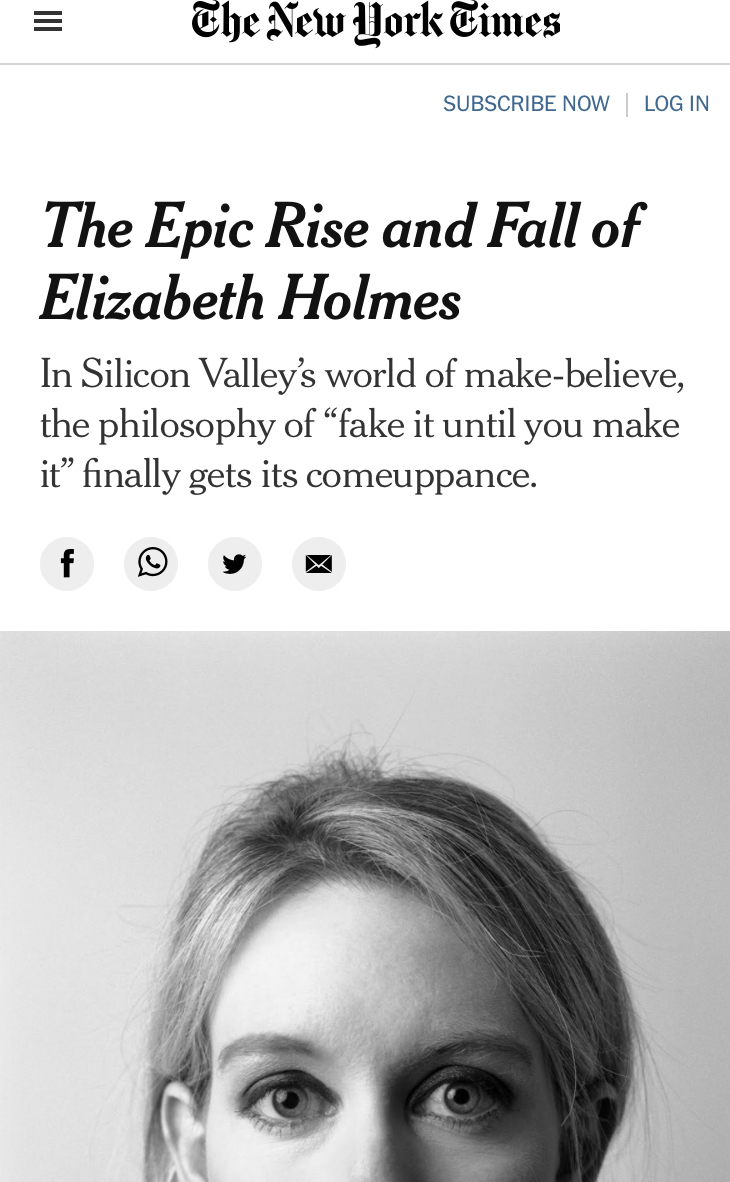
Click this photo from the New York Times and use it with your next Gatsby unit. Here it is:

The Epic Rise and Fall of Elizabeth Holmes

This Jan. 3, 2022 New York Times story by writer David Streitfeld documents the recent conclusion of the trial of Elizabeth Holmes, founder and former CEO of Theranos Corporation, a Silicon Valley medical technology company located in Palo Alto, Calif.

In January, Holmes was found guilty of four counts of fraud that each carry a possible 20-year prison sentence for creating, producing, and marketing a portable blood testing service that ultimately, according to investigators and prosecutors, was inaccurate and unreliable.

The service, made possible by a device known at Theranos as the “minilab”, had even begun to appear in a few Walgreens stores’ Wellness Centers. A nation-wide rollout was in the works.

The article draws parallels between Jay Gatsby and Holmes, citing the daily routines each practiced as they reached for self-improvement and prosperity through their ill-gotten wealth.

“Hiding fraud behind the imperatives of secrecy wasn’t the only way Ms. Holmes’s actions were rooted in tradition. Her self-improvement plan dated back to Ben Franklin but found its most indelible expression in F. Scott Fitzgerald’s creation of Jay Gatsby, the mysterious, alluring, handsome millionaire who also ran a few swindles.”

The Epic Rise and Fall of Elizabeth Holmes

In the article, reporter Streitfeld goes on to draw more parallels between Gatsby and Holmes, invoking connections between the Jazz Age’s Wall Street and our Internet Age’s Silicon Valley.

I used this assignment as a weekly Article of the Week assignment, where I asked students to simply reflect on the article in general. I also required students to discuss the various allusions to The Great Gatsby incorporated in the piece.

Elizabeth Holmes of Theranos at TechCrunch interview
Photo: TechCrunch | Creative Commons | Attribution

This story has been in the news a lot lately and it will be in the news also next fall, when sentencing for Holmes takes place.

In other words, this article has legs. Bookmark it for the next time you teach Gatsby.

There’s also a book out by the Wall Street Journal investigative reporter, John Carreyrou. Check out Bad Blood: Secrets and Lies in a Silicon Valley Startup here.

In addition, there’s a movie by the same title in the works starring Jennifer Lawrence as Holmes. Here’s an article about that.

To find six more info text articles to build relevance for The Great Gatsby, check out this post I published last summer. Note: this is an updated post that features the New York Times Elizabeth Holmes article at the top of the list. When you get to the post, just scroll down for the six additional articles.

Marilyn Yung of ELA Brave and True

I just couldn’t wait…

…to let you know about this awesome Gatsby tie-in article. Have any similar real-world articles up your sleeve? Feel free to share in a comment below this post or by leaving a message on my Contact page.

Finding connections like this between the world and literature is what excites me about my content area. It’s great to be a teacher!


Need a new poetry idea?

Enter your email below and I’ll send you this PDF file that will teach your students to write Treasured Object Poems, one of my favorite poem activities. I know your students will enjoy it!

Image shows readers the paper I'll send for signing up for my email list. The handout gives instructions for a Treasured Object poem.
Treasured Object Poems

Processing…
Success! You're on the list.

Looking for something specific?

ELA Brave and True


Feature photo by Max Morse for TechCrunch TechCrunch, CC BY 2.0 https://creativecommons.org/licenses/by/2.0, via Wikimedia Commons

Poetry Lesson: The Ode

Celebrate the unexpected with contemporary odes

One day during plan time last fall, I stumbled upon poet Kevin Young’s “Ode to the Midwest,” on the Poetry Out Loud website. I literally laughed out loud at its opening lines (I want to be doused in cheese & fried.) and knew I would have to introduce the ode to my new poetry class. Young’s poem is unexpected and irreverent; being a native Kansan, it just resonated with me. Click here to read Young’s poem.

So, in order to acquaint my students with the ode, I gave them a brief history on the form. For example, there are four kinds of odes:

We also watched this awesome video of Lucille Clifton reading “homage to my hips”:

To explore the ode for themselves, my students decided to concentrate on the contemporary ode form and explore it in a fun, freestyle way. There were no requirements to rhyme or be focused on a certain topic. The only requirement I made was that their odes be of at least ten lines.

My students came up with some great odes. Here are a few of the unexpected things they paid tribute to with their odes:

  • Darkness
  • Casseroles
  • The Color Orange
  • Heartbreak
  • The Sun
  • Artificial flowers
  • The Renaissance
  • Red markers
  • Happiness
  • Jokes
  • A car
  • Sunsets
  • The number 13, and last but not least…
  • A dysfunctional gall bladder

See what I mean? Fresh. Evocative. And totally unexpected.

And just for fun, I experimented with my own… An Ode to the Cold War. (It’s always fun to work alongside students when we try something new.)

Odes are a nice way to provide a degree of focus for poetry writing. Odes also allow students to express their unique visions.

If you’re needing an easy and fun poem form to explore with your students, definitely add the ode to your list of upcoming poem ideas. Discuss the form and its classical roots, but then shift the focus to the contemporary form so students can readily apply it to their experiences.


Need a new poetry idea?

Enter your email below and I’ll send you this PDF file that will teach your students to write Treasured Object Poems, one of my favorite poem activities. I know your students will enjoy it!

Image shows readers the paper I'll send for signing up for my email list. The handout gives instructions for a Treasured Object poem.
Treasured Object Poems

Processing…
Success! You're on the list.

Looking for something specific?

ELA Brave and True


Featured Photo: Photo by Autumn Goodman on Unsplash

The Love Song of J. Alfred Prufrock

Connect to Prufrock with this easy, mindful project

Note: The idea for this assignment came from Amy Goldman of Teaching The Great Gatsby Facebook group. Goldman created this assignment, and I created the PDF file below for my own use in the classroom. Feel free to give it a try!

I’ve included a free downloadable PDF of the directions for this project at the end of this post.

If you need an easy and creative way to help your students show their understanding of T. S. Eliot’s “The Love Song of J. Alfred Prufrock,” then try this simple activity as a culminating project. My high school juniors seemed to enjoy creating these “Prufrockian Perspective” heads to show what’s going on in Prufrock’s brain. Most students were able to express their own interpretations of the poem in a creative way with this project.

This is the bulletin board I made to showcase all the Prufrocks that my junior students made at the conclusion of our study.

But first, some background.

Here’s a quick rundown of how my classes worked with Prufrock before making these:

  • We took notes on Modernism (including comparing pre-Modern vs. Modern masterpieces) and the events that spawned the Modern Era. We also took notes on T. S. Eliot, his career, and other basic biographical facts.
  • We read and discussed pre-Modern poems such as William Wordsworth’s “I Wandered Lonely as a Cloud”, “Sonnet 43” (How Do I Love Thee?) by Elizabeth Barrett Browning, and “Psalm of Life” by Henry Wadsworth Longfellow. For contrast, we followed up these pre-Modern poems with the Modern classics, Ezra Pound’s “In a Station of the Metro”, and “Thirteen Ways of Looking at a Blackbird” by Wallace Stevens.
  • And then it was time for Prufrock, where I read aloud the poem as a cold read merely to provide students a first impression.
  • The cold read was followed by a second reading where we annotated and jotted down noticings regarding word choice, imagery, allusions.
  • I assigned stanzas to pairs of students and asked them to do a close reading, taking stock of their particular stanza and its meaning before sharing their thoughts with the class. Specifically, they were to work with a partner to:
  1. Underline key words.
  2. Notice any pattern among words, i.e. do they suggest a tone or feeling?
  3. Identify any imagery or symbols.
  4. Determine a theme or attitude in their stanza.
  5. Discuss how their stanza fits into the whole.

When we completed all those activities, I felt it was time for kids to show their understanding with some Prufrockian Perspective art. Here are the instructions:

  1. Get a template for Prufrock’s head. (This was something I drew, photocopied, and provided to students on 11″ x 14″ copy paper. I’ll be adding the template to this post very soon, so please bookmark and check back!)
  2. Fill up the head with what is going on in Prufrock’s mind, based on what you learned from the poem.
  3. Use words, phrases, and images from the poem.

Download the directions here:

Your Prufrockian Perspective: An Easy Prufrock Activity

Download this brief slide presentation that explains this creative, easy-to-implement activity that helps students connect to Eliot’s modern masterpiece. Read my post about this free resource here: The Love Song of J. Alfred Prufrock | Connect to Prufrock with this easy, mindful project.

This activity is a great way to enhance your teaching of historical context for The Great Gatsby.

Here are the colorful results!

Standards alignment

CCSS.ELA-LITERACY.RL.11-12.9: Demonstrate knowledge of eighteenth-, nineteenth- and early-twentieth-century foundational works of American literature, including how two or more texts from the same period treat similar themes or topics.

CCSS.ELA-LITERACY.RL.11-12.10: By the end of grade 11, read and comprehend literature, including stories, dramas, and poems, in the grades 11-CCR text complexity band proficiently, with scaffolding as needed at the high end of the range.


This easy little project was a good way to culminate our study of Prufrock, which was a lead-in to our novel unit for The Great Gatsby. I think that for most of my juniors it allowed them a way to visualize and reproduce their take-aways from the poem, which admittedly seemed at times to be a little “out there” for them.

My advice to them when it comes to understanding “out there” poetry? I just tell them that Modern poetry — and really, all poetry — is not necessarily meant to be understood, but rather felt.


Need a new poetry idea?

Enter your email below and I’ll send you this PDF file that will teach your students to write Treasured Object Poems, one of my favorite poem activities. I know your students will enjoy it!

Image shows readers the paper I'll send for signing up for my email list. The handout gives instructions for a Treasured Object poem.
Treasured Object Poems

Processing…
Success! You're on the list.

Looking for something specific?


ELA Brave and True