9/11 Poetry Lesson Plan: The stories the artifacts tell

Artifacts link the 9/11 attacks to the loss of a single human life

I believe in teaching students about the September 11th terrorist attacks. It seems that up until a few years ago, students had an intrinsic desire to understand it better. Still, it seems that their desire to learn about 9/11 is waning, especially among high school students.

My current juniors and seniors were born in 2001 and 2002, and they tell me they have “been taught” about Sept. 11 every year for as long as they can remember. As a result, they feel they know all they need to know about this world-changing event.

But they don’t.

Yes, they’ve watched movies and documentaries galore that show (yet again) the airplanes crashing into the towers. They’ve seen photographs of Ground Zero. They know about Afghanistan.

But they may not know about…

  • a pair of shoes found in the rubble
  • a charred jewelry box found buildings away in a bank vault
  • a crumpled wallet

Simply put, students haven’t heard the stories the artifacts tell.

In 2018, I discovered a few sources for photographs of artifacts from Ground Zero. One of these websites was the 9/11 Memorial & Museum. Click here to go to the museum’s Memo Blog where you can search for artifacts. You can also find the artifacts I used at this page from New York magazine: Click here. Of course, Pinterest will help you find many also.

June 2021 Update:

I have located online another source of more artifacts photos and information. Visit the National September 11th Memorial Collection for a large selection of photos you can print out as well as narrative details that describe the objects and the owners of the objects.

The lesson plan for this project is available on TpT by clicking this link.

By the way, here’s an idea that sparked as I searched online to write this post. Another effective way to connect the tragedy to the loss of life might be to focus on the missing persons signs that family members and friends posted around the city in the days immediately following the attack. Here’s a source for missing persons posters from New York magazine.

Other sources included commemorative articles about the attacks in New York magazine and The New York Times. Last year, when I discovered these artifacts, I planned on using them in a new activity; however, that never transpired. I kept the artifacts photos, however, since I knew I could use them in the future whenever I figured out what I wanted to do with them in a learning unit. Besides that, color printing is so costly that I didn’t want to waste them.

IMG_1615
My first-hour juniors work in the lab on their poems and one-word summaries.

This year, I finally was able to incorporate the photos into a four-day unit on 9/11 that I hoped would teach students about the tragedy beyond dates, place names, and facts. I hoped to show students a more personal side of the tragedy. That is, after all, what makes the attacks so devastating. Beyond the ferocity and horror of the crashing towers —and the Pentagon and Flight 93— was the shocking comprehension of the violent loss of nearly 3,000 innocent lives.

I feel that young people fail to grasp the human factor in the attacks… through no fault of their own.

So with that in mind, I created this lesson plan and activity that’s intended to help students see 9/11 in a new light.

Here’s a rundown of my new 9/11 Artifact Project.

First, before I ever even said the word “artifact,”  I assigned a 9/11-themed Article of the Week assignment. AOWs are weekly assignments that my students receive every Tuesday; they’re due the following Tuesday. These assignments are considered homework and are fashioned after AOW assignments created by Kelly Gallagher.

IMG_1650
IMG_1651

This 9/11 AOW featured a 2016 USA Today article entitled “Fifteen Years Later: The Questions that Remain in Our Minds…15 Years After 9/11.” Even though this article is three years old, it’s the best one I’ve found for containing a wealth of information in a concise length. In the assignment, students read the article and then annotate it with their own  thoughts and observations. Students then respond to the writing prompt that asks them to reflect on and explain what they learned from reading the article.

Based on our discussions after reading aloud the article, it seemed that most, if not all,  students learned from this AOW. Most students had no previous knowledge about the 1993 truck bombing attempt. Some were unaware of Flight 93, which was eventually crashed by the passengers into a field in Shanksville, Pa.

None had heard of the bombings and attacks that preceded the World Trade Center attacks, such as the USS Cole attack in 2000, and the 1998 attacks on the U.S. Embassies in Kenya and Tanzania.

This AOW assignment was turned in the day we started the 9/11 Artifact Project, so students would have the article’s information in the back of their minds as they began to delve deeper into the project.

After turning in their AOW assignment, I asked students to pick up a photo of an artifact from a table where I had scattered 25 photos. The artifacts included keys, shoes, firefighter helmets, jewelry, mangled pieces of metal from one of the airplanes, and other objects. I didn’t tell students where the images were from, but they quickly deduced that since it was September 10, that the images must have something to do with the terror attacks that would be commemorated the next day.

June 2021 Update: I have located online another source of more artifacts photos and information. Visit the National September 11th Memorial Collection for a large selection of photos you can print out as well as narrative details that describe the objects and the owners of the objects.

After picking up their image, I asked students to simply write a paragraph to describe the object. They could describe the artifact, discuss who might have owned it, and what it might have symbolized to its owner. Here’s one of those paragraphs:

IMG_1612
A student’s paragraph describing the artifact, work gloves, they had chosen from the table.

After we wrote these low-stakes paragraphs, I passed out some reading material. I read aloud the Author’s Note to the incredible book 102 Minutes by Kevin Flynn and Mark Dwyer.

IMG_1640

This book contains the stories of 367 people who survived the destruction of the towers. It contains eye-witness accounts of exactly what unfolded during the 102 minutes that transpired between the strike and the collapse of the north tower.

fullsizerender-181 (1)
My own photo from a trip to NYC in 1997.

After reading the Author’s Note, I asked students to get into groups of four. In their groups, they read either the first half or the second half of the Prologue. They could read their pages however they wished: one student could read the entire excerpt, students could take turns… it was their choice how they could complete it. They each had their own copy of the text so they could annotate it as they read. I also passed out sticky notes and asked them to write down three to four new words from the reading (students are now using one of the words in a literary analysis assignment that began the next week).

What came next? A one-word summary of the excerpt. I asked students to choose one word to summarize their excerpt and then write a paragraph  defending their choice of that word.  The only requirement was that the summary include evidence from the text followed by a sentence or two of interpretation. Students wrote these summaries by hand on notebook paper in the classroom; they typed them on computers later in the week in the computer lab.

After students had finished their one-word summaries, we took a break from reading and writing and instead did a quick speaking and listening activity. I passed out to students slips of paper that contained descriptions of their respective artifacts. Some of the descriptions were lengthy; some were just a sentence or so.

IMG_1623

One by one, we went around the room and each student walked to the document camera, projected their artifact onto the screen, and then read their description to the class. Everything from office keys, to crumpled police car hoods, to shoes were shown.

Here are some of those artifacts along with descriptions:

IMG_1627

With this project, I thought it would be interesting to experiment with linking different genres, so I asked students to bear with me and try something new. Here’s what I asked them to do: take the word that they chose to summarize the 102 Minutes Prologue and use that word to create an acrostic poem about their 9/11 artifact. The poem would also include the quote or a phrase from the quote they used as evidence in their summary.

IMG_1626

Using a word from the text to dictate the direction of the poem would, I hoped, provide a clear link between the disaster and a specific person involved in the attacks in some way, whether they were a World Trade Center worker or an emergency responder.

IMG_1625

Since my goal was to link the atrocity to a single human life, I thought connecting the 102 Minutes text to a personal artifact would be a valuable task. 

It seemed somewhat strange to students at first to make their word from the text be the centerpiece of their poem, but once they had the idea firmly in their minds, they seemed to see the connection being made.

IMG_1624

I also provided them my own example of a poem and a summary for them to reference, which I showed via the document camera. Here’s the instruction sheet I made and then my example poem and summary on the back side:

IMG_1630
IMG_1629

In reflection, I think my first “go” at this activity was successful. When we finished, I assembled all the materials and put them into a three-ring binder for safe-keeping for next year. I placed each artifact photo and its description into its own plastic page protector so they wouldn’t get lost in the shuffle, as well as samples from students to use as mentor texts for next year.

Here are a few samples from students:

IMG_1605
IMG_1604
IMG_1608

As for receiving feedback from students regarding this project… I did give each student a three question half-sheet for them to fill out at the conclusion of the project.  I gained a few ideas for how to improve the project for next time, such as…

  • Allow more time for the project.
  • Do either the poem only or the one-word summary only. It became confusing for some.
  • Slow the speed of the lesson down. (And I’ll admit, on new activities, it seems I never allot enough time.)
  • Possibly add a video to the project. In my previous position, my eighth-graders watched the New York: The Documentary at the conclusion of a unit on the attacks. Because my students at my new school had told me they were studying 9/11 in their history and/or government classes, I opted not to watch one this year. Perhaps next.

In addition, most students responded that they now know more about 9/11 than they did previously. And sure, a few don’t think that they gained any new knowledge about the attacks.  Here are a few responses I received back from my half-sheet lesson evaluation.

IMG_1632
IMG_1636
IMG_1633

By the way, my students really put a lot of thought into these little evaluation half-sheets. I was so surprised that they didn’t just rush through them or put “idk”  in the blanks. They really took their time and I’m thankful for that.

To sum it up, I will definitely do this project again with my students next year. I think my first attempt at it was successful based on the connections my students made between the text, which resulted in a product that combined non-fiction summary writing with poetry.

Sure, there are some modifications to be made, but that’s a given with any lesson plan… new or tried-and-true.

Perhaps most importantly, I believe putting the human element into the story of 9/11 captures students’ attention. Viewing a crumpled and nearly destroyed employee i.d. card adds a visceral element to the sterile facts, dates, and statistics that can all too often dominate a textbook study of a historical event.

If, in the end, that’s all this lesson plan accomplished, I’m fine with that.

Also, to see photos of how another teacher used this project to decorate his hallway with his students’ artifact poems, read A Sept. 11 Artifacts Poetry Display.

A colleague used “The Stories the Artifacts Tell” poetry project in 2020 as a 9/11 lesson.

I’ve made a three-page lesson plan for this project available for purchase in my TpT store. Here are some photos of the lesson plan.

Standards Alignment

This four-day unit instructed in the following Missouri Learning Standards:

  • Reading Informational Text 1D: Explain two or more central/main ideas in a text, analyze their development throughout the text, and relate the central ideas to human nature and the world; provide an objective and concise summary of the text; 
  • Reading Informational Text 3D: Synthesize information from two or more texts about similar ideas/topics to articulate the complexity of the issue.
  • Writing 2A: Follow a writing process to produce clear and coherent writing in which the development, organization, style, and voice are appropriate to the task, purpose, and audience; self-select and blend (when appropriate) previously learned narrative, expository, and argumentative writing techniques. 
  • Writing 3A: c. Conventions of standard English and usage: Demonstrate a command of the conventions of standard English grammar and usage, including spelling and punctuation; d. Use a variety of appropriate transitions to clarify relationships, connect ideas and claims, and signal time shifts; e. Use technology, including the Internet, to produce, publish, and update individual or shared writing products in response to ongoing feedback, including new arguments or information.
  • Speaking and Listening 2A: Speak audibly and to the point, using conventions of language as appropriate to task, purpose, and audience when presenting including fluent and clear articulation, strategically varying volume, pitch, and pace to consistently engage listeners.

9/11 is such an important topic to teach our students. Feel free to share your 9/11 lesson ideas by leaving a comment via my Contact page.

Here’s another recent post on the 20th anniversary of the World Trade Center attacks.

Thanks for reading again this week! To subscribe to my blog, enter your email below and instantly receive a poetry lesson in return!


Need a new poetry lesson?

Enter your email below and I’ll send you this PDF file that will teach your students to write Treasured Object Poems, one of my favorite poem activities. I know your students will enjoy it!

Image shows readers the paper I'll send for signing up for my email list. The handout gives instructions for a Treasured Object poem.
Treasured Object Poems

Processing…
Success! You're on the list.

Students draw maps to explore memoir ideas

Drawing can recall forgotten memories

If your students struggle with getting memoir topic ideas, read on. A few weeks ago, my junior and senior students wrote memoirs… creative personal narratives about an important memory that taught them an important truth about life, growing up, or the world in general.

In the past I’ve always passed out an idea sheet to help students gather ideas for their memoirs. It contains about thirty questions that are intended to spur memories or at least interesting stories. That sheet is beneficial, but this year I wanted to try something new: map-making.

I read about map-making in Writing Life Stories, a book by author and writing coach Bill Roorbach. In his book, he recounts how he has his own students draw maps of special places in their childhoods: their house, a neighborhood, a farm, a grandparents’ house.

Roorbach suggested to his students to draw as detailed as a map as they could. He asked them to include the hiding places, the forbidden zones, and the favorite spots of their location. The point: to jog their memory about a forgotten incident… a long ago discarded recollection of a particularly scary game of tag, for example. Or maybe a memory with a grandparent they had nearly let go of.

IMG_7689

Drawing a location will naturally help one remember, says Roorbach. He suggests putting as much detail as possible into their maps. For example,

  • Don’t forget the propane tank behind the oak tree.
  • The dog bowl under the porch.
  • The soybean field.
  • The clothesline.
  • The garden gnome at the end of the iris patch that you tripped over one time.

My students took about one or two 56-minute class periods to draw their maps. Some finished much more quickly than others and once they landed on a memory, they could start writing. Here are some of the maps (or some detail shots) that my juniors and seniors drew:

IMG_1537
IMG_1532
IMG_1533
IMG_1535 (1)
IMG_1534

Here’s my own example map that I showed students before they started their own. This is my maternal grandparents’ farm in rural southwest Missouri.

IMG_1493
This is my maternal grandparents’ farm near Hume, Mo. I drew in as much as I could… even where I watched a possum play possum one afternoon from the “davenport” near the front of the kitchen. My map shows the grape arbors, a cherry tree, a peach tree, a fuel tank for the tractors, a propane tank. I put a question mark where I couldn’t quite remember the exact positioning of things.

My classes wrote first and second drafts of their memoirs. I gave each student full participation points if they reached the word-count minimum, which was 750 words for their second draft. (First drafts could be turned in with only 450 words, but their first drafts did need to be complete with a beginning, middle, and end, including the reflective “lesson learned” part of their memoir.

I still have the second drafts of everyone’s memoirs. In about a month, I’ll pass these back out for further revision. I hope we are able to look at them with “fresh eyes.” We may get into Protocol Peer Review Groups to collaborate on revision and editing.

It’s my hope that there will be a handful of memoirs that can be entered into the Scholastic Art and Writing Awards in December.

After students had turned in their second drafts, I asked them their thoughts on the map-making portion of the project. Was it beneficial? Did drawing a map help them recall memories they had forgotten?

I didn’t do a Google Form to survey them, but just asked for a show of hands at the end of class. Some acknowledged that yes, the maps were helpful. Most students, however, seemed indifferent (a common response to just about anything it seems!).  But then again, a few were emphatic that the map exercise brought forth the memory that they ended up writing about.

One student in particular agreed that the map helped him.  Drawing his farm allowed  him to recall a tree that he climbed when he was about twelve. That tree caught on fire when he was still in it due to some burning paper airplanes that a cousin, I believe, flew into the tree. Reading about his fiery hot, melting rubber shoe soles and his ensuing panic made for a stirring and shocking story. Fortunately, he wasn’t hurt and the main outcome of the fire was that a cousin had to pick up rocks on the farm for a good while afterward.

This story, “The Burning Tree,” has so much potential for the Scholastic Art and Writing contest. It’s my hope that further revisions and editing will allow us to enter it into the student’s contest account soon.

And to think it all started with making a map.


Marilyn Yung

Thanks for reading again this week

! Are you planning to enter some student work into the Scholastic Art and Writing Awards this year? Students could begin opening accounts on September 12. None of my students has opened their accounts yet. Those who submit work will likely upload their work in November or December. Leave a comment or question about the contest and I’ll see if I can help.


Follow my blog for more middle school and high school teaching stories.

Need a new poetry idea?

Enter your email below and I’ll send you this PDF file that will teach your students to write Treasured Object Poems, one of my favorite poem activities. I know your students will enjoy it!

Image shows readers the paper I'll send for signing up for my email list. The handout gives instructions for a Treasured Object poem.
Treasured Object Poems

Processing…
Success! You're on the list.

Looking for something specific?

ELA Brave and True


Featured Photo: Photo by Dan Farrell on Unsplash

Teach high schoolers how to “explode a moment”

Teach descriptive writing with this sure-fire lesson

For some reason, young writers seem to want to write as little as possible when describing a scene. I read descriptions as sparse as this example: I shot the ball and it went in and everybody freaked out. However, when kids see the effectiveness of exploding a moment, they’ll surprise themselves with how much description they can generate.

About a year ago, I wrote this post about a mini-lesson where my students watched a slow-motion video clip from writer and author Barry Lane’s YouTube channel. We watched the clip in five- to ten-second second segments. Following each segment, I would pause the video and the kids would write down what they saw. In effect, they were exploding a moment. The video was of a boy who looks about ten years old hitting a baseball. The idea is that the boy hits a home run, which causes the crowd to go wild.

If you’re unfamiliar with “exploding a moment”…

Exploding a moment is one of Lane’s signature revision strategies. When writers explode moments, they do what movie directors do to indicate a film’s pivotal moment: they show the moment in slow motion to indicate its importance. When a moment in a narrative holds the same importance, exploding that moment  across a page or two can do the same thing. If students take an important moment from their narratives and envision it happening in slow motion, and then write what they see, they’ll inevitably “paint” a much more detailed rendering of the moment than they would otherwise. 

This year, I wanted to try this same Barry Lane idea with high school students.

This year, I wanted to try this same Barry Lane idea with my students at the high school where I now teach; however, I thought the ten-year-old’s baseball video might seem too much like middle school material.

So, I tried to remember movies that I’ve seen that include slow-motion moments. One of those I remembered also just happened to be baseball-themed: The Natural.

If you watch this YouTube video clip and watch it from :40 to 1:20 in eight- to ten-second chunks, you’ll provide your students a similar moment to explode that is a little more “grown up.”

Here’s that clip from The Natural, which only a couple of my students (out of about 90) had seen.

Before playing The Natural clip, I asked students to imagine that they were Roy Hobbs, the player at bat (played by Robert Redford), and I also suggested that they write their explosion in first-person point-of-view. I thought this would make their writing more immediate. Also, when it came time to share, it might be helpful if we all focused on the same character’s perspective in the video.

Playing the movie clip, pausing, asking students to write what they saw, and then also having a few of them share their “explosions” took about thirty minutes or so. (With some classes it took less time because —at least at my school— many of these older students are reluctant to share their writing. Right now, many of my high school students don’t care to share their writing, which is a real change from middle school where kids can’t share enough!)

Here’s one student’s exploded moment:

IMG_1596

Here’s another example from one of my high school students:

IMG_1597

Finally, here’s a copy of my handwritten explosion that I shared here and there during my classes to either encourage sharing or just to help students see what exploding a moment might look like.

IMG_1592
IMG_1593

Here’s that free slow-mo video site…

I’ve also thought about finding more short video or movie clips to play during the year so kids can continue to practice this technique more. Videvo.net has a huge supply of short, slow-motion video clips of everything from runners in a marathon to a candle flame.

Many are free to view and some are only available for purchase with an account. Here’s a link to a free clip of that candle flame.

https://www.videvo.net/video/candle-flame-in-slow-motion/2683/

I haven’t used any of these yet, but I think an occasional one might make a good bell-ringer activity while also keeping the explode a moment technique fresh in students’ minds.

And no, it might not seem that a candle flame would be a pivotal moment in a narrative… but it could be.

Imagine if you had a character making an important life decision while watching a candle flicker. For example, I can picture the character watching the flame, pondering her choice of whether to marry her boyfriend. As she examines the flame, she might see connections to their relationship. For instance, she might see that the flame bends and sways in the breeze, much like their relationship has had to bend and sway to accommodate their individual needs and goals. Anyway, you get the idea.


Marilyn Yung

This is literally one of my favorite writing activities ever! It demonstrates to students that they CAN elaborate and that they CAN write descriptively.

Thanks for reading! For more ELA teaching ideas and lessons, enter your email address below, and I’ll add you to my list!

Have a great week!


Need a new poetry idea?

Enter your email below and I’ll send you this PDF file that will teach your students to write Treasured Object Poems, one of my favorite poem activities. I know your students will enjoy it!

Image shows readers the paper I'll send for signing up for my email list. The handout gives instructions for a Treasured Object poem.
Treasured Object Poems

Processing…
Success! You're on the list.

Looking for something specific?

ELA Brave and True


Focus Your Binoculars and Zoom In

A revision mini-lesson

Because it seems my high school students would benefit from learning some revision strategies, I decided to do a search on Teachers Pay Teachers for any revision handouts featuring the work of Barry Lane. I found this one (it’s FREE from Texas ELAR Coach) entitled Writing Strategy: Adding Detail by Zooming In with Barry Lane’s Binoculars. Lane’s technique of “focusing the binoculars” allows readers to see better, clearer pictures in our stories.

When you download the page, you’ll see that the page’s title is “Focusing the Binoculars.” However, I decided to write “Zooming In…” at the top of my handout since I’ve often seen these two terms used interchangeably in some of Lane’s materials. In addition, when I talk in class, I often use both terms. To avoid confusion, I wanted to make sure that both terms appeared on the page.

IMG_1555
Find this handout at this TpT page: Texas ELAR Coach

The handout features this example of a fuzzy sentence: The lady looked kind of funny. In class, we talked about how that sentence doesn’t paint a clear picture. It’s a good example of vague language that accomplishes nothing. For example…

  • What does “kind of funny” look like?
  • Does funny mean humorous?
  • Does it mean weird?

Below the fuzzy sentence are two sentences that paint a vivid picture of the funny-looking lady. It gives a crystal clear description that provides a “mind movie” to the reader. We discussed how much more vivid the zoomed-in sentence is. We can picture the woman, her hat, her pale skin, her bobbing head, the way she looks like a black lid.

Mr. Lane’s handout makes an obvious point: when you imagine that you’re looking through binoculars at an object, person, or landscape—or anything, really— in your story, and then adjust those binoculars, and describe what you see, your readers will be able to visualize your writing so much more clearly. Writing we can see in our mind while we read creates memorable writing.

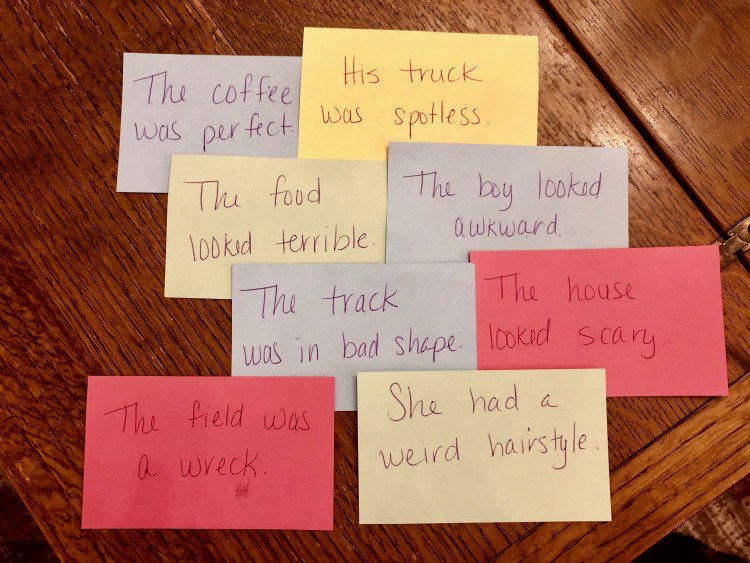
On the handout, there are four further examples of zooming in.  I decided to write each of these on an index card and then I made some more cards so kids could get with a partner, pick a card, and then zoom in.

IMG_1557
I made these cards. Four of them feature fuzzy sentences from the handout and I created a few more so I would have enough for class.

Kids moved around the room to find partners and to write their sentences. I asked them to write their fuzzy sentence at the top of a sheet of notebook paper, and then add two to three more “zoomed in” sentences. After about five minutes of work, we went around the room and listened to each pair’s attempt at using their narrative binoculars.

IMG_1559
This photo shows some of the “zooming in” my high school students tried last week. They wrote the fuzzy sentence first and then “zoomed in” for two to three more sentences.

Even though I had asked students to read their fuzzy sentences first, I also reminded them that if they “zoom in” well, the fuzzy sentence is unnecessary. This activity illustrates how the fuzzy sentence tells while the “zoomed in” sentences show

Following our share time, I wrapped up the mini-lesson by reminding students to use this technique in the computer lab (where we were going next) where they were to continue revising their memoirs.

Side note:  Because I thought my students might confuse ‘zooming in’ with “exploding a moment,” a technique we had explored a few days before,  I reminded them that writers “explode a moment” when they want to fully develop the most suspenseful, climactic part of their narratives.

On the other hand, writers can focus the binoculars and “zoom in” at anytime during a story.  “Zoomed in” detail makes the difference between vivid and dull writing. It’s especially useful for grounding dialogue… adding scene-setting imagery and details to conversations to develop characters or set a scene. Without this grounding, dialogue can feel like mere isolated lines of speech devoid of life.

After returning the conversation to zooming in, several students skimmed through their drafts looking for places where they could focus their binoculars and describe a person, object, or landscape more acutely.

IMG_1558 (1)

This activity lasted for about twenty minutes. It was just enough time to explore the concept sufficiently, yet also leave enough time for students to immediately practice it in the computer lab, which is where we spent the remainder of the class period.

Since I had requested that their next draft be 750 words,  most students recognized the lesson’s usefulness in helping them to increase their word count.

I felt this lesson resonated with my students. There was real purpose in it and they were able to immediately implement it.


Thanks for reading again this week! Feel free to click like and leave a comment or question. And if you have any ideas to share, please do! If you’d rather contact me directly by email, please contact me at marilynyung@gmail.com. Have a great week! 

Acknowledgement: Thanks to author Barry Lane and Texas ELAR Coach at Teachers Pay Teachers for the use of their fantastic materials.

Slice-of-Life Writing: The Anti-Instagram Narrative

These short narratives celebrate the ordinary

IMG_1494

One result of a three-month summer break? Students out of practice with writing, especially creative writing.

To remedy that last week, I decided to introduce my high school students to slice-of-life writing, a fairly new genre within the world of narrative non-fiction. In my former middle school ELA teaching position, slice-of-life writing was a staple with my students. They enjoyed writing slices more and more as they became familiar with the form.

By the way, I learned about slice-of-life writing from this inspirational group of writer-teachers. Teachers write and post their own slices on Tuesdays at this site. For information about this group’s Slice-of-Life Writing Challenge for classrooms, visit here.

One way to think of slice-of-life writing is to consider it an acknowledgement of the moments we wouldn’t post in an Instagram feed. Usually, we put the major moments of our lives in our feeds… memorable vacations, weddings, graduations, fun outings. With slice-of-life writing, however, we write about the more ordinary moments of our lives. These have merit, too, and perhaps as much merit as the milestones in our lives simply because the small moments are more numerous.

After a brief introduction of the genre to my high schoolers, I went over the points on the PowerPoint slide (shown below).

IMG_1498

After talking through the above Powerpoint slide, I passed out copies of a sheet with mentor slice-of-life essays. I read aloud these three from the sheet: Drip Drop by Annison E., Feeding the Dogs by Isaiah F., and Cutting the Grass by yours truly.

The first two were written by former students, and were published by Creative Communications of Logan, Utah in one of the publisher’s essay anthologies. (While the company continues to publish poetry anthologies for middle schoolers, they no longer publish the essay anthologies. Darn!)  Here’s that mentor text handout:

IMG_1496
IMG_1497

After reading and discussing the mentor texts, I asked students to spend thirty minutes working on a first draft, after which we would do some revision. As for length, I asked students to fill the front side of a sheet of notebook paper plus a few lines on the back.

In some of my classes, it was evident that some additional guidance was needed. Some students seemed to be confused by what exactly constituted a “slice.” During my first hour class, I wrote alongside them, scribbling out a first draft about cleaning the windshield of my car, which I had done the night before. I read it aloud, stumbling through my quickly written cursive. I told students I was not totally satisfied with it (especially the  powdered sugar reference), but it was a start. Here’s my quick “demo” first draft of my own slice:

“Shhhhhhhhh.” The foamy spray fizzes onto my car’s windshield like a thin layer of powdered sugar. A sweet chemical odor lifts from the foam.

The foam sludges down the glass like a glacier, shifting and sliding slowly down toward the wiper blade, a guardrail of sorts.

The stains of unlucky insects that fluttered their wing one final time against the glass melt into the white of the foam cleaner. Moths, wasps, and horseflies decompose and disintegrate into the liquid… a tiny life lost and wiped away.

I rip off a handful of paper towels  and wipe the glass. Clean straight swaths absorb and remove the foam, the bugs, the film of road grease and oil.

The window is wide and requires that I stretch to reach the entire glass. So I walk around to the other side to clean the remaining half.  I trip on a cord from the leaf blower left on the floor. I untangle my ankle from the cord and finish cleaning the windshield.

The glass is clear. One crusty patch remains and I spray it one more time. The crust dissolves and I smudge out the remaining residue.

The paper towels, damp and dripping, feel cold in my hand. The job is done.

Following my read aloud of my demo slice, they started or continued on their own. After about thirty minutes, I asked students still working to finish the sentence they were writing, so we could add to our first drafts.

Adding to our writing is one way we revise, I said.

“Let’s add to our first drafts with sensory language,” I said. “Skim through your draft and look for  a place to add a sound,” I suggested. Students worked for about five minutes to add a sound.

Of course, without fail, in each class, one student would ask, “What if you already have a sound?”

“See if you can add another,” I prompted.

Following sounds, we then added fragrances/odors (smell), textures (touch), and if appropriate, a flavor (taste) to our drafts. Obviously, if students were “showing and not telling,” their writing should have already have contained an image.

After our revision, I asked for volunteers to share their slices. A few students agreed to do just that. My first impression from their writing: I hadn’t sufficiently stressed the importance of focusing on a single moment in their slices. When a few students shared their entire morning routine (First, I get up and then I take a shower, and then I grab some breakfast, feed the dog, brush my teeth, wait for the bus, and then it comes and I go to school.), or evening football practice, I knew I needed to emphasize that slice-of-life writing is all about focusing on a single small moment in life, an ordinary moment that one would never think to include in their Instagram feed, for example.

I had conveyed this idea earlier in the lesson by recalling last week’s reading of excerpts from Bill Roorbach’s Writing Life Stories, where Roorbach discusses memory. He mentions “informational memory,” which he calls the “stuff of lost days.”

Slice-of-life writing  builds on  and celebrates the “stuff of lost days” people are engaged in on a daily basis.

Yes, our lives are punctuated with big life events, but our lives are also lived in the not-so-big events, the events that are easily forgotten or downplayed, but actually form the bulk of our existence.  Slice-of-life writing capitalizes on these easily dismissed activities.

IMG_7689

Because a handful of students (in one particular class, curiously) wrote what I call “And then I did this, and then I did this” essays, I tweaked my Powerpoint slide to place more emphasis on focusing on a single moment or task. The final version of that slide is the one I’ve included in this post above.

However, I still need to add these points, which should help them write “in the moment” better next time:

  • Write in the first-person point-of-view to put the reader right there with you.
  • Write in the present tense to add immediacy to your slice.

The next day in class, students typed up their slices in the computer lab. I told them that if their slice was a series of events or moments, that they could go ahead and use it for this first slice, since I felt my instructions hadn’t been clear enough at first. Next month, however, when we try another one, they will need to get choosy with their writing and focus on a single moment.

Right before they began typing, I asked students to create a Google Doc and name it Slice- of-Life Essays so we could add a slice monthly for the next few months. We’ll plan to publish a small collection of slices at the end of the semester or at the end of the year. Having a collection of essays about their everyday and ordinary teenage life should be a treasure as they continue through high school and beyond.

After typing, I asked students to print two copies and read their copy aloud to a partner who would follow along on their own copy so they could  offer feedback for more revision. I specifically asked students to look for:

  1. First: unclear and/or confusing areas
  2. Second: editing, such as punctuation, grammar, and spelling

I added, “When you turn in your final draft, also hand me your first draft copies so I can see the feedback your partner gave you.”

Unfortunately, most kids brought me their final drafts with a first draft that contained minimal feedback provided by their partner. Many simply had misspelled words circled or commas added here and there. “That’s not revision. That’s editing,” I thought, making a mental note that my new students would need extra encouragement to revise.

And that’s where we are in my new high school classes. I am figuring out that they need to learn some revision strategies. This week, I plan to cover “exploding a moment” and “writing small,” two similar yet separate strategies that should help students flesh out their writing into fuller, more meaningful compositions. Stay tuned.


Thanks for reading again this week!

It’s interesting to make the transition from middle school to high school. Older students definitely have different motivations and goals! Learning ways to make writing (and revising) more relevant is definitely my charge.

Slice-of-Life essays are a start in doing just that.

Feel free to leave a comment below with your comments or if you have questions. You can also reach me through my Contact page at this link.

Need a new poetry lesson?

Enter your email below and I’ll send you this PDF file that will teach your students to write Treasured Object Poems, one of my favorite poem activities. I know your students will enjoy it!

Image shows readers the paper I'll send for signing up for my email list. The handout gives instructions for a Treasured Object poem.
Treasured Object Poems

Processing…
Success! You're on the list.

Need something else?

More Slice-of-Life Writing Lessons

ELA Brave and True | Love teaching. Make it memorable.

The Rubric Rub

Do what the rubric says. And only what the rubric says. And by all means, don’t think too hard.

Last week in my high school Language Arts classes, students spent time planning memoirs that they will begin drafting this week. On Friday, a few girls who had already decided on a memory to recount were starting to write their opening paragraphs.

As one student was scribbling out her first lines, she asked, “Do you have the assignment sheet for the memoir?”

“No, I’ll have it ready for you next week. For now, just go ahead and start writing,” I told her.

“How long does it have to be?” another student at the same table asked.

“I’m not sure. I haven’t decided yet. It’s too early to think about that anyway,” I told her. Actually, I had already considered an approximate length, but hadn’t decided for sure.

“But what are we supposed to put in it?” the first student pressed.

I was surprised. We had been learning about the genre of memoir all week.

“Well, what we’ve talked about the past few days,” I told her, alluding to the mentor texts we had read during our class periods earlier in the week, including a narrative by Annie Dillard, an essay written by a young woman, which appeared in Teen Ink, plus a short memoir I wrote a few years back. “You’ll write about a memory or moment that impacted your life in some way and then you’ll reflect on it… tell why the memory has stayed with you… what you gained from the experience… how it affected your life or your understanding of life.”

“Well, I’m not gonna start writing then if I don’t know what you’re looking for,” she said. “I’ll just jot down some notes for now.” In no way was this student rude or disrespectful; in fact, her candor with expressing how she wished to approach the task at hand impressed me.

“That’s fine,” I replied, surprised at her hesitation to get started. Five minutes earlier, she was ready to begin, ready to start recounting her experiences. Without the assignment sheet, however, she seemed unwilling to experiment.

I thought, Yes, make sure you don’t write anything that might not be ultimately used in your final draft. Of course, I was being sarcastic, so I kept that thought to myself; however, it did lead me to wonder that perhaps these students merely possess a “one and done” approach to writing not only in my class, but possibly other classes across the curriculum.

The whole situation gave me pause. I was taken aback that this student and her friend refused to write simply because they didn’t have “directions.”

So I rationalized. These girls are conscientious students, after all. Maybe they just aren’t used to creative writing, I thought. Or maybe they’re unaccustomed to revising their work beyond mere proofreading. That could be it.

But could it be more than that? Picturing my own detailed assignment sheets (some of which contain rubrics), I know these sheets may appear to students to spell things out a little too clearly, as in “Here’s the rubric. Do what it says. Don’t do anything it doesn’t say. Turn it in. Get the A.”

Of course, part of my reasoning for providing such detailed rubrics takes absent students into account. If a student is absent when an assignment is explained, everything they need to know about it is found on the sheet.

But in the case of these girls, could their hesitancy to start writing their memoirs be the unintended result of well-meaning teachers like me who provide students with specific checklists, detailed rubrics, and formulaic instructions for getting the job done right the first time?

By providing rubrics consistently, have I unintentionally signaled to students that the rigid adherence to a rubric is what’s most important?

Have I signaled to students that there is only one way to complete a task?

Have I inadvertently prioritized specific steps or criteria in the rubric at the expense of experimentation? In other words, can I use a rubric that encourages flexibility in a process and creativity of thought?

Does the rubric with its points awarded for a correctly cited quotation, for example, receive more consideration than it should from a busy student who just wants to finish the assignment as quickly as possible?

After all, if a student focuses on satisfying the rubric, then it won’t be necessary to rethink an idea or backtrack on a thought… essential, organic, and mysterious parts of the writing and thinking process.

Of course, rubrics serve a valid purpose. Rubrics clearly convey to students how to succeed on a task. And for teachers, rubrics allow quick, fair, and objective grading.

However, as my students’ hesitancy indicated, perhaps I should use rubrics and checklists more sparingly. Perhaps I should allow for variation from the expected way to complete a task. Perhaps I should allow—encourage even—students to find their own way through an assignment. To get lost in it. To muddle through it. To get unorthodox with it. To think it through on their own.

After all, their future boss won’t provide a rubric for landing an account or creating a marketing campaign. Instead, she’ll expect the former student to know how to figure things out for themselves.


Thanks for reading! School has started and we’ve already got a few assignments under our belts. Rubrics be warned. Stay tuned for more posts about the transition from middle school to high school ELA.

When Anxious, Depressed Students Stare into Space

Don’t assume they aren’t listening

Last spring in my middle school language arts classes, I taught the Narrative of the Life of Frederick Douglass, An American Slave for the eighth year. It’s the autobiography of Douglass, who was born into slavery. In his formative years, he experienced an epiphany: literacy equaled freedom. As a result, he taught himself to read and write. Years later, sure enough, he escaped from bondage.

As a free man, he became an outspoken leader for civil rights and suffrage and was eventually appointed United States Minister to Haiti. Douglass’ narrative is one of my favorite books in American literature for its honest and raw portrayal of the horrors of slavery conveyed with Douglass’ frank, accessible, and often poetic prose.

It’s an important book that is as relevant today as when it was first published in 1845. As a result, students find the text compelling and riveting. They are spellbound as they read of the realities of slavery often for the first time.

During the unit in which we read Douglass, one of my brightest students—let’s call her Ellen—endured a new low in her personal experience with anxiety and depression. She had battled these demons for a few years then, but did seem to sink even deeper during the month or so that we spent studying Douglass’ text.

It was a tough spring. At a time when her peers were looking forward to spring break, the April dance, and their graduation to high school, Ellen found it difficult just to get to school. She was often absent. On a good day, she was late to first period by half an hour.

As we read Douglass’ account of his life, Ellen seemed bored and detached. And, to be honest, I worried at the time about the content of the book being detrimental to her fragile state. How helpful can it be to read about the atrocities of human bondage when one is already suffering from negative emotions from all sides?

1024px-Frederick_Douglass_as_a_younger_man
Frederick Douglass’ master believed learning would spoil the best slave in the world. Engraved by J.C. Buttre from a daguerreotype. | Photo: public domain

When we read Douglass’ stories about his various masters and life primarily as a city slave, Ellen stared blankly across the room or at the wood grain Formica pattern of her desktop. She did not turn in assignments, and only rarely contributed to class discussions. However, she would take usually do well on the occasional reading comprehension quizzes. Even so, I could tell she wasn’t engaged with Douglass. Or that’s what I assumed.

One day at the end of class, near the culmination of the unit, she casually mentioned to me, “I wrote this poem last night.” An introspective girl, Ellen enjoyed writing poetry and it wasn’t the first time she had asked me to read something she had written outside of class.

I glanced at the title, “Master Mind, and then skimmed through the stanzas as the next group of students coasted in for the boisterous last class period of the day. I noticed Frederick Douglass’ name tucked among the lines; my interest piqued.

“Can I keep this and read it after school?” I asked Ellen. She nodded and sauntered off to eighth hour.

After school, I picked up the poem and read it again. This time, I was able to concentrate.

As I read, I began to realize Ellen had written about her own kind of slavery… to depression.

I felt bad for assuming she hadn’t been listening when, truth be told, she had indeed found connection with Douglass’ experience and words. Yes, she understood and appreciated the horrific dehumanization of American slavery that Douglass experienced, but she went further. She correlated Douglass’ oppression under slavery and injustice to her own oppression under anxiety and depression.

In no way, I’m sure, did she intend to downplay or distract from Douglass’ experience when she compared her own struggle with mental health to his struggle with state-sanctioned slavery. After all, students cannot help but be shocked at the inhumane treatment Africans suffered under the peculiar institution. When Ellen applied Douglass’ experience to her own, I believe it was an honest attempt to deal with her crisis.

And what’s more, she creatively built on that attempt and created her “Master Mind” poem to sustain and even heal herself.

In short, Ellen was doing exactly what educators want their students to do: apply classic literature to contemporary life.

Here are two excerpts from Ellen’s poem:

Master Mind

I am a slave to my own mind.

I’m tied up, naked, and afraid,

While my uninvited thoughts hold the whip,

All day, I try to please my master,

Only to be starved of my happiness.

My fear shatters all remnants of hope,

By striking me for laughter…

Another excerpt:

For I want to be the next Frederick Douglass.

I will escape the darkness in my head,

And I plan on writing about my struggle and the struggle of others…

I am simply bringing a different kind of modern slavery to light.

And to think I assumed Ellen was just filling a chair in my classroom. Yes, she was staring into space, but she was still engaged, making meaning, finding sustenance and encouragement from her identification with Douglass.

This was the ultimate text-to-self connection, wasn’t it?

Let’s not always assume that students aren’t “getting it.” They may be understanding and gaining more from a text than we ever expect.

This experience with Ellen has shown me the value of being watchful of how students are connecting with our classroom texts. From now on, I won’t be so quick to assume that students who stare off into space are not engaged.


Thanks for reading! This has been a busy summer, and I’ve skipped a couple of weeks’ worth of posts. Between a month-long trip to Greece, (click here for one of about 25 posts), moving to a new city, a new teaching position, AND delivering my daughter to NYC last weekend for graduate school, writing on my teaching blog has been put on the back burner. However, I intend to start posting weekly starting today.

Stay tuned for my next post where I write about my new high school classes, memoirs, and map-making.

I teach kids it’s okay to be rejected

Rejection proves that my students are indeed writers

IMG_8895
Here’s a picture of my students posing with their first rejection letters from a youth writing contest. They thought it was funny that I wanted their picture. I just wanted them to know that a rejection letter proves that they are indeed writers.

I teach kids it’s okay to be rejected.
I teach them it’s okay to fail and
That it’s good to receive a rejection letter because
That’s what writers do: They get turned down.

I teach kids it’s okay to be rejected.
I teach them to risk it all and
Write it down now because
That’s what writers do: they deal in danger.

I teach kids it’s okay to be rejected.
I teach them to give themselves permission
To write a junky, uninspired first draft because
That’s what writers do: they don’t wait for inspiration.

I teach kids it’s okay to be rejected.
I teach them their words must work hard,
That lazy words aren’t worth their time because
That’s what writers do: they crave precision.

I teach kids it’s okay to be rejected.
I teach them to write, to rewrite, try once more
Only to receive this message yet again:
“Best of luck in your creative endeavors.”

And then I photograph my kids,
My fiery bunch of seventh-graders,
Clutching their “Best of luck” letters because
That’s what I do: I create writers.


Thanks for reading! I’m a big advocate of encouraging students to enter any and all writing contests I can get my hands on. Click here for my favorite contest of the year, the Daughters of the American Revolution American History Essay Contest. See my Student Writing Contests page for the entire list of contest I use.

Next year, I’ll be moving to a new school district where I’ll be teaching high school students. There are even more contests for older students than younger ones, so follow my blog to learn about those opportunities!