“Song of Myself” Videos Make Personal Connections

Students find personal connection with video poems

Here’s what you’ll find in this post: 1) links to an award-winning documentary project that features Alabama residents reciting “Song of Myself”; 2) videos from the Whitman, Alabama project and a description of the assignment I created inspired by the project; 3) a reflection of how I’ll change this project for next time; 4) the handout I used with my students available for purchase here.

For the backstory, start reading in the next paragraph. To cut to the essentials, scroll down to where you see this picture:

The Backstory

What does it mean to be an American? How was the American identity formed? Those were two essential questions I discussed with my junior (grade 11) English students last year during my unit on Transcendentalism and the American Identity. In this unit, we discussed how the works and philosophies of Ralph Waldo Emerson, Henry David Thoreau, and Walt Whitman broke tradition to sever the reliance on European cultures and customs to create a new national American identity.

During that unit in March, I looked for a creative way to help my students appreciate the contemporary relevance of the poetry of Walt Whitman, the final writer we studied in the unit. Whitman’s major work was his Leaves of Grass, a collection of poetry that, among other works, included his 52-verse poem “Song of Myself.”

Photo by frank mckenna on Unsplash

According to this article on the Library of Congress webpage, “The publication of the first slim edition of Walt Whitman’s Leaves of Grass was the debut of a masterpiece that shifted the course of American literary history.” Based on that assessment, as an English teacher I can’t overlook the influence that Whitman made on the shaping of the American identity. After all, that was the notion that had compelled me to include Whitman in our Transcendentalism unit in the first place.

Indeed, Whitman’s poetry pervades not only American history, but our contemporary and pop culture as well. According to this 2017 article from the University of Rochester Newscenter:

“His (Whitman’s) impact on American literature over the past century and a half is incalculable. Virtually every American poet has at some point engaged Whitman directly…
Whitman always addressed his poems to readers in the future, and American poets have talked back to him continually—arguing with him, praising him, questioning him about the diverse and democratic American future he promised. The list of American poets who have carried on this non-stop debate with him is endless: from Langston Hughes and Muriel Rukeyser to William Carlos Willams and Robert Creeley, from June Jordan to Yusef Komunyakaa to Marín Espada. American poets have viewed Whitman’s radical poetics as essentially intertwined with the national character, a kind of distinct and distinctive American voice.”

University of rochester newscenter

Of course, with resources like this article, I could easily show students last March that Whitman resonates in our culture.

However, because I still desired for them to make a personal connection with his work, I kept researching for ways to do just that. Beyond knowing, for example, that Whitman shows up in the TV series Breaking Bad, or in a Levi’s commercial, as the Newscenter article later explains, how can students relate to Whitman on a personal level? That’s what I was really trying to find out and what I hoped to provide for my students in some type of creative assignment. So I kept looking for ideas online.

And then I stumbled upon something amazing: “Whitman, Alabama.”

One winter weekend, I unearthed an interesting website called Whitman, Alabama that featured the work of American journalist and filmmaker Jennifer Crandall and her production team interviewing and recording ordinary Alabamans reciting verses from Whitman’s infamous “Song of Myself.” (If you’re wondering why Alabama was chosen, Crandall explains here.)

Crandall’s background led her to explore the American identity through the lens of Alabama citizens. Part white and part Chinese, her website reveals her desire to explore themes of identity and connection.

According to Crandall’s website, the Whitman, Alabama project is an “experiment in using documentary and poetry to reveal the threads that tie us together — as people, as states, and as a nation.” The more I looked at the Whitman, Alabama website the more I realized how Crandall’s concept could dovetail nicely with the essential questions of my Transcendentalism and the American Identity unit.

From the website, we understand Crandall’s goal with her documentary series: “inviting people to look into a camera and share a part of themselves through the words of Walt Whitman. The 19th-century poet’s “Song of Myself” is a quintessential reflection of our American identities.”

Bingo, I thought. This is perfect.

Intrigued, I clicked a few of the “Song of Myself” video links on this page of her site and was instantly mesmerized.

And then I knew I’d found my assignment: My students needed to make their own Whitman, Alabama-style videos!

These gems from Crandall’s series speak for themselves. For sure, the variety of the project’s participants represents Whitman’s love of the diversity of the American people. Crandall works with young couples, an airline pilot, a musician, an actress, a plumber, young families, a judge, and others, to reflect the full gamut of American society.

Below are links to the three videos I showed my students during class to introduce the project. While there are many more online to watch either on the Whitman, Alabama website or YouTube, I thought the three videos below would work well as mentor texts to capture the overall flavor of Crandall’s project.

This is the first video I showed to my students. It’s probably the most well-known of Whitman’s verses from the poem with these memorable opening lines:

I celebrate myself, and sing myself,
And what I assume you shall assume,
For every atom belonging to me as good belongs to you.

Take a look:

Beautiful! Students loved hearing this woman read the poem with such expression! Here’s the next video I showed in class:

Wasn’t that precious? This video engaged my students even more. It was fun to watch this little girl and her grandmother interact and laugh spontaneously with the film crew as they started and stopped to reshoot verse 46.

Here’s the last of the three videos I showed my students. It features a mechanic reading verse 39. This one really appealed to many of the boys in my classes, especially those who, like the subject in the video below, were unfamiliar with the influence of Whitman.

This video was the perfect one to end on. It seemed to totally captivate everyone in the room, and I even found myself tearing up at the mechanic’s sincerity and honesty. Here he is minding his own business, working hard at his job, and — oh, yeah — reciting poetry by some dude named Walt Whitman.

I think what I love most about the Whitman, Alabama project is its spontaneity and the demographic variety of subjects Crandall and her team showcased. That diversity explains why Whitman’s “Song of Myself” is the jewel of 19th-century American poetry: the poem that began as a personal expression of Whitman’s life evolved into an expression of what it means to be American, whether we live in Alabama, Oregon, Kansas, or Maine.

“Song of Myself,” the poem that began as a personal expression of Whitman’s life evolved into an expression of what it means to be American, whether we live in Alabama, Oregon, Kansas, or Maine.

So, you can probably guess the assignment I created. I asked my students to make a video of someone they knew reading a verse from “Song of Myself.”

And now for the results… here are three videos made by my students!

This first one is probably my favorite because it’s recorded outside by a student (Riley V.) and her grandmother. Riley chose verse 1 from “Song of Myself.” (used with permission)

Below is another student’s (Aliychiyah L.) video using verse 17. (used with permission)

Below is the final video I’ll include here. It features Ashley C’s. father reading verse 51. (used with permission)

Nearly all of my 26 juniors (except for two) eagerly turned in this assignment. While these three videos captured the essence of the assignment, many others did as well, and that’s a huge plus. The project’s inherent spontaneity lends an honesty to each video and also assures student success.

Reflection time

However, like any assignment, there are always things I want to do differently next time. Here’s my list as it looks right now:

  • Require readers to be doing something related to their job or hobby. This might cause them to relax a little and read more naturally. Even just having someone hold a coffee cup will help them loosen up.
  • Avoid the “person talking against a wall” syndrome. Encourage kids to go outside. Even merely angling the chair the reader is sitting in will add interest.
  • Adhere to deadlines better to better avoid more than one student choosing the same verse. This year with COVID, I literally had no late work policy and kids turned things in largely at their convenience (or so it seemed at the time). Many of those late students didn’t tell me their verse choice until it was too late and I had a handful choose the same verse somehow. While there’s nothing really wrong with that, I wanted to cover more of Whitman’s monumental poem than we did.
  • Advise kids to read their verses in their entirety before making their choices. Whitman is known for writing about sexuality and the human body, so to avoid an awkward situation, students really need to take their time choosing and, again, let me know their choice so I’m aware and can make changes if needed.
  • Encourage students to memorize their verses. Actress Curtia Torbet reads Verse 38 in several modes of expression and gives a breath-taking reading your kids will enjoy. See it here.
  • And last but not least: Next year, I’d like to diversify the authors within this unit. Could there be a way to also work in Langston Hughes’ “I Too Sing America”? What about women transcendentalists, such as Margaret Fuller and Louisa May Alcott? I’m sure I’ll have this figured out for next time.

This project will no doubt change in more ways by next year. I guess you could say it’s a work in progress… much like America itself, come to think of it. However, based on this initial experience, I know this project will have another “go” next year.

What I love about this assignment:

  • It connects to my essential questions: What does it mean to be an American? How was the American identity formed?
  • It incorporates video and poetry!
  • It offers students a break from the traditional essay, and
  • It demonstrates the essence of Whitman’s “Song of Myself”

So thank you, Jennifer Crandall and team, for capturing “the quintessential reflection of our American identities” through Whitman’s poetry. Your idea inspired this project at my small rural high school, and while there are changes to be made for next time, I am beyond excited about this first attempt.

I’ve made a PDF of the handout I used for this assignment available here on my website at this link on my TpT store. If you use this handout and/or have your students do this project, please let me know how it goes by leaving a message on my Contact page.

Thanks for reading again this week!

Have any thoughts or ideas or suggestions for this project?

How do you demonstrate the relevance of pivotal 19th-century writers like Walt Whitman?

Leave a comment below or on my Contact page.


Need a new poetry lesson?

Enter your email below and I’ll send you this PDF file that will teach your students to write Treasured Object Poems, one of my favorite poem activities. I know your students will enjoy it!

Image shows readers the paper I'll send for signing up for my email list. The handout gives instructions for a Treasured Object poem.
Treasured Object Poems

Processing…
Success! You're on the list.

Need something else?


Yes, my students experimented with Braille! Read here about it:

Coming next week: Musical allusions in The Great Gatsby


ELA Brave and True | Love teaching. Make it memorable.

Switch Up Sketchnotes to Engage Distracted Students

Hybrid sketchnotes differentiate for all listeners

I love sketchnotes. They’re engaging, colorful, and creative, and allow me to make illustrative connections while I listen to a book. But here’s the thing: I’m not a very good listener.

Woman daydreaming while looking out a window.
Daydreaming while attempting to listen to an audiobook is a problem for some… including me.

I need to carefully concentrate on the words I’m hearing or my mind wanders to whatever’s going on in the hall, outside the window, or just inside my head.

So even though I’m a huge fan of sketchnotes, sometimes I need a more passive kind of sketchnotes… sketchnotes that keep me engaged, but still able to focus on the text so I can create meaningful notes and doodles that will ultimately aid understanding and retention of the content.

And here’s the thing: some of my students have this same issue.

In playing around with this problem, I thought of a blogger-friend of mine named Janis Cox. Cox journals while she studies the Bible. And her journaling looks very similar to my definition of differentiated or hybrid sketchnoting. Here are two photos of her Bible journaling from her Instagram account (@janis_cox):

To create her Bible journaling, Jan interacts directly with the text, illustrating and embellishing specific scripture verses right on those pages in her Bible.

As I looked at Jan’s work, I asked myself, “Why couldn’t this be done in the classroom?”

So, during the last couple of weeks of school, I decided to try out Jan’s style of journaling– I now call it differentiated or hybrid sketchnoting –with my juniors’ final end of the year unit on The Great Gatsby.

To create a style similar to Jan’s, I photocopied the first two pages of each chapter of the novel and had students take their sketchnotes directly on the photocopied text.

Blank photocopies of the first two pages of chapters from The Great Gatsby
I provided each student with a copy of the first two pages of The Great Gatsby for their differentiated sketchnotes.

This accomplished three things:

  1. It caused students to more directly and intentionally interact with the text.
  2. It prompted their thinking and sketchnoting. When the words of the text are your canvas, it takes some of the load off of the “What do I sketch?” problem, and allows you to listen better.

When the text is your canvas, you listen more directly and interact more intentionally with the text. #sketchnotes

When I have the text as my canvas, I find myself better processing the author’s actual words and plot action. I can illustrate and doodle if I like or zoom into words, phrases, and dialogue.

So with these thoughts in mind, I’ve outlined below four ways I differentiated sketchnoting for my students. In addition to the traditional sketchnoting sheets you can download free at Spark Creativity (Thank you, Betsy Potash!), I suggest you meet all your student listeners and offer them a photocopied sheet of the text as well.

Four Ways to Differentiate Sketchnotes

1. Spot drawing sketch notes

Spot drawing sketchnotes allow students to draw at certain spots across the text to illustrate the words on the page. Spot drawing sketchnotes appear most like traditional sketchnotes, but these still encourage interaction with specific passages and words within the text.

Use spot drawing sketchnotes with students who may need limited guidance on what exactly to draw, but are still able to sketch and listen simultaneously.

2. Word focus sketchnotes

Word focus sketchnotes

I call these word focus sketchnotes. These allow one to listen to the text because all they need to do is draw dots around certain words and phrases in order to make connections with the text. Word focus sketchnotes take most of the load off of the “What do I draw?” problem that I see some students struggling with during traditional sketchnoting.

Here are two ideas to consider with word focus sketchnotes:

  • Make sure to give students a couple of minutes (while you take roll, for example), to skim the pages to locate unique words and important phrases before the reading starts. If students don’t have some time upfront to skim the pages, they’ll do that instead during the reading and miss out on the text.
  • Have students consider the use of color as they listen. Then supply a stash of markers, colored pencils, and crayons so they can load their sketchnotes with color. Some chapters may be loaded with color symbolism. For example, Chapter 3 in Gatsby uses yellow words and tones extensively and symbolically.

However, if a student still would rather only listen and leave all the drawing for later, the next style, symbol sketchnotes, might work better for them.

3. Symbol sketchnotes

Symbol sketchnotes

Symbol sketchnotes let the listener focus solely on listening so they can leave the drawing for later. After the reading, the listener summarizes the chapter with a symbol that best represents that chapter. For chapter 1 of Gatsby, the green light is the object I chose to symbolize that chapter.

True, choosing a symbol takes some analytical thought and that will happen when the student has some time to think after the reading. Allow students time to do that during class or at home.

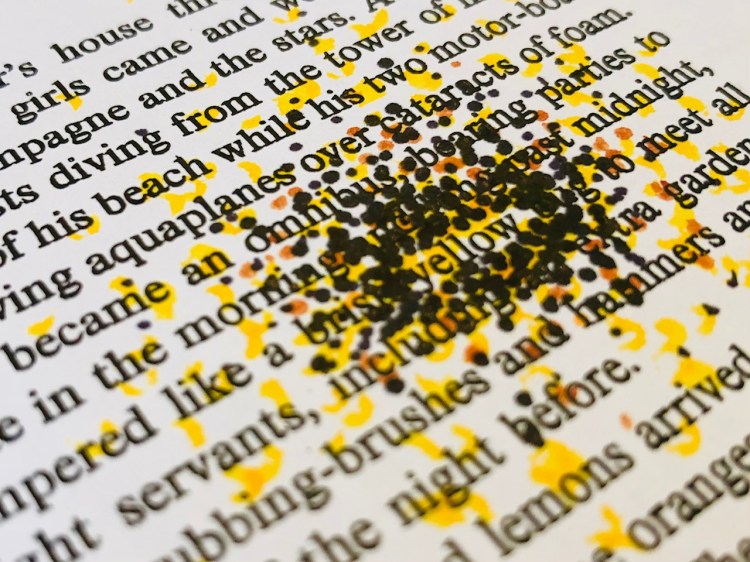
4. Blackout poetry sketchnotes

Blackout poetry sketchnotes

Another way to differentiate sketchnotes is to borrow a technique from blackout poetry. Again, this style of sketchnotes requires some time beforehand so students can read ahead to locate the words they want in their blackout poem. However, during the read-aloud, students are free to listen well since the black lines, for the most part, require minimal concentration.

An idea to make this work better: beforehand, have students draw rectangles around the words they wish to appear in their poems so when the read-aloud begins they can listen closely.

To sum it all up

I hope these “hybrid sketchnotes” ideas will help you switch up your sketchnoting for next year. After all, sketchnoting isn’t a one-size-fits-all process. Some kids grasp the concept and love it and others can’t stand having to do all that drawing while they listen. These alternatives should appeal to the former while serving the latter.

Thanks for reading again this week! I’m interested in your thoughts about sketchnoting and these alternatives. Feel free to leave a comment below or on my Contact page.


Need a new poetry lesson?

Enter your email below and I’ll send you this PDF file that will teach your students to write Treasured Object Poems, one of my favorite poem activities. I know your students will enjoy it!

Image shows readers the paper I'll send for signing up for my email list. The handout gives instructions for a Treasured Object poem.
Treasured Object Poems

Processing…
Success! You're on the list.

Need something else?


Check out my most read post of the year (so far!) at the link below:

Need a fun way to end the year?

Try Headline Poetry for high schoolers.

Headline poetry is awesome. Click here for loads of resources!
Thanks for reading again this week! Feel free to drop me a line by leaving a comment below or on my Contact page.

Seven Articles to Pair with The Great Gatsby

Pair these articles to build context with The Great Gatsby (updated Feb. 2022)

Often when working our way through a novel or info text, it helps to tie that text to current events or contemporary life so students can make connections between what we read and the real world. I always have my antennae tuned for interesting articles, podcasts, or even other texts that correlate with our extended reading units.

I’ve updated this post by adding four more articles, including one brand new (Jan. 3, 2022!) article that connects so exquisitely to Gatsby that I get chills just thinking about it.

So without further ado, here are seven articles to pair with Gatsby, in no particular order:

1. The Epic Rise and Fall of Elizabeth Holmes

This article is almost too good to be true. I mean, how often do you find an article about a current news topic that ALSO contains multiple allusions to a novel you’re reading with your students???

Elizabeth Holmes, Theranos
Photo by Max Morse for TechCrunch TechCrunch, CC BY 2.0 https://creativecommons.org/licenses/by/2.0, via Wikimedia Commons

This Jan. 3, 2022 New York Times story by writer David Streitfeld documents the recent conclusion of the trial of Elizabeth Holmes, founder and former CEO of Theranos, a Silicon Valley medical technology company. Holmes was found guilty of four counts of fraud that each carry a possible 20-year prison sentence for creating, producing, and marketing a portable blood testing service that ultimately, according to investigators and prosecutors, was inaccurate and unreliable. The device had even begun to appear in a few Walgreen’s stores Wellness Centers. A full nation-wide rollout was in the works.

The article draws parallels between Jay Gatsby and Holmes, citing the daily routines each practiced as they reached for self-improvement and prosperity through their ill-gotten wealth.

“Hiding fraud behind the imperatives of secrecy wasn’t the only way Ms. Holmes’s actions were rooted in tradition. Her self-improvement plan dated back to Ben Franklin but found its most indelible expression in F. Scott Fitzgerald’s creation of Jay Gatsby, the mysterious, alluring, handsome millionaire who also ran a few swindles.”

The Epic Rise and Fall of Elizabeth Holmes

The article draws more parallels between Gatsby and Holmes, also invoking connections between the Jazz Age’s Wall Street and our Internet Age’s Silicon Valley.

I used this assignment as a weekly Article of the Week assignment, where I asked students to simply reflect on the article in general. I also required students to discuss the various allusions to The Great Gatsby the writer Streitfeld incorporated in the piece.

Elizabeth Holmes of Theranos at TechCrunch interview
Photo: TechCrunch | Creative Commons | Attribution

This story has been in the news a lot lately and it will be in the news also next fall, when sentencing for Holmes takes place. In other words, this article has legs. Bookmark it for the next time you teach Gatsby.

There’s also a book out by the Wall Street Journal reporter, John Carreyrou. Check out Bad Blood: Secrets and Lies in a Silicon Valley Startup here.

In addition, there’s a movie by the same title in the works starring Jennifer Lawrence as Holmes. Here’s an article about that.

2. When Nostalgia Was a Disease

Without mentioning Fitzgerald’s novel, this short 2013 article indirectly discusses Jay Gatsby’s fascination with repeating the past, which I think can be renamed as nostalgia.

A child swinging on a playground.
Photo by Johnny Cohen on Unsplash

In my experience, nostalgia will be a new word to most students, even though they will likely think of their childhoods with nostalgia.

After talking about what the word means (author Beck breaks down the etymology), I think I’ll connect it to Gatsby himself. Here are Beck’s views on nostalgia:

“Obviously the prevailing view on nostalgia has changed over the years, to the point where we now actively cultivate it with GIF-laden lists and VH1 specials, and rarely, if ever, die from it. But advice on treatment from French doctor Hippolyte Petit is as relevant to someone clinging to the past today as it was to a soldier driven mad by a milking song hundreds of years ago: ‘Create new loves for the person suffering from love sickness; find new joys to erase the domination of the old.’ Or, just let it go.”

from When Nostalgia Was a Disease by Julie Beck in The Atlantic

Some questions this article evokes:

  • Is nostalgia, in essence, what Jay Gatsby suffered from?
  • Should he have instead, as Beck suggests, just moved on?
  • Is there a lesson about nostalgia for readers that Fitzgerald is trying to relate? When does longing for the past become counter-productive or even destructive?

Sidenote and warning: At one point in this article Beck writes, “Some of the symptoms (nostalgia) victims presented with are fairly logical–melancholy, sure; loss of appetite, okay; suicide, upsetting but understandable.” I have a problem with her description of suicide as “understandable.” This seems to be a flippant and dangerous adjective to describe ending one’s life, especially when so many students struggle with depression and suicidal thoughts. Please use this passage with caution.

3. Jay McInerney: Why Gatsby is So Great

This 2021 article from The Guardian has so much to discuss, but beware for spoilers.

Written by my favorite author from the ’80s, Jay McInerney — who wrote Bright Lights, Big City the year I graduated from high school — this article from The Guardian poses many interesting ideas. Here are a few:

  • How does Fitzgerald use, as McInerney writes, Jay Gatsby’s “act of self-invention with the promise of the new world,” as a symbol for what could be called Americanism?
  • Why do Americans consider The Great Gatsby, as McInerney writes, in an “irrational way” as part of our “collective self-image”?
  • How is The Great Gatsby an autobiographical account for Fitzgerald? Take this quote, for example:

“Ultimately, Jay Gatsby’s story mirrors Fitzgerald’s, a poor boy who falls in love with the golden girl and performs heroic feats in order to win the hand of the princess. In Fitzgerald’s case, the princess was Zelda Sayre of Montgomery, Alabama, whom he meets when he is stationed as an officer there. He is engaged to Zelda but eventually rejected when it seems clear that the aspiring writer can’t support her; crawls home to St. Paul, Minnesota, where he writes a novel which makes him rich and famous virtually overnight. In this story the hero gets the girl. Gatsby’s love story seems almost plausible in light of Fitzgerald’s. Although the vagueness of the source of his wealth is almost glaring, the Horatio Alger story, in which poor boys work their way up to wealth and power, was ingrained in the American psyche.”

from Jay McInerney: Why Gatsby Was So Great in The Guardian

McInerney also poses some interesting thoughts about the effectiveness of the myriad film adaptations of the novel, even skeptically pronouncing his intention NOT to see the latest 2013 Luhrman version. McInerney writes, “Fitzgerald’s Gatsby is a very fragile creation, made of words and dreams.”

A hand reaching toward a green light
Photo: Unsplash

That being the case, he argues film versions naturally are unable to convey the character accurately and fully. And that explains, as he adds, why none of the film versions prior to Luhrman’s were very successful (except for a stage version called Gatz that covers the entire novel). (Rest assured, I’ll be checking out Gatz ASAP to provide you with some details on it as well.)

4. Why Do We Keep Reading The Great Gatsby?

In this Jan. 2021 article by Wesley Morris in The Paris Review, the author suggests there are two main reasons:

1) Fitzgerald’s Writing: Morris notes Fitzgerald’s finesse with this passage, “ ‘The cab stopped at one slice in a long white cake of apartment-houses’? That line alone is almost enough to make me quit typing for the rest of my life.” Morris is right. There are so many breath-takingly beautiful images in Fitzgerald’s writing that it makes your head spin. My favorite is the paragraph that concludes chapter 6: “He knew that when he kissed this girl, and forever wed his unutterable vision to her perishable breath, his mind would never romp again like the mind of God. So he waited, listening for a moment longer to the tuning-fork that had been struck upon a star. Then he kissed her. At his lips’ touch she blossomed for him like a flower and the incarnation was complete.”

A photo of the yellow car Gatsby drove in the 2013 movie, The Great Gatsby
The drive to succeed at all costs is symbolized by Gatsby’s “circus wagon” of a car. | Photo: Alan Light | CC BY 2.0 https://creativecommons.org/licenses/by/2.0, via Wikimedia Commons

2) The Book’s Heartlessness: Morris writes that the novel displays the recklessness of the Jazz Age, the drive to succeed at all costs, the disdain for practicality and economy, and the idea of Gatsby as a parody of prosperity after he returns to Daisy with the wealth he needed to win her all those years earlier.

In his article, Morris also touches on the massive technological innovations of the ’20s, namely motion pictures and the ensuing notion of celebrity.

“The motion picture actually makes scant appearances in this book but it doesn’t have to. Fitzgerald was evidently aware of fame. By the time The Great Gatsby arrived, he himself was famous. And in its way, this novel (his third) knows the trap of celebrity and invents one limb after the next to flirt with its jaws. If you’ve seen enough movies from the silent era or what the scholars call the classical Hollywood of the thirties (the very place where Fitzgerald himself would do a stint), it’s possible to overlook the glamorous phoniness of it all. It didn’t seem phony at all. It was mesmerizing. Daisy mesmerized Gatsby. Gatsby mesmerized strangers.”

from Why Do We Keep Reading The Great Gatsby by Wesley Morris in The Paris Review

This fascination — with newness, novelty, and the longing for both the past and the future — forms more layers to interpret ceaselessly in The Great Gatsby. And that’s why I love this book so much. It just has so much to say and think about.

5. The Great Gatsby: What It Says to Modern America

A variety of U.S. cash bills
Image by NikolayFrolochkin from Pixabay

This 2011 BBC News article by Tom Geoghegen touches on several themes in the novel. For example, Geoghegen writes, “‘The novel is not really about the end of the American Dream but the opening up of it,’ says Keith Gandal, a professor at City University of New York.”

“Gatsby’s failure to enter the highest class in social terms and move into that class isn’t about money but the Wasp elite pushing back in the 1920s against ethnic Americans.

Not only do they close ranks against outsiders like Gatsby but they destroy him and escape punishment for it, says Mr. Gandal, which is a very modern theme.

Tom and Daisy just skip off and that resonates more than anything else.

There’s a sense [today] that it’s the super-rich on Wall Street who made this happen. I’m sure that resonates terrifically with middle-class Americans.”The Great Gatsby: What It Says to Modern America by Tom Geoghegan

Even though this article is ten years old and speaks to the 2008 recession, this discussion point is still timely.

Money can provide the means to escape accountability as Tom and Daisy prove after Myrtle’s death.

6. What The Great Gatsby Got Right About the Jazz Age

This 2013 article in Smithsonian Magazine will help you create historical context for the novel, which stems from Fitzgerald’s purpose for writing it.

Times Square, New York City
The rise of media technologies, including radio, led to the celebrity culture that The Great Gatsby reveals. | Photo by Clément Falize on Unsplash

Writer Amy Henderson, a historian at the National Portrait Gallery, cites Fitzgerald biographer Arthur Mizener:

“Fitzgerald wrote his agent Maxwell Perkins in 1922: ‘I want to write something new. . . something extraordinary and beautiful and simple.’ Like today, newness was fueled by innovation, and technology was transforming everyday life. Similar to the way social media and the iPhone shape our culture now, the Twenties burst with the revolutionary impact of silent movies, radio and recordings.”Amy Henderson in What the Great Gatsby Got Right About the Jazz Age

Technology was changing the culture of the country, including introducing the idea of “celebrity.” Much like the Internet has transformed modern society, motion pictures, air travel, and radio transformed the America of the 1920s.

7. The Great Gatsby‘s Copyright is Expiring: What to Know

Use this article to talk about copyright law with your students. You could even ask students to invent ideas for sequels, prequels, and other adaptations of Gatsby since legally they are able to do so since Jan. 1, 2021. Writer Annabel Gutterman writes in TIME in this piece from January:

“…Gatsby enters U.S. public domain on Jan. 1. Literary works are protected from replication for a certain number of years, depending on when they came out. When the copyright for Fitzgerald’s classic novel of greed, desire and betrayal expires, anyone will be able to publish the book and adapt it without permission from his literary estate, which has controlled the text for the 80 years since his death.”The Great Gatsby’s Copyright is Expiring by Annabel Gutterman in TIME

That means that students can create all sorts of Gatsby spin-offs. Here’s an example by author Dick Heese that might spark some creativity:

The Great Gatsby But Nick has Scoliosis by Dick C. Heese
This Gatsby spin-off is also a parody. Find it on Amazon at this link. In it,

According to product information found on Amazon: “Through the use of throw-away references to Nick Carraway’s scoliosis, he (Heese) reimagines the American classic to include the narrator being afflicted with a curved spinal structure. Nick’s mild deformity does nothing to change the original plot of the novel in any capacity. Undoubtedly, F. Scott Fitzgerald’s estate is ruing the release of their copyright into the public domain.”

The expiration of a copyright is a big deal. Get your kids thinking about what that could mean — for better and for worse — to readers, authors, and their family members.

To be sure, many popular early 20th-century literature selections will be seeing their copyrights expire over the next few years. This NPR article, Party Like It’s 1925 on Public Domain Day, discusses this issue and contains links to lists of more books that are now “free for anyone to use, reuse, build upon for anyone — without paying a fee.” Other notable books with expired copyrights: Theodore Dreiser’s An American Tragedy, Virginia Woolf’s Mrs. Dalloway.

An envelope decorated with the words The Great Gatsby
An envelope that will hold the hybrid sketchnotes my students made while listening to The Great Gatsby on Audible.

Some context for this post:

The backstory: Due to popular demand, this spring, I’m giving my juniors a taste of The Great Gatsby by F. Scott Fitzgerald. One Friday in April, I read the first chapter of the famous book (yes, I’m experimenting with First Chapter Fridays this year) and based on that, a few asked if we could read more. “But I don’t have any class sets of Gatsby,” I replied. And then I reconsidered. After all, when you’ve got students asking to read a book, you find a way.

After all, when you’ve got students asking to read a book, you find a way.

So I purchased the audiobook on Audible, assigned hybrid sketchnotes, and timed out the book over the remaining two-and-a-half weeks left of school. And it would have worked perfectly if a couple of unexpected assemblies hadn’t been thrown into the mix. Oh, well. That tends to happen at the end of the year.

But never fear.

We listened anyway and arrived halfway through chapter 7 last week. And while I wished we had had time to get further, I made sure to stop reading at a point where we could do two things: 1) not spoil the rising action and events of this all-important chapter, and 2) still have time to watch the 2013 Baz Luhrman movie version in its entirety without students knowing how the story ends.

So during this quick (and my first!) attempt at teaching Gatsby, I’m feverishly collecting notes and jotting down ideas for my teaching of it next year.

Here’s a list of what I’ve documented regarding Gatsby on my website so far. Check out these resources:


I hope these article ideas and the specific details and passages I’ve pulled from them will entice you to examine them further. Just click on the links and see what you find to discuss with your students.

Teaching Whitman? Here’s an innovative video project I came up with to support Whitman’s Song of Myself.


Need a new poetry lesson?

Enter your email below and I’ll send you this PDF file that will teach your students to write Treasured Object Poems, one of my favorite poem activities. I know your students will enjoy it!

Image shows readers the paper I'll send for signing up for my email list. The handout gives instructions for a Treasured Object poem.
Treasured Object Poems

Processing…
Success! You're on the list.

Need something else?

Feel free to leave a thought, comment, or question in the comments below this post or at my Contact Page. I would love to hear from you!

ELA Brave and True


Featured image: Photo by Saketh Garuda on Unsplash

The Great Gatsby 2013 Film Chapter Breakdown (updated 1/31/22)

How the movie aligns with the novel chapter-by-chapter


Jan. 31, 2022: I’ve been wanting to update this post lately, and since it’s been receiving a lot of views over the past week, I decided to go ahead and make those additions in lieu of this week’s post. In addition to providing the movie start and stop times for each of Gatsby’s nine chapters, I’ve added the dialogue to listen for as you show the movie to students. For myself, I got tired of looking for the time to know when each chapter stopped. So I got smart one day (ha!) and gave the movie another listen, jotting down who is saying what at the conclusion of each scene or chapter. I hope this makes your viewing of Baz Luhrman’s The Great Gatsby viewing more valuable. Enjoy!

Click here to purchase this one-page guide here for $1 on TpT.


Use this guide if you need a chapter-by-chapter breakdown of the 2013 film The Great Gatsby directed by Baz Luhrman. I made this chapter-by-chapter film guide because I couldn’t locate one for my own grade 11 English classes. I am in the middle of planning an admittedly quick unit on F. Scott Fitzgerald’s great American masterpiece chronicling the Jazz Age and the rise and fall of Jay Gatsby.

My classes are listening to the audio version on Audible narrated by Anthony Heald, creating hybrid sketch notes of each chapter drawn on photocopies of the first two pages of each chapter’s text, answering a few comprehension questions for each chapter, and having some brief discussions on various themes of the book.

Read here for last week’s post where I explain how this quick end-of-year unit came about and also offer three ideas for poems to pair with your unit.

Without a doubt, we will be watching Luhrman’s film version after we listen to as much of the book as possible. At this point, I foresee us being able to listen through chapter seven or eight.

This is a photo of my SUPER OLD copy of The Great Gatsby. I’ve marked it up, highlighted, and sticky-noted it to death! (Considering all that, it actually looks pretty good.)

What’s even more challenging is the fact that due to End-of-Course testing and two year-end assemblies, my two sections of ENG III are on different schedules.

It’s basically a planning nightmare, but…

I’m just going to take the remaining time day-by-day and try to squeeze in as much of the reading as possible while still leaving two hours and 23 minutes of time for the movie, which by the way, everyone is very excited about!

As I was planning a few days ago, I wanted to know exactly how well Luhrman’s Gatsby aligns with the novel. To find out, I watched the movie (purchased and streamed on Amazon) with novel in hand so I could follow the film as it progressed through the novel.

So enough already. Scroll no more.

Here are the timed locations for all nine chapters AND the dialogue to listen for as you show the film to your students.

Click here to purchase this one-page guide here for $1 on TpT.


So there you have it. The next time you need to align the movie with the novel, just use this handy guide.

Thanks for reading again this week!

Subscribe and become a follower or sign up for more ideas by entering your email below.

Have a specific need in your lessons, but short on time to research? Leave a message on my contact page and I’ll see what I can do to help!

Marilyn | ELA Brave and True

Need a new poetry lesson?

Enter your email below and I’ll send you this PDF file to teach your students to write Treasured Object Poems, one of my favorite poem activities. I know your students will enjoy it!

Image shows readers the paper I'll send for signing up for my email list. The handout gives instructions for a Treasured Object poem.
Treasured Object Poems

Processing…
Success! You're on the list.

ELA Brave and True


Great Gatsby Featured Photo Credit: Flickr.com | License

Three Poems to Pair with The Great Gatsby

Bring these poems along for the ride to West Egg

Have you ever wanted a few poems to pair with The Great Gatsby? Y’know, a few good, not-too-longish poems to work into a bell-ringer activity, if needed, or use as add-on texts to supplement literary analysis essays?

My junior English classes are reading The Great Gatsby to finish out the year. And it wasn’t on my initial plan.

The Great Gatsby by F. Scott Fitzgerald

We don’t have a class set of these books, after all.

However, after reading Chapter 1 as part of my First Chapter Friday ritual, which I’ve been doing all year btw, a few students expressed disappointment that we weren’t going to read the whole thing.

To capitalize on their engagement, which lags quite a bit lately, I stepped back from my original plan to extend “April’s National Poetry Month” focus with a Dickinson unit.

Instead, I reconsidered. Could I actually make Gatsby work in the short time left in the year?

So my wheels started turning. I looked at the calendar.

We just have time to do it, if I can get over my self-inflicted teacher-guilt that this will be a very abbreviated treatment of one of my favorite novels. This upcoming week, for example, we are going to listen to an excellent audio version narrated by Anthony Heald on Audible, while students take what I’m calling “hybrid sketchnotes.”

An envelope decorated with The Great Gatsby handwriting will be used to hold a student's sketch notes.
One of my students decorated her manila envelope that will hold all nine pages of her “hybrid sketchnotes” she is taking while listening to the audio of The Great Gatsby. My next post will show examples of these notes that are a blending of sketching directly on the text.

That’s a lot of listening and I realize that. That’s why I’m skimming through the chapters, looking for ways to make listening more interactive.

For example, I’m thinking of saying something like, “Okay, when you hear the word ‘hope,’ get up and move to the other side of the room.” It may not play out exactly like that, but I’m mainly wanting to keep them focused on the audio, especially during my fourth hour class, which happens just after they’ve returned from lunch and are full and rested.

But thankfully with Gatsby, the action is fast, the dialogue snappy, and the events fairly easy to follow.

So while I feel that this is one book that can handle a quick unit, I also know we’ll be caught short when it comes to the wealth of discussion and opportunities for in-depth conversations that the book will invariably bring up.

Side note: Yes, once again, I am teaching something for the first time. (Oh my gosh, will this never end?!?! Answer: Yes, it will… on May 18, to be exact.)

A copy of The Norton Anthology of Poetry
This book is old but comprehensive. I snatched it up for only $5 while out thrifting one day!

Anyway, I perused my super-old Norton Anthology of Poetry this morning (we have Mondays off) for poems to pair with the text.

These should work as quick bell-ringers to have students read before we listen to the audio and start sketchnoting.

Next year, when I have my class sets that I just requisitioned, we can use these poems in our literary analysis essays.

So, without further ado…

Here are those three poems to pair with The Great Gatsby:

  1. The World Is Too Much with Us by William Wordsworth
New York City skyline
What would NYC have looked like in Gatsby’s era? | Photo by Anders Jildén on Unsplash

This one, with its “Getting and spending, we lay waster our powers; Little we see in Nature that is ours; We have given our hearts away, a sordid boon!” parallels the heady elation of the Jazz Age. There are moments of introspection on man’s being “out of tune” with “everything” … humanity’s preoccupation with wealth detaches us from our innate connection with the natural world. You get the drift… it’s Wordsworth, and it’s delicious.

2. A Noiseless Patient Spider by Walt Whitman

A spider sits in the middle of a spider web
Photo by YOGESH GOSAVI on Unsplash

I can envision using this awesome little number as a metaphor for Nick. I see Nick as “Surrounded, detached, in measureless oceans of space, Ceaselessly musing, venturing, throwing, seeking the spheres to connect them,” hoping to understand Gatsby’s hope and motivation for reuniting with Daisy.

However, let’s turn it around. How might it apply to Gatsby? Those lines that describe “A noiseless patient spider,… on a little promontory it stood isolated,… launching “filament, filament, filament, out of itself, Ever unreeling them, ever tirelessly speeding them,” paint a picture of Gatsby as he refuses to relinquish hope to repeat the past, in hopes that “the gossamer thread you fling catch somewhere, O my soul.” Hmmm… so many thoughts on this one and how it shows us the inner workings of Gatsby’s mind.

3. The Love Song of J. Alfred Prufrock by T. S. Eliot

A lone figure is silhouetted standing before a large window
Photo by Sasha Freemind on Unsplash

This poem and its complex themes of alienation, modernity, disappointment, and aging echo throughout the novel. Guide students to find connections with these larger themes that permeate literature of the Modern Era.

You can find more literal connections in Prufrock beyond the larger themes, though. Three examples include: 1) the white flannels in the poem that Nick wore in the novel, 2) allusions to romantic hesitation, and 3) urban and sea imagery. It’s obvious that Eliot’s hallmark poem of modernity would make the ultimate poem to pair.

Updated 2/9/23: Please note that since this post originally published, I have created a handy-dandy slide presentation that’s FREE! Go to my FREE RESOURCES page and find it there. It’s a super easy poetry response activity where students draw the mind of J. Alfred Prufrock. Here are some examples from students:

Prufrock Poem Activity

The caveat to using Prufrock is that it will work best with a unit that is NOT abbreviated. So, for next year, this poem will be on my pairing list, but not this year when we just won’t have the time to delve deeply into it. Addendum: The year after this post was published, we spent two class periods studying this poem, doing some close reading in small groups, and creating the project pictured above. Don’t forget to get your FREE Prufrock project slide presentation here.

So there you have it: three poems to pair with The Great Gatsby, a time-honored student favorite. What poems do you use alongside Gatsby? Leave a comment below to let me know or use my Contact page.

And don’t forget… become a follower or subscribe below to catch a future post on “hybrid sketchnotes.”


Need a new poetry lesson?

Enter your email below and I’ll send you this PDF file that will teach your students to write Treasured Object Poems, one of my favorite poem activities. I know your students will enjoy it!

Image shows readers the paper I'll send for signing up for my email list. The handout gives instructions for a Treasured Object poem.
Treasured Object Poems

Processing…
Success! You're on the list.

Looking for something else?


ELA Brave and True


Gulliver’s Travels & The New York Times’ Anatomy of a Scene

Students analyze satire in Gulliver’s Travels

A few weeks ago, my senior British Lit students were studying Jonathan Swift’s Gulliver’s Travels. Our textbook’s excerpt seemed lacking in the scaffolding needed for most of my students, and so I decided for this first year — my first year teaching British Literature — to focus on the story of Gulliver’s Travels as shown in a film version from 1996.

Gulliver's Travels (TV Mini-Series 1996) - IMDb
Gulliver’s Travels starring Ted Danson was produced by Hallmark Home Entertainment

I learned about this particular movie adaptation from a thread in one of the private teacher groups I belong to on Facebook. Another teacher had commented that this version of the story follows the original narrative more closely than any other movie, including the popular 2010 version starring Jack Black.

Intrigued, I decided I wanted to take a glimpse myself, so I began to scour the internet.

Sure enough, I did find it on Amazon and also on YouTube. Even though the YouTube version of it is excellent in video quality and resolution, I did decide to purchase it on Amazon in case it’s ever removed from YouTube.

Anyway, this 1996 version from Hallmark Home Entertainment is excellent. The cast is well-known and diverse, and includes Mary Steenburgen, Peter O’Toole, Sir John Gielgud, Alfre Woodard, Omar Sharif, Kristin Scott Thomas, and more. In addition, the special effects, which are obviously dated, have held up well over time.

Even though my own exposure to Gulliver’s Travels before this unit had mainly been from a children’s storybook version, I found this movie the perfect way for my students to get a taste of Swift’s story complete with his biting satire.

The complete movie runs about three hours long. I initially intended to watch only the first half, which includes the first voyage to Lilliput and the second one to Brobdingnab; however, when the first half ended with the floating island of Laputa flying overhead, my students were so curious, I just decided to watch the entire film, which culminates with the fourth voyage to the Houyhnhnms.

I wouldn’t have done this much movie-watching if I hadn’t also purchased a movie viewing guide on TpT from Sherron McMillan. The guide was definitely needed to help students follow the action, which does admittedly become slightly confusing due to some frequent flashback scenes. It also helps students locate and analyze the satire.

20 Classics #8: Gulliver's Travels by Jonathan Swift – LiteraryMinded
Ted Danson plays Dr. Lemuel Gulliver in Hallmark Home Entertainment’s Gulliver’s Travels. Search for it on Amazon or YouTube.

Now, looking back to a few weeks ago, this Ted Danson version of Gulliver’s Travels is an excellent alternative to reading the text, which in my opinion was one of the more difficult texts I had read with my class all year.

Delve a little deeper

After watching the movie, I wanted to delve a little deeper into a study of the mellower Horatian satire that Swift uses in Gulliver’s Travels.

Somewhere in my research I had learned about how The New York Times’ Anatomy of a Scene collection can provide interesting ways to teach texts and films, and specifically, to help students think deeper about the decisions that writers and directors make in the creation process.

Photo by Denise Jans on Unsplash

Help students think like authors and directors

Creating an “anatomy of a scene” encourages students to think more broadly about a text and/or its filmed adaptation. To better wrap my own mind around the concept, I read this article written by educator Julie Hodgson on the New York Times website about how she uses these two- to three-minute videos.

“In these short clips, film directors narrate a scene from one of their movies, walking viewers through the decisions they made and the effects they intended them to have,” writes Hodgson. “These videos demonstrate to students how to step outside of their personal reader-to-text experiences and examine literature from a wider lens — to see a story, memoir, essay or poem from the perspective of its creator.”

Julie Hodgson | The Learning Network at The New York Times

This sounded interesting, so I nosed around on the NYT website and came up with an idea for students to create their own “anatomy of a scene” from the Gulliver’s Travels movie we had just finished.

To introduce the whole “anatomy of a scene” concept, I showed students three examples from the NYT collection. Here’s a link to the anatomy from the movie, A Quiet Place.

I also showed students the “anatomy of a scene” from the 2019 version of Little Women below.

And for good measure, I finished with this clip from the Harry Potter franchise:

After showing them just three examples from the entire 260-plus NYT “anatomy of a scene” collection, it was time to provide some instructions and an example made by Yours Truly.

Here are the instructions I created for this assignment:

  • Imagine yourself as the director of Gulliver’s Travels. You have recently finished shooting the movie and you’ve been asked by the New York Times to narrate a scene for its Anatomy of a Scene collection, similar to the clips from the movies, Little Women, A Quiet Place and Harry Potter.
  • Scan back through the movie using the links on Google Classroom and choose an important 1-3 minute scene to narrate for the class.
  • Make sure to discuss two or more elements of the film, such as setting, characters, mood, camera angles, sounds, costumes, lighting, special effects, props, and any others elements present in your scene.
  • Make sure to also discuss satire. Based on what you know about the story, using the Lit Charts summaries and “The Satire of Gulliver’s Travels handout below, what is Swift commenting on?  How is Swift’s satire evident in your scene? 
  • Record your narration on your cell phone. Also, in the beginning of your narration please tell us the “minutes and seconds” location of your scene, so I can easily locate your particular clip.
  • Turn in your audio file on Google Classroom. If they had trouble doing that, I asked them to email it to me instead. It was the first time I’ve had then submit audio files in this way, so I was a little unsure about how it would all work on the technical end.

Well, whether they turned in their audio files on Google Classroom or merely emailed it to me, this project worked very well! All I had to do was open their file, listen for the location of their clip, open a new tab for the movie, find the clip in the movie, mute the video (or turn the volume down so the audio commentary can be heard), and then play both simultaneously. My computer speakers played the sound as the video played on my slide screen.

It worked!

Just as I hoped they would, the students’ “anatomies of a scene” emulated those on the New York Times site.

They were able to speak as if they were the directors, creating commentary on lighting, setting, props, and whatever else they chose to highlight. As stated in the instructions, they also discussed the satire shown in the clip.

Below, you’ll find the “mentor” audio I made to show students an example of what they were supposed to do.

To show this example to you in this post, I merely played the audio files while also playing the movie on my TV at home. In other words, you’re actually watching the movie clip play on my small-ish TV screen at home. The same goes for the two student examples that follow.

The mentor I made for students:

One student’s anatomy of a scene:

And one more…

This assignment ended up being an easy, fun, and relatively quick way for students to identify and expound on the satire in this particular work of Swift’s.

Have you ever used the New York Times’ Anatomy of a Scene collection? How did it go? Was it beneficial? Feel free to weigh in with your experiences or ideas about this particular post.


…Or try this new poetry lesson!

Enter your email in the box below and I’ll send you this PDF file you can use tomorrow to show your students how to write Treasured Object Poems, one of my favorite poem activities. I know your students will enjoy it!

Image shows readers the paper I'll send for signing up for my email list. The handout gives instructions for a Treasured Object poem.
Treasured Object Poems

Processing…
Success! You're on the list.
Student and teacher selfie
That’s me on the left with a former student, Hailey B.

Paradise Lost: My British Lit Students Translate Lines into Braille

And cultivate empathy for the visually impaired

At the conclusion of our short unit on the English poet John Milton’s Paradise Lost, I decided to do something totally different. We had spent a few days reading, discussing, and answering questions about the poem and its story about the Fall of Man. After these activities, it felt like it was time to move on, but I did want to spend a couple more days working in a creative way with the text.

To do so, we produced a few passages of Paradise Lost in Braille and then asked a fourth grader at our school, Finley Mabary, who is visually impaired, to visit our class to check our work.

Students read Braille text of John Milton's Paradise Lost.
Fourth-grader Finley Mabary, who is visually impaired, reads lines from Paradise Lost that had been produced in Braille by my seniors.

I’m not sure where the idea to reproduce some poetry in Braille came from, but it seems that I had read about World Braille Day on January 4, which is also the birth anniversary of the code’s French inventor, Louis Braille. Braille, published his military-inspired system of dots in 1829 at the age of fifteen. Here’s the video we watched in class at the beginning of the activity:

When I first brought up the project idea to my students, they were on-board. Even though they had all heard of Braille, they didn’t know anything about how to create it. However, by the end of the project, it was fun to hear them start to recognize the dot patterns for some of the most frequently used letters codes and to hear them identify the individual dots by numbers one through six.

As for myself, I’ve always possessed a curiosity about Braille. I distinctly remember seeing a Braille card at the public library in my hometown. All those raised dots intrigued me and to this day, I run my fingers over those six-dot cells whenever I notice them next to a hotel door, on an elevator, or at a archaeological site like this one we saw two years ago in Delphi, Greece.

A historical marker in Braille in Delphi, Greece.
You’ll find Braille around the world. I was intrigued by this historical marker at the archaeological site in Delphi, Greece during a trip there during the summer of 2019.

My first step in the project was to purchase some Braille slates. I ordered three two-packs of this style. They cost $13.99 for each two-pack, including shipping. Each slate comes with a stylus for punching the dots.

Braille slates

I experimented with the slate and stylus before bringing them to school for students to use. I quickly realized that this would be more involved than I initially thought it would be.

I watched this video from the National Federation of the Blind to learn how to use the slate and stylus.

Things got complicated

If you watch the video, you’ll see how this project quickly became more challenging than I initially thought.

Since you’re embossing dots into the paper, you must work “backwards.” The paper you’re impressing will be turned over when it’s removed from the slate, so you must emboss the words from right to left on the slate. To compound the complexity, one must also “flip” the dots in each cell so when the paper is turned right side up, the dots read correctly.

Learning Aid in Braille and Typography | SpringerLink
I made several copies of this handout from the National Braille Press for students to reference as they reproduced lines from Milton’s Paradise Lost.

I decided to make a special graphing sheet for students to use as they embossed their lines from Paradise Lost. The sheet basically allows students to plan out their words and dots beforehand and then also check their work before even starting to emboss or “punch” the cardstock paper. This short video explains how the graphing sheet works.

Over the course of two class periods, students used the graphing sheet to plan out and emboss their lines from Paradise Lost in Braille.

The room was quiet as students worked

During the project, my students were engaged and the room was silent with concentration as they worked. Without a doubt, writing backward and reversing cells of dots was tedious and time-consuming!

Here’s the bulletin board I made at the completion of the project. The board displays the two lines of Paradise Lost that each student reproduced in Braille.

Bulletin board with Braille excerpts created by high school students

Once students finished embossing with the stylus, they cut out their lines and then mounted them on construction paper. Then they handwrote or typed out those same lines in English (as a sort of key) and attached them under the Braille sheet.

Elementary students read Braille created by high school seniors.
Finley Mabary and his brother Ralph enjoyed visiting my high school seniors to check their Braille translations.

The final step was inviting Finley Mabary, his brother Ralph, and their mother Ashley, to my classes to try their hands at reading the Braille.

To read Braille, the pads of Finley’s index fingers work in unison to feel their way, cell by cell, over each word. He holds his right index finger stationary alongside his left index finger to keep it aligned on the row of cells. His left finger is the one that actually decodes all those dots.

For the most part, my seniors produced some admirable and readable coding. Yes, there were mistakes. For example, some of the letters were incorrect. Some of the one-dot cells that denote capital letters had been inadvertently omitted. Also, our punctuation wasn’t 100 percent, but for an initial introduction to this global coding system, I think they did pretty well.

John Milton dictating to his daughters the text of Paradise Lost.
This engraving shows John Milton dictating to his daughters. | Photo: CC BY 4.0 https://creativecommons.org/licenses/by/4.0, via Wikimedia Commons

Did you know?
The famed poet John Milton (1608-1674) became blind at the age of 43. He dictated his most well-known poem, Paradise Lost, to others, including his daughters as shown in the engraving above. Paradise Lost was first published in 1667.

Encyclopedia Britannica

In addition, Ashley Mabary said that visiting the seniors was a real treat for Finley and Ralph whose impressive Braille-reading skills are growing quickly.

On the left is a closeup of one’s student’s two lines from Paradise Lost. In the image on the right, you can see the translation.

If only empathy were a standard

No, producing Braille text does not meet an English or ELA standard in my classes, but if empathy for the visually impaired were a standard, my students would have mastered it for sure!

Overall, my students were intrigued by trying something new and were surprised at the complexity of this task. In addition, they seemed to enjoy the break from the day-to-day reading and writing that makes up a large portion of my British Literature classes.

Want to try it?

The next time you need a break from the regular routine, consider introducing your students to Braille to expose them to something new.

If you’d like a copy of the worksheet I made for this project, please leave me a comment on my contact page or leave a comment below. I’ll be glad to help you do this project with your own students.


Try this new poetry lesson!

Enter your email in the box below and I’ll send you this PDF file you can use tomorrow to show your students how to write Treasured Object Poems, one of my favorite poem activities. I know your students will enjoy it!

Image shows readers the paper I'll send for signing up for my email list. The handout gives instructions for a Treasured Object poem.
Treasured Object Poems

Processing…
Success! You're on the list.

Thanks for reading again this week!

Become a follower, subscribe, or leave a comment here to request that I cover/investigate a topic or lesson idea.

The Dream of the Rood: A Dream of a Poem

Plus: an initial reading resource

During this, my second year teaching junior and senior English, I’ve been teaching loads of content I’ve never taught before. Prior to my current position, I taught middle school ELA for eight years. Gone are the days of Chasing Lincoln’s Killer, I Am Malala, Flesh & Blood So Cheap and all the other texts I was so accustomed to teaching.

Now, I’m teaching the full scope (yikes!) of British Lit to my senior classes.

So far this year, I have introduced my students to the major Anglo-Saxon elegy poems; Beowulf; Le Morte d’Arthur; The Canterbury Tales; Everyman, the morality play; the sonnets of Sidney, Shakespeare and Spenser; Marlowe’s Dr. Faustus, Milton’s Paradise Lost, Swift’s Gulliver’s Travels and “A Modest Proposal,” and probably a few more that I can’t think of off the top of my head.

Oh, yes… and I can’t forget the Anglo-Saxon dream vision poem “The Dream of the Rood!”

How to describe this jewel of Anglo-Saxon poetry? In short, it’s beautiful, imaginative, accessible, and probably one of my favorite texts we’ve studied all year. And that’s surprising because I could have so easily missed it as I planned out my lessons.

At right is a photo of my Prentice-Hall textbook. Despite being quite old, it’s a solid resource.

Last fall, as I read and planned lessons for Beowulf, “The Wanderer,” and “The Seafarer,” I kept coming across “The Dream of the Rood.” For example, in the documentary In Search of Beowulf, the narrator Michael Wood mentions the poem as a pivotal text. (By the way, rood means cross or pole and in the poem an unknown poet dreams that he meets the tree upon which Christ’s crucifixion took place.)

However, since “The Dream of the Rood” wasn’t included in our Prentice-Hall British literature textbook, I dismissed it initially. But then it kept popping up, and and since it was included in my trusty Norton anthology, I became more and more curious.

Eventually, I decided to add it — however briefly — to my curriculum. And I’m so glad I did.

My close reading activity for “The Dream of the Rood” includes a key and will guide your students through this beautiful poem. Order it on TpT.

At the time, I was homebound with Covid-19 for a solid two weeks. On one of those days, I decided to create a worksheet of sorts that would 1) give students a taste of this beautiful old poem and 2) guide them through an initial reading of the poem.

To do this, I created a “Dream of the Rood” initial reading worksheet with key. I’ve made it available for purchase here on my TpT store, where believe it or not, it’s the ONLY resource on the entire site for the poem.

The activity features an introduction to the poem and then fill-in-the-blank portions for each of three different sections of the reading, which is based on the prose translation by E. T. Donaldson found in the Norton Anthology of English Literature (through the eighth edition).

Check out my Dream of the Rood Reading Activity here on Teachers Pay Teachers.

Side note: I will be creating a similar activity for the current alliterative verse translation by Alfred David soon.

Learn more about this old, old poem

In case you’re unfamiliar with “The Dream of the Rood,” here’s how the encyclopedia Britannica describes this beautiful poem:

The Dream of the Rood, Old English lyric, the earliest dream poem and one of the finest religious poems in the English language, once, but no longer, attributed to Caedmon or Cynewulf:
In a dream the unknown poet beholds a beautiful tree—the rood, or cross, on which Christ died. The rood tells him its own story. Forced to be the instrument of the saviour’s death, it describes how it suffered the nail wounds, spear shafts, and insults along with Christ to fulfill God’s will. Once blood-stained and horrible, it is now the resplendent sign of mankind’s redemption.
The poem was originally known only in fragmentary form from some 8th-century runic inscriptions on the Ruthwell Cross, now standing in the parish church of Ruthwell, now Dumfries District, Dumfries and Galloway Region, Scot. The complete version became known with the discovery of the 10th-century Vercelli Book in northern Italy in 1822.

Britannica, dream of the rood

Eighteen verses of “The Dream of the Rood” are found on the Ruthwell Cross (680 AD) inside the Ruthwell Parish Church near Dumfries in southern Scotland, part of the former kingdom of Northumbria.

This photo is taken inside the Ruthwell Parish Church, which houses the Ruthwell Cross, the 18-foot Anglo-Saxon cross that was possibly used as a conversion tool. It contains an inscription in runes of a version of Dream of the Rood. Photo: Heather Hobma, CC BY-SA 3.0 https://creativecommons.org/licenses/by-sa/3.0, via Wikimedia Commons

The cross, which is mentioned in Michael Wood’s documentary Beowulf on YouTube, is thought to be one of the most impressive Anglo-Saxon Era monumental sculptures in existence. “Featuring intricate inscriptions in both Latin and, more unusually for a Christian monument, the runic alphabet, the Ruthwell Cross is inscribed with one of the largest figurative inscriptions found on any surviving Anglo-Saxon cross,” according to Visit Scotland, Scotland’s national tourist board.

A picture is worth a thousand words

Showing students images from Dumfries and of the Ruthwell Cross will provide a real-world angle to their reading of the poem. Showing images and taking virtual tours when they’re available has been a real help to me this year. I like to “travel” in my British lit classes as much as possible to show students the actual landscapes from which our texts descend.

Ruthwell Paris Church, Scotland | Photo: DeFacto, CC BY-SA 4.0 https://creativecommons.org/licenses/by-sa/4.0, via Wikimedia Commons

Writing for an audience

Just as we teach students to write for an audience, “The Dream of the Rood” was written with its own audience, the pagan Anglo-Saxons.

Some scholars believe “The Dream of the Rood” may have been a tool to gradually convert Anglo-Saxons to Christianity.

The idea of Christ as a hero who bravely conquers death upon the cross may seem foreign to contemporary Christians, but that kind of heroism likely appealed greatly to Anglo-Saxon warriors.

The personification of the cross by the poet is also a fresh, unusual approach and provides a clear and extended example of this literary device in Anglo-Saxon poetry. (In the poem, the anonymous author tells of a cross that feels duty-bound to provide the foundation upon which Christ may show his heroism.)

If you teach British literature, consider giving your students a taste of this beautiful, imaginative poem.

Even if it’s not included in your current text or curriculum, it’s worth checking out.

Thanks for reading again this week!

Become a follower, subscribe, or leave a comment here to request that I cover/investigate a topic or lesson idea.

I’m eager to hear your feedback!

Try this new poetry lesson!

Enter your email below and I’ll send you this PDF file you can use tomorrow to show your students how to write Treasured Object Poems, one of my favorite poem activities. I know your students will enjoy it!

Image shows readers the paper I'll send for signing up for my email list. The handout gives instructions for a Treasured Object poem.
Treasured Object Poems

Processing…
Success! You're on the list.

ELA Brave and True


ELA Brave and True | Stay passionate about ELA.

Featured Photo by Aaron Burden on Unsplash

A New Movie for Your Anglo-Saxon Poetry Unit

Netflix’s The Dig is worth a watch

Make a multi-media connection during your Anglo-Saxon poetry unit with The Dig from Netflix. The movie, released in January, recounts the 1939 discovery and excavation of the mammoth Anglo-Saxon archaeology site known as Sutton Hoo in Suffolk, England.

Actor Ralph Fiennes
Ralph Fiennes, and at right, Carey Mulligan | Ralph Fiennes Photo: Siebbi, CC BY 3.0 https://creativecommons.org/licenses/by/3.0, via Wikimedia Commons

The Dig, rated PG-13, stars Ralph Fiennes as self-taught archaeologist and astronomer Basil Brown and Carey Mulligan as the wealthy widow who owned the property that held the famous site, including the 90-foot Anglo-Saxon ship, which served as a tomb for a warrior-king… similar to that of King Tutankhamun.

The 1-hour and 52-minute movie is captivating, and builds suspense and excitement around the very culture awash in the elegies The Wanderer and The Seafarer, and even the epic Beowulf.

On the eve of World War Two, as the Sutton Hoo ship’s remains and its treasures were being unearthed on property owned by wealthy landowner Edith Pretty, many archaeologists at the time assumed the finds would date from the Viking era.

However, self-taught archaeologist and astronomer Basil Brown, the site’s excavator hired by Pretty, suspected the artifacts might be older and Anglo-Saxon. He was right… and the rest is history.

I think I’ll show The Dig’s first sixty or so minutes.

I’ve watched The Dig three times (so far) and I plan to use only the first sixty minutes of the movie with students. The film’s storyline does meander significantly from the main plot of the excavation into the “not historically accurate” professional and personal lives and loves of other on-site professional excavators.


I’ve created a viewing guide with key for The Dig. Click here for the guide.

The first sixty-six minutes contains the major moments of discovery without delving into the story’s subplot, which in my opinion, seems a little disjointed and beside-the-point to the movie. In fact, this is where the movie really starts to veer from its historical base. (Don’t you hate it when that happens?!)

Read this Roger Ebert movie review, which makes this same point here, highlighting the film’s best moments:

Told with simplicity and grace, and a sensitivity to the pastoral Suffolk landscape of wide fields and wider skies, “The Dig” is often quite thrilling, particularly in the dig’s initial phases, when it’s just Basil and Edith discussing how to proceed. 

Sheila O’Malley | rogerebert.com
Sutton Hoo helmet
The famous Sutton Hoo helmet found at the site. The Sutton Hoo collection is found in Room 41 at the British Museum. | Photo: Jim Brewin of Pixabay

Need a text as you dive into the film?

Yes, there is the 2007 novel by John Preston (nephew to one of the site’s archaeologists) by the same name that the movie is based on.

And honestly, based on this review, it sounds like a great book to add to my summer reading list, so be watching for a review later this fall.

However, for a shorter text to use in class, use Revisiting Sutton Hoo, Britain’s Mythical Ship Burial from The New Yorker to acquaint your students with the entire Sutton Hoo story.

I used this article to build an Article of the Week assignment last fall (2020) as my students were transitioning from Anglo-Saxon poetry to our Beowulf unit. The article will be a good introduction to Edith Pretty and Basil Brown and will provide your students with more archaeology background before viewing the film.

Side note: This article is an awesome “blended genre” mentor text that weaves narrative with exposition.

After the movie, take a virtual tour of the treasures.

Here’s a quick shot of Room 41 at The British Museum. Students can take a virtual tour.

Have your students visit The British Museum via Google Arts and Culture Street View to tour Room 41, where the Sutton Hoo treasures are displayed. Loads of artifacts, including the famous Sutton Hoo helmet, are presented to further ground the film in history.

Whether you add the movie, the article, or the novel to your Anglo-Saxon poetry unit, know you’ll be helping students make useful connections as they experience the foundational texts of the English language.

This fall, I’m adding more film to Brit Lit.

My goal is to pair each of the texts we study with a quality film adaptation or a film as closely related to the text as The Dig is to Anglo-Saxon poetry.

It’s no secret that adding film can strengthen a text-heavy curriculum.

“Film can be used effectively in almost every English language arts classroom and elective. For example, you can easily pair movies with literature, such as a coming-of-age movie when you’re studying Catcher in the Rye.”

Education Week article by Nancy Barile

Offering a mix of media also meets standards intended to appeal to students with different learning styles. In short, adding quality layers of media (and film is just one) can enhance and strengthen our learning.

Photo: Unsplash

Similar text and movie combos should help me better engage my Brit Lit students in many of the classic texts that have formed the foundation of Western literature.

After all, Anglo-Saxon poetry is far removed from contemporary life.

Whisperings from an ancient seaborn past, the poetry seems inaccessible to many teens. However, when you incorporate contemporary media such as The Dig, you’ll help students make connections to their lives today. As a result, they’ll more likely appreciate the insights these ancient verses offer on universal themes and concerns such as isolation, loss, and grief.

See you at the movies!


Try this new poetry lesson!

Enter your email below and I’ll send you this PDF file you can use tomorrow to show your students how to write Treasured Object Poems, one of my favorite poem activities. I know your students will enjoy it!

Image shows readers the paper I'll send for signing up for my email list. The handout gives instructions for a Treasured Object poem.
Treasured Object Poems

Processing…
Success! You're on the list.

Looking for something else?

Follow my blog for more ELA teaching posts! Thanks for reading again this week!

I work in a district with four-day weeks. I publish a new post every Monday when I’m at home writing, reading, doing laundry, you know the drill…

Hey, look! More British literature posts!

Thanks for reading!

ELA Brave and True | Love teaching. Make it memorable.

The Slice of Life Poem

Elevate everyday moments with this creative poetry idea

“Slice of Life” writing is one of my favorite genres. You take an ordinary moment — one you commonly do on a regular day — and elevate that moment by honoring it with about 250 words of prose. I first learned about “slicing” at Two Writing Teachers, where every Tuesday, writing teachers from all over the country post some personal writing of their own on the TWT blog.

Slice of Life writing logo from Two Writing Teachers website
Visit twowritingteachers.org for more information about slice of life writing.

I’ve enjoyed writing and posting several slices over the past couple of years, and have enjoyed even more sharing this genre with my middle school and high school students. (Read about slice of life essays for both middle school and high school students in these past posts from my blog.)

Recently, it occurred to me that slice of life prose writing would work equally well in poetic form. In fact, if generating a page of prose seems daunting for some of your students, perhaps suggest the option of writing a free verse poem instead.


Side note: Two Writing Teachers hosts a month-long slice of life story challenge every March for teachers and their students. Visit this site for more information. I haven’t tried it yet, but I keep mulling it over every year. Maybe in 2022?


Try these ideas to guide your students to awesome slice of life writing in poetic form:

  • For structure, suggest to your students that their slice of life poems should be from ten to twenty lines in length. Yes, that’s a fairly broad range, but it also differentiates for varying ability levels.
  • Remind students to write about an ordinary moment or task. An ordinary moment can be anything they do in the course of an ordinary day, such as feed a pet, grocery shop with a parent, or suit up for practice.
  • Steer them from the tired topic of “my morning routine.” The solution? Have students take one task from their morning routine and focus on it only. (If I don’t challenge students away from their morning routine as a topic, one-third of the poems I receive will start, Buzz!!! My alarm goes off and I hit the snooze button... blah blah blah.)
  • Ask students to title their poems. If they struggle thinking of titles, suggest they search within the lines of their poems for interesting phrases that would make provocative titles.
  • Provide a mentor text of a slice of life poem. Feel free to use the one below I wrote recently about handwashing Tupperware… or better yet, write one with them!

Tupperware and Diligence

Last night,

I washed a collection of

knock-off Tupperware:

ovals, squares, rectangles,

all the annoying, ill-fitting lids.

Now,

after sleep and as coffee brews,

I lift the geometry

from the drying rack.

Icy threads race from

wrist to elbow,

sloughing off water

that had secreted away

into plastic frontiers…

crouching inside peripheral grooves

and shallow recesses, lying low

within raised feet that harbor

capacity specs, country of origin logos,

washing instructions, recycle-me threats.

Now:

to dry fully with a cloth

or simply toss, still dripping,

into the designated drawer?

Diligent-but-not-too-diligent,

I toss and move on

to the next

kitchen task.

M. YUNG
Photo by Dollar Gill on Unsplash

In the Missouri Learning Standards for ELA, writing slice of life poems satisfies standards (W2A) that require students to craft narratives about real or imagined experiences. Skim through your state’s standards to see which ones you’ll meet with these engaging and very personal poems.

I’m sure it won’t take long to see that slice of life writing — whether prose or verse — helps you do your job, while showing your students another way to express themselves creatively.

Thanks for reading! Click like and feel free to follow my blog for future posts!

Visit my site shop for this Slice of Life Narrative Essay assignment. This might be just the ticket to ease your students into a Slice of Life poem or essay activity.

Need a new poetry lesson?

Enter your email below and I’ll send you this PDF file you can use tomorrow to show your students how to write Treasured Object Poems, one of my favorite poem activities. I know your students will enjoy it!

Image shows readers the paper I'll send for signing up for my email list. The handout gives instructions for a Treasured Object poem.
Treasured Object Poems

Processing…
Success! You're on the list.

ELA Brave and True