The Favorite Place Poem

Have students create content with a poem about their favorite place

Many of my students are reading poetry. On Instagram. Okay, okay… I know. But whether or not you take verse found on Instagram seriously, poetry is experiencing a resurgence in popularity… thanks to social media, where many poets, including Rupi Kaur and others, gain exposure. That exposure is fueling a new audience seeking out poetry volumes in stores and online. According to this October 2018 article in The Atlantic,

“This year, according to a survey conducted by the National Endowment for the Arts and the U.S. Census Bureau, 28 million Americans are reading poetry—the highest percentage of poetry readership in almost two decades. Kaur’s publisher, Kirsty Melville, has seen it happen firsthand: ‘It used to be that poetry was down in the back of the store next to the bathrooms, and now it’s out front,’ she told us. ‘And that naturally helps sales of all poets. The classics and other contemporary poets are selling.’ “

How Instagram Saved Poetry | The Atlantic | Faith Hill, Karen Yuan | Oct 2018

Chances are many of your students are familiar with Kaur. They are also probably familiar with Atticus. Go ahead and drop these well-known names into your class discussions. Trust me, if you don’t know these two celebrity-poets, several of your students do.

And then, invite your students to not only consume content, but to create some as well.

One way to start: write a favorite place poem.

Whether you call them favorite place poems or sacred place poems, getting students to focus on and write a poem about a place they enjoy has many benefits. For example, favorite place poems let students:

  • Spend time thinking about a positive topic.
  • Recall a pleasant memory.
  • Practice their descriptive writing skills.
  • Reveal something new about themselves.

Favorite place poems were one of the options among several writing projects in my high school Writer’s Workshop schedule last fall. Here are the basic guidelines I offered to students:

  1. Choose a special place to write about. This could be either a physical space or a figurative place, as in the mentor poem on the PDF printable.
  2. In a free verse poem, describe the place and how it makes you feel when you’re there. Students should challenge themselves to generate as much sensory language as possible by focusing on sounds, smells, textures, and tastes, and sharp visual descriptions.
  3. Use figures of speech. Include metaphor, simile, hyperbole, onomatopoeia, personification, repetition, and alliteration.
  4. Length: 20-24 lines.  Use your judgment when assigning a certain number of lines. Some students need the structure; many don’t.

You’ll find a PDF file of these instructions after the two student-written examples that appear next.

Two student examples:

Madison, one of my junior English students last year, wrote about her favorite place in the poem below. After two revisions, she submitted this as part of her writer’s studio portfolio.

My Favorite Place to Be

"Madison Ponder on deck!"
As I hear my name, I burst up onto my feet and stretch.
Preparing myself to throw,
I concentrate on my muscles.
"Madison Ponder is up,
Emma Bloom on deck,
And Amy Matthews in the hole!"
I take a deep breath and enter the ring from the back.
I touch the the board with the tip of my feet,
Turn around,
And take two strides to the back of the ring.
I feel the heat radiating on me
I take a deep breath and move into position,
When I throw my shot, I watch it go far and high.
I then hear it land with a big thump.
"38 feet and 10 inches."
I smile and exit the back of the ring.
Two hours later
"With the first place in shot put,
From Southwest Missouri,
Madison Ponderrrr!"
I smile proudly and say to myself,
This is my favorite place to be.

Another student, Grady, wrote a favorite place poem about working at a cattle auction sale barn.

The Sale Barn

The smell of sweat and cigarettes fill the air. 
The clink of the gates rattles and 
The sound of cows bawling surrounds me. 
The horses stomp their feet 
And pin their ears back 
As the rider pulls the gate. 
The cows just sold by the auctioneer 
Come running down the alley. 
Dust flies in the air and the riders take off. 
The gates slam behind the cows as they run in. 
Everyone returns to their spot. 
Twelve hours a day. 
This is home. 
This is the sale barn. 

The 2019-2020 school year was my first year teaching high school at a new-to-me rural school district. Being “the new teacher” last year was really hard at times. However, assigning, reading, and otherwise working on these poems with my new students opened up conversations for us to get to know each other better. After all, a novel study doesn’t regularly reveal the after school or weekend lives our students know.

I’m positive you’ll experience the same opportunities when your students write their own favorite place poems.


Download this favorite place poem assignment sheet:


And I use the term “assignment sheet” loosely. It’s more of a list of guidelines. Adjust them to fit your teaching style and students.

Of course, distance learning could (and should!) involve some creative writing. Students could post and share their poems on a Padlet, for example. Then host a virtual gallery walk where students post feedback on a few. Some students may wish to post their poem on social media or enter it in a contest. In other words, let your students’ words about their favorite places circulate beyond your desk. Get them out into the real world.


Thanks for reading! Have you used favorite place poems in your classes? Got any ideas other readers (including me!) should know about? Share away in the comments below! Also… for more ELA teaching ideas and lesson plans, add your name to my mailing list below:

Processing…
Success! You're on the list.

Call for submissions: Frederick Douglass wants your students’ essays

Give students a real-world audience

This morning, I learned about an organization taking essay submissions from students around the world for possible online publication.

Photo: Wikimedia Commons

The organization is called Frederick Douglass Family Initiatives. Founded in 2007 and based in Rochester, NY, FDFI is  dedicated to the legacy of the abolitionist Frederick Douglass and the vision of “a more equitable world without slavery or racism.”

FDFI wants your students’ “best words and ideas” for its Douglass Mind Blog.

What remedies do your students advocate to confront and end racism in the world today?

In the words of FDFI co-founder Kenneth B. Morris, Jr., great-great-great grandson of Douglass and great-great grandson of Booker T. Washington:

“For those of you feeling so much anger, so much frustration, this may not be the answer you’re looking for, but it’s a fact: Frederick Douglass would express his rage through words.”

Kenneth B. Morris, Jr.

Watch this video narrated by Morris about the contest’s goals:

Find this and other Frederick Douglass Family Initiatives videos on YouTube.

Know a young writer who may wish to express their thoughts on racism with their words? Here are three steps they should take:

  1. Reference mentor essays. Read these other entries already published on the Douglass Mind Blog here. Of the ten essays that appear, all the writers are teens except for one. One entry is from a student in Sri Lanka. Here are links to five of the essays:

2. Read Douglass’ 1881 essay, “The Color Line,” to gain more knowledge about Douglass’ philosophy on prejudice and racism, especially with regard to the African-American experience. In one portion of the essay, Douglass writes, “Prejudice against color is… “a moral disease…” Calling prejudice and its cousin, racism, a moral disease conveys a distinct nature of sickness, of disorder. Several essays already on the blog capitalize on this idea and draw connections between illness and racism.

3. Cite any sources used in a bibliography.

4. Enter your best writing online at the FDFI website by scrolling to the bottom of the page at this link.


Marilyn Yung

Thanks for reading!

I’m a huge fan of writing contests for how they motivate students to write for a real-world audience. Getting their words in front of readers outside of the school setting engages and builds relevance like nothing else! Check out my growing list of writing contests.

To make a comment or ask a question, use my Contact page.


Need a new poetry idea?

Enter your email below and I’ll send you this PDF file that will teach your students to write Treasured Object Poems, one of my favorite poem activities. I know your students will enjoy it!

Image shows readers the paper I'll send for signing up for my email list. The handout gives instructions for a Treasured Object poem.
Treasured Object Poems

Processing…
Success! You're on the list.

Looking for something specific?


ELA Brave and True


Poetry Activity: The Cold Within

James Patrick Kinney’s poem meets Frost’s “Mending Wall”

Looking for a poem to generate a rich and engaging discussion with your students?

I recently came across a post in one of the Facebook Groups I belong to. As I scanned the comments on a particular post, I learned about a poem called “The Cold Within” by American poet James Patrick Kinney (1923-1974). The teacher commenting said this simple poem had yielded some of the most meaningful discussions her students had ever experienced.

Photo: Pexels

I did some quick online searching and located the poem, which is in the public domain, according to this website. In this article by Susan Hawkins, the author’s son Timothy Kinney acknowledges that his father wrote the poem as a “parable about the things that separate us and how the coldness in men’s hearts is a kind of death.”

Even though James Kinney had written the poem during the early years of the United States’ Civil Rights movement, it didn’t gain notoriety until much later, Hawkins writes. He presented it to the city council in Cheviot, Ohio (near Cincinnati) in response to the council’s begrudging attitudes about the removal of a long-standing curfew that had been placed on African-Americans years earlier.

Kinney applauded the lifting of the curfew; he abhorred the council’s initial hesitation to do so. You can read much more about the conflict here, but without further ado, here’s the poem:

THE COLD WITHIN

by James Patrick Kinney

Six humans trapped by happenstance
In bleak and bitter cold.
Each one possessed a stick of wood
Or so the story’s told.

Their dying fire in need of logs
The first man held his back
For of the faces round the fire
He noticed one was black.

The next man looking ‘cross the way
Saw one not of his church
And couldn’t bring himself to give
The fire his stick of birch.

The third one sat in tattered clothes.
He gave his coat a hitch.
Why should his log be put to use
To warm the idle rich?

The rich man just sat back and thought
Of the wealth he had in store
And how to keep what he had earned
From the lazy shiftless poor.

The black man’s face bespoke revenge
As the fire passed from his sight.
For all he saw in his stick of wood
Was a chance to spite the white.

The last man of this forlorn group
Did nought except for gain.
Giving only to those who gave
Was how he played the game.

Their logs held tight in death’s still hands
Was proof of human sin.
They didn’t die from the cold without
They died from the cold within.


See what I mean by powerful? Can you imagine the conversations? Can you envision the possibilities with this poem?

Of course, you’ll want to first read it a few times aloud with your students, teach any new vocab, close read (to study the poem’s structure, rhyme, and word choice), and introduce students to the author and his motivation for writing the poem.

You may also want to read my post about how to make discussions fair and respectful of student privacy.

After that, here are three ways to dive deeper into “The Cold Within” in your classroom:

  • Ask students to write down the character from the poem they can identify or sympathize with — and why — as you read the poem. For example, if a student feels as if people who are born into wealth have an easier time at life, she would write that she can sympathize with the man in tattered clothes from the fourth stanza. Next is the hard part: explaining why, personally, they feel this way. What circumstances or observations have prompted this belief? Are those observations accurate and fair?
  • Have students share their first impressions of the poem. Prompt them by asking, “If you were to describe this poem’s message to someone, what would you say?” This will help them boil the poem down to its essence… to summarize it, in effect. Another idea: try a one-word summary.
  • Even though this poem addresses six different “coldnesses,” others also exist. Ask students to think of one more type of “cold within.” What other difference could compel people to grasp tightly to their metaphorical birch logs? A disability? Political worldview? Gender? Have students write a four-line stanza for their one additional “cold within” that could be added to Kinney’s poem. Ask how can we find commonalities despite these differences?

Stay tuned for more posts about poems I think might be interesting for high school classrooms in the year 2020. Whether we’re in our classrooms this fall, holding Zoom meetings, or simply sharing poems in packets, students need practice reading them, discussing them, and honing their civil discourse skills amid real world issues and struggles.


Enter your email below to join my mailing list. THANK YOU!

Processing…
Success! You're on the list.

Reading The Bluest Eye by Toni Morrison… again

Reading it once is not enough.

When author Toni Morrison died last August, I assigned an article about her life and career for our first weekly Article of the Week assignment of the year. I also read the first chapter of her first novel, The Bluest Eye, plus parts of the foreword to expose students to the language and a bit about the impetus for Morrison’s best-selling first novel.

Toni Morrison | Photo: Wikimedia Commons

I admitted to my students that I hadn’t read the novel in its entirety yet. It was on my “To Read” list on Goodreads, and I had purchased a copy… but y’know… actually reading it was on my list for later. Like over Christmas break perhaps. That didn’t happen.

However, it finally happened last week when I read it over the course of five days. (By the way, five days of off-and-on reading is fast for me. I tend to be a slow reader.)

In case you’re unfamiliar with the story, read this from the back cover:

“Pecola Breedlove, a young black girl, prays every day for beauty. Mocked by other children for the dark skin, curly hair, and brown eyes that set her apart, she yearns for the blond hair and blue eyes that she believes will allow her to finally fit in. Yet as her dream grows more fervent, her life slowly starts to disintegrate in the face of adversity and strife. A brilliant examination of our obsession with beauty and conformity, Toni Morrison’s virtuosic first novel asks powerful questions about race, class, and gender with the subtlety and grace that have always characterized her writing.”

Toni Morrison, The Bluest Eye

After I finished my five-day reading, I skimmed back through the foreword and immediately knew I need to read this novel again.

As I understand the foreword, here are four notions that Morrison wanted to explore with this book:

  1. The notion of accepting rejection as legitimate.
    1. “When I began writing The Bluest Eye, I was interested in…the far more tragic and disabling consequences of accepting rejection as legitimate, as self-evident.” (Foreword x) The book explores what happens when we accept that when others reject us it’s because they have a justified reason. This isn’t the case in The Bluest Eye.
  2. The notion to enter the life of the one (character) least likely to withstand such damaging forces (rejection).
    1. “The project, then, for this, my first book, was to enter the life of the one least likely to withstand such damaging forces because of youth, gender, and race. (Foreword x) This shows me why Morrison chose to tell the story of Pecola, a young girl scorned for her appearance.
  3. The notion of racial self-loathing.
    1. “And twenty years later, I was still wondering about how one learns that. Who told her (Pecola)? Who made her feel that it was better to be a freak than what she was? Who had looked at her and found her so wanting, so small a weight on the beauty scale? The novel pecks away at the gaze that condemned her. (Foreword xi) I appreciate how Morrison, in quite plain language, tells us exactly what she wanted her novel to explore.
  4. The notion of racial beauty.
    1. “The reclamation of racial beauty in the sixties stirred these thoughts, made me think about the necessity for the claim. Why, although reviled by others, could this beauty not be taken for granted within the community? Why did it need wide public articulation to exist?” (Foreword xi) I take this to mean that Morrison desired that the beauty of blackness should be a given.

Reading The Bluest Eye in five days in fits and starts does not work for me. I have to read it more deliberately, with more intention. Yes, I comprehend the plot, but there’s so much more in this book that I want to observe… especially in writing that is as evocative, graceful, and layered as Morrison’s.

For example, I hope to observe more consciously Morrison’s assertion and elevation of black codes, language, and culture, what she describes as “attempts to transfigure the complexity and wealth of Black American culture into a language worthy of the culture.” (Foreword xiii)

And that’s why I’m re-reading The Bluest Eye again, with pen and highlighter in hand. I’ll fill you in later on that re-reading.

In fact, reading texts twice (or more) is something I’ve started practicing on a regular basis in my classroom. Reading once just doesn’t cut it. For students to comprehend fully, to enjoy a book fully, I believe a second or further reading is necessary. And since I do this on my own, why not in class?


Thanks for reading! Enter your email below for more ELA teaching ideas and lessons, and news about student writing contests.

Processing…
Success! You're on the list.

What’s your favorite Morrison book? Leave a comment to share your thoughts below and become a follower to catch my post on what I learn from a second reading of this American classic.

New writing contest: Book blurbs!

Photo by Francisco Delgado on Unsplash

Whether you’re distance learning or at school, start fall with this new contest

With talk of a second corona virus wave coming late summer, knowing what “school” will look like in August or September is impossible right now.

However, one thing I know for sure: on the first day of school, my creative writing class –whether we’re in my classroom or delving into distance learning yet again — will be writing 100-word book blurbs.

QueryLetter.com contacted me recently with news of an interesting FREE contest for students and non-students alike, from anywhere in the world. Take note, international schools!

Check out these details:

  1. Students compete by writing a 100-word (or fewer) blurb for the back cover of a non-existent, hypothetical novel. Students make up the plot, theme, characters, setting… everything. It’s all up to them!
  2. The contest deadline is Sept. 15 at noon U.S. Eastern time, so there’s plenty of time to brainstorm, draft, revise, edit, present, and enter their writing.
  3. Students enter the contest at QueryLetter.com, a service that connects authors with agents, using a dedicated submission link.
  4. One writer will receive a $500 prize! Yes!!! Extra motivation!
  5. Judging, done by professional query letter writers, will evaluate three things: the blurb’s hook, writing style, and overall impression.
  6. Did I mention that it’s FREE to enter?!
This “book blurb” contest is hosted by QueryLetter.com.

I think it will be refreshing to jump right into this contest on day one.

Kids will have had enough rules and procedures for one day, and besides, we can sprinkle those in later during the first week.

Instead of procedures, I picture myself lugging a bunch of books into my classroom from the library (or maybe having my class visit the library, if possible) and then spending a class period reading the back covers, passing the books around, talking about them, and discussing these questions:

  • What works about the blurb on this book?
  • How does the blurb tempt the reader?
  • How does the blurb provide the needed narrative points? For example, how many words are devoted to setting, conflict, plot?
  • What phrase or sentence made this blurb stand out from the other drafts that were no doubt submitted to the book’s editors?
  • Do we know what the book’s theme is based on info in the blurb? In other words, do we know what the book is really about?
  • In the words of the contest’s guidelines, does the blurb reveal what “raises the stakes in a way that makes readers want to find out more?”

Here are some mentor book blurbs we could discuss:

China Rich Girlfriend by Kevin Kwan: These two paragraphs comprise 115 words.

Turtles All the Way Down by John Green: These two paragraphs clock in at 84 words.

The Horse Whisperer by Nicholas Evans: This top banner tag plus the paragraph below add up to 105 words.

Maybe we’ll do some quick presentations where students find the best blurbs from those we find in the library and then “teach” that blurb’s best qualities. That might be fun. In fact, these informal presentations could be done via Zoom meeting, having students upload a slide to a Google Slides presentation, or adding to a Padlet board.

After we read these mentor blurbs, it’ll be time to start brainstorming some story ideas.

After that, we’ll draft out some messy blurbs.

It will likely be best to just write out blurbs for our first drafts, ignoring the 100-word limit. We can always revise, edit, and otherwise refine the drafts in Protocol Peer Review Groups later.

I think I’ll also throw in some new vocabulary.

Do students know the meaning of the word “query?”

  • In the world of writing, a query letter is a communication that authors send to publishers when they are seeking publication. It’s a brief proposal that provides a snapshot of the novel or book.
  • The noun “query” means “a question, especially one addressed to an official or organization.” The verb “query” means “to ask a question about something, especially in order to express one’s doubts about it or to check its validity or accuracy.”
  • The noun form derives from the Latin quaere, meaning a “question.” The word translated to “query” around 1600 due to the prominence of the word “inquiry,” according to Online Etymology Dictionary.

I envision this project taking about four class periods or so.

That would leave us enough time to let our entries “cure” so we can revisit them a final time two weeks later before submitting. I plan to have students submit their entries about a week before the Sept. 15 deadline.

Visit this page for more rules about the contest from QueryLetter.com.

For more contests, ELA teaching ideas and lessons, sign up for my mailing list. Enter your email below — THANK YOU!

Processing…
Success! You're on the list.

Thanks for reading! I love contests and it seems like they are becoming harder and harder to discover. Check out my Student Writing Contest page where I’ve grouped all my writing contest posts. Feel free to share your writing contest experience in the comments below!

The Ten Percent Summary

Jazz up the typical summary assignment

Ever get tired of having kids write summaries? If you’re like me, it’s easy to become tired of summary writing. However, I also know it’s a skill that students need to practice from time to time. Summary writing helps students comprehend a text, prioritize its ideas, and convey the knowledge they gained from reading it.

But plain ol’ summaries can get plain ol’ boring.

That’s why I like to have kids write Ten Percent Summaries every now and them. I wish I could remember where I found the idea for the Ten Percent Summary. And if you know who’s the brainchild of this, please leave a comment so I can give them credit.

Here’s how the Ten Percent Summary works:

  1. Find a text for your students to read. It should be from 600-2,000 words in length.
  2. Count the words. Here’s what I do: for a printed text, I count the number of words in five or so lines to determine an approximate number of words per line. Then I count the lines in the piece of writing and then multiply the number of lines by the number of words per line to arrive at the word count for the reading. (Obviously, if you’re using an online text, just highlight the text, paste into a word processing app, and do a word count.)
  3. Find ten percent of the total number of words in the text and assign a summary of that length give-or-take ten words. (Bonus: For some easy math practice, have your kids figure out how many words they’ll write.) Just as in any summary, students should omit their opinions, and paraphrase key points in the order they are presented in the text.
  4. If kids are handwriting, you will no doubt have one student who’ll ask, “How do we know how many words we have?” It’s funny how kids are surprised that counting the words one-by-one is the best way. I often suggest to them to count their writing in chunks of ten words, drawing a vertical line at every ten words and doing a final count when they finish. Of course, if students are working electronically, they can highlight their writing and let their device do the counting.
  5. You can add these options to the assignment if you wish:
    • Remove the ten extra words cushion and require summaries to meet the exact ten percent number.
    • Make a few weak words off-limits, such as “very” and other weak adverbs. In other words, use the opportunity to work in some parts of speech lessons along the way.
    • However, if asking kids to meet the exact number of words shifts the focus to numbers and not the ideas within the writing, then you may want to reconsider those aspects of the assignment.

Here are some additional ways to beef up the Ten Percent Summary if you’re working with a text of 1,000 words or more:

  • Ask students to quote the text directly by requiring that one sentence start “According to the text/article/story,… followed by the direct quote.”
  • Have students then interpret that quote by following the direct quote with a sentence that starts “In other words, …”. This prompts them to rephrase the quote, explaining it in their own words and possibly coming up with additional ideas to support their summary.
  • Ask students to add a sentence or two after their “In other words,” sentence with more discussion or clarification of the quote. Read this post for more on interpretation.
  • Ask students to elaborate by adding a sentence that starts “For example, …”.
  • Another idea: Help students use complex sentences by starting one sentence with a subordinating conjunction of their choice. I have a chart on the wall in my classroom that lists the most common ones: although, while, when, until, because, if, since. (Sometimes we call these subordinating conjunctions by the acronym AWUBIS.)
Image by Gerd Altmann from Pixabay

A note of caution: be careful if you decide to add two or more of these extra requirements.

I have found that too many will stifle creativity and turn the Ten Percent Summary into a sort of puzzle that can make summary writing feel too formulaic and dry. Overusing these may also “eat up” too many of the allotted words.

The best way to figure out the balance is to do your own assignment beforehand to make sure your assignment is do-able.

To be sure, some kids need the structure these extra requirements bring to the summary. Click here for a post about a former under-performing student who, despite being distracted and disinterested most of the time, thrived with these extra add-ons to create thorough, well-written summaries. (Ideas for these add-ons were based on this article I read in The Atlantic about the benefits of providing specific phrases and transitions to help students elaborate effectively.)

As always, the Ten Percent Summary will entail lots of conferencing.

Move around the room, answer questions, help kids spell, suggest a beefier word, make accommodations to those who need it.

Try the Ten Percent Summary the next time your students need to hone their summary skills and let me know how it goes.


For more free ELA teaching ideas and lessons, enter your email below and I’ll add you to my subscriber list — THANK YOU!

Processing…
Success! You're on the list.

Ever tried the Ten Percent Summary? If so, let me know your experience with it. Click like, leave a comment, or subscribe for more ELA teaching posts like this one about another favorite summary assignment: The One-Word Summary.

Headline poetry: capture 2020 with found words

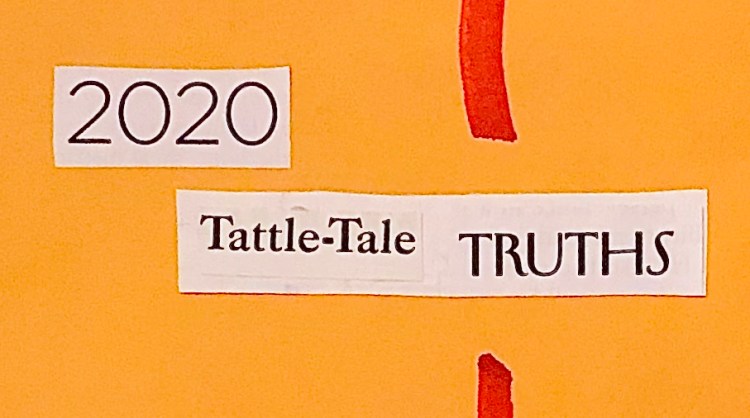
2020 Tattle-Tale Truths

Where have you been lately?

Home cookies story hour

A briefly noted

breakthrough

What are your symptoms?

Untrue advice:

A subtle silence

A war of persuasion

What tests should you expect?

Action equities fire

Next-level knowledge

The might-have-been modern world


A week ago, I started collecting about 100 words to make a headline poem. I finished it yesterday. With this poem, I wanted to capture 2020 as I’ve experienced it so far. Like everyone, I’m still experiencing the COVID-19 pandemic that was ushered into our lives in March when my school closed for the remainder of the year. Fortunately, since my husband and I both teach, it’s been a spring of staying in, working, baking, writing, completing a few house projects, and keeping up with the news. We’ve had an easy go of it compared to so many others and I get that.

But gradually, spring gave way to summer with the protests and violence spurred by the deaths of African-Americans at the hands of police. Somehow, I wanted my poem to capture both of these history-making forces.

The jury’s still out on whether I succeeded, and after all, a poem is just a poem. I don’t have to get it right, whatever “right” means. And that’s one thing I love about this art form.

If you’re unfamiliar with headline poetry, read my two posts here and here.

I am definitely turning into a headline poetry enthusiast.

I think it can open up new doors to expression for both students with a flair for language and those who struggle to get words onto a page. I also like that it gets students using printed materials, scissors, glue… and creativity. With so many “screen time distractions,” it’s refreshing to create a tangible memento.

The key to headline poetry is to be open to metaphor, nonsensical word choices, and creativity.

Likewise, it helps to be open to unusual materials. For example, I couldn’t find a sheet of paper at home to arrange my words onto. My daughter suggested this manila envelope and I really like the way it can be folded like a book. This accomplishes three things:

  • it protects the words
  • it creates a “frame” for the work
  • it makes the poem easy to store in a notebook or file cabinet, i.e. no more giant sheets of poster board or construction paper that require space I simply don’t have in my classroom
Using an envelope creates a cover for your poem.

For this poem, I used present-day magazines such as The New Yorker and Better Homes and Gardens. However, all I had on hand were pre-pandemic issues, which opened up new word possibilities. Since there weren’t corona virus stories in these issues, I had to make other, more unexpected word choices. (The questions Where have you been lately?, What are your symptoms?, and What tests should you expect? were from an article about general spring flu season remedies, and not COVID-19).

Poem detail.

For contrast and fun, I collected a few words (cookies, story hour, knowledge, and modern) from vintage magazines. These included the January 1948 issue of Children’s Activities, and the September 1940 Woman’s Home Companion. My goal was to see how old typefaces would affect the poem’s tone. In this case, the old type didn’t seem to add much. Maybe next time I’ll add some photos or illustrations from these magazines to see what that does.


Thanks for reading!
Check out this headline poetry post for more details. For more ELA teaching ideas and lessons, enter your email below and I’ll add you to my list — THANK YOU!

Processing…
Success! You're on the list.

Frederick Douglass Unit Plan, Resources, and Handouts

10 reasons to teach Douglass plus the unit plan

As I promised last week in my post about Frederick Douglass graphic essays, I’m providing a link below so you can purchase a PDF of my unit of instruction for The Narrative of the Life of Frederick Douglass. Although this unit was designed for regular, in-person teaching, its activities and resources could be incorporated as part of a distance learning plan.

Click here to purchase the Douglass Unit Plan from my site shop.

One more note: this plan isn’t perfect. Rarely does any topic or book I teach go exactly the way I want it to. However, this is my starting point or my game plan, if you will, for approaching this wonderful book that many of my former students have told me is one of their favorites from my classes.

But first, why teach Frederick Douglass’ narrative?

Here are ten reasons, in no particular order, of why we all should be teaching Frederick Douglass to our middle and high school students.

  1. So kids read an eyewitness account of the institution of American slavery.
  2. So kids understand the dehumanizing effects of slavery and that dehumanizing language and actions are used by oppressors around the world still today .
  3. So kids can recognize directly the connection between the horrors of American slavery and its legacy… racial strife in America today.
  4. So kids understand the power of reading and, more generally, education.
  5. So students know the risks Douglass took in telling the world about the horrors of slavery.
  6. So kids understand the roots of racism in the United States as expressed in the inhumane and abusive treatment of African-Americans, and how those roots continue to reveal themselves today.
  7. So students can understand connections between the America of 1845, when Douglass’ narrative was first published, and the America of 2020.
  8. To learn the strength of powerful arguments told through both prose and poetry.
  9. To be inspired and to work for a better world.
  10. To learn that no matter how tough life gets, others have gone before them and survived their own equally harrowing ordeals.

Also in this post: unit plan resources and handouts available for purchase. See below.

Whenever I teach Frederick Douglass, I truly desire that students read the entire text and understand and appreciate its tough lessons, grim realities and inspiring anecdotes. To that end, each chapter includes…

  • traditional reading comprehension questions
  • discussion starters
  • a drawing/sketch activity
  • collaborative textual analysis
  • brief, low-stakes presentations
  • written responses
  • cloze activities
  • vocabulary instruction
  • a culminating argument essay

And of course, based on the particular mix of students in my classes, each year is different when I teach Douglass. As a result, some years I design on-the-fly, ancillary activities that tend to be more creative. During Chapter 10, the longest chapter (by far!) of the book, you may feel — as I do — that students would enjoy some creative artistic projects.

In the past I’ve had students work on these activities as they listen to Chapter 10 from an audio CD or a streamed service. It’s been a beneficial way to help students persevere through the longest chapter in the book while letting their creative juices flow.

One year, students located passages in the chapter that revealed one of Douglass’ personality traits and incorporated that passage into a drawn portrait. Another project asked students to create an illustration of the ships in Chesapeake Bay that included a passage from text in the background of the illustration.

Without further ado…

I’ve made my Frederick Douglass Unit Plan plus Resources and Handouts available for purchase from my shop on this site. To see sample pages from the 67-page plan scroll through the images below. This plan is not available on my TpT store.

Please contact me with any questions by leaving a message on my Contact page. I will receive an email notification and will respond as soon as I can today.

Download these additional items for the unit plan at no charge:

Click here for the Color Emotion Guide Infographic

Click here for the Internet Minute Infographic

And here’s the Kevin Bales video featured in the unit plan infographic extension. Bales is Professor of Contemporary Slavery and Research Director of the Rights Lab at the University of Nottingham in the United Kingdom. He’s written numerous books on modern slavery, including Blood and Earth, Disposable People, and Ending Slavery.


Marilyn Yung

Thanks for reading!

I consider Frederick Douglass to be our country’s greatest unsung hero. His narrative is a must-read for every student in the United States. Feel free to share your ideas and comments about this unit plan. If I have omitted a needed detail or step, or if you notice errors, please comment and I’ll make the needed changes asap.

Contact me via my Contact page. Enjoy!


Need a new poetry idea?

Enter your email below and I’ll send you this PDF file that will teach your students to write Treasured Object Poems, one of my favorite poem activities. I know your students will enjoy it!

Image shows readers the paper I'll send for signing up for my email list. The handout gives instructions for a Treasured Object poem.
Treasured Object Poems

Processing…
Success! You're on the list.

Looking for something specific?


ELA Brave and True


Headline poetry: At a loss for words? Let the words find you

Ever feel that words don’t exist to describe summer 2020?

Ever feel as if words simply don’t exist to describe the summer of 2020? Here’s an idea: search through magazines, newspapers, mail, anything, and…

let the words find you.

I started this headline poem last night. I’m on step 1… searching and clipping. I have about 75 words clipped so far. I’ve found my words in a pre-lockdown New Yorker, the July 2020 issue of Better Homes and Gardens, the January 1948 issue of Children’s Activities, and the September 1940 Woman’s Home Companion.

Over the next week or so, I’ll be refining this, and by “refining” I mean all these things:

  • looking for meaning
  • letting a theme rise to the surface
  • noticing new metaphors
  • interesting word choices
  • finding fresh expressions

When you can’t find the words to describe current times and turmoils, try a headline poem. I’ll be posting my progress on this poem over the next week or two.

In the meantime, read Headline Poetry is So Much Fun! and Headline Poetry for High School, for how I’ve used headline poetry in my middle school and high school ELA classes. Make no mistake, blackout poetry is awesome (and I want to try some of that later this fall with the social impact novels my juniors will be reading), but make sure to explore the possibilities of headline poetry as well. It just may surprise you!


Thanks for reading! Check in next Tuesday when I’ll be sharing with you my unit plan for Frederick Douglass’ narrative. It’s one of my favorite nonfiction books and with every reading, I learn something revelatory and new from whom I believe to be the United States’ most unsung hero.

When class discussions get controversial (and unfair)

Photo by Sam Balye on Unsplash

I need this plan for better discussions in my classroom

Because I am a writer first, and a speaker second, teaching via whole-class discussions does not come easily to me. When those class discussions involve racially-charged, controversial topics, it’s even more difficult. This difficulty can be blamed on two things:

  • I teach at a nearly all-white high school. It’s not uncommon for one student to be the sole African-American in a class of fifteen to twenty. That ratio means I have to make sure that every student feels that they have a voice.
  • Even though I’ve been teaching for nine years, I just don’t have enough experience in facilitating whole-class discussions.

I know this and struggle with it.

So when I stumbled across the article, “Dangerous Discussions: Voice and Power in My Classroom” in the National Writing Projects’s Write Now publication on Medium.com, I knew I had to share the link with you.

It’s written by Oregon high school teacher, Ursula Wolfe-Rocca and, despite being written long before this week’s protests over the killing of George Floyd by a white police officer, it has some excellent, practical steps for better, more inclusive class discussions.

It’s comforting to know I’m not the only teacher who has felt frustrated with my lackluster skills at leading a discussion. Wolfe-Rocca echoes my concerns in this excerpt from her essay:

Affirmative Action for Class Discussions

“I’d bet all teachers have experienced a totally unsatisfying class discussion on a topic about which we care deeply. In my early years as a teacher, I made the mistake of interpreting these unsuccessful discussions as the students’ fault, a sign of their apathy or disengagement. Over time, I started to notice that different discussions failed in different ways. In some cases, a few students might make tentative, short stabs at contributing, but nothing gets rolling, and long silences dominate. At other times, one or two students are so confident and emphatic as to suck all the collaborative oxygen out of the room.”

Ursula Wolfe-Rocca in “Dangerous Discussions: Voice and Power in My Classroom” in NWP Write Now:Reflections on Writing from the National Writing Project (used with permission)

Wolfe-Rocca then continues the article to offer a plan where students write first in response to a discussion starter. She then reads student responses, collects a balanced selection of anonymous comments, and makes a handout for the next day’s discussion. You can learn the rest of her process by reading the article here.

Here’s the link again. You may have to open a free Medium account to read it as part of a trial membership.)

In closing, I really want to figure out how to lead better discussions in my English classroom. I’m tired of the blank stares that happen when kids feel too vulnerable to voice their opinions. I’m tired of some kids feeling shut out by the confident, in-the-majority talkers. I’m tired of not knowing how to include everyone.


Thanks for reading. I’m still taking your lit suggestions for fall. I’ve ordered class sets of Frederick Douglass’ narrative, but I’m wondering about newer literature to address racial issues in my class. Feel free to share your ideas in the comments. For more background, here’s that post, White Teacher Question: Are these race and social justice books enough?