I’ve noticed this for quite a while now. Have you? I have several student writers who use the term “stick out” or “stuck out” in their writing in an unusual way. Here are some examples:
Several ideas really stuck out to me as I read the story.
The biggest idea that stuck out to me in the book was the ending.
Many details stick out to me when I write memoirs.
Yes, talking about how things stick out is fine. It’s colloquial. It’s informal. It’s idiomatic.
However, in formal writing, especially academic writing, it’s imprecise and inappropriately casual.
After all, things don’t stick out.
Instead, here are six things they actually do:
They make an impression.
They are significant.
They assume prominence.
4. They rise above.
5. They take precedence.
6. They reveal their importance.
I plan to offer these six alternatives the next time I read about things sticking out to my students. Let’s rephrase those phrases at the top of this post with these more precise alternative phrasings.
Several ideas took precedence in my mind as I read the story.
The biggest idea that revealed its importance to me in the book was the ending.
Many details make an impression on me when I write memoirs.
Writer’s workshop is starting up next week with my juniors. When I notice this pesky little phrase “sticking up” in my students’ writing, I’ll make sure to offer them some better options… at least for their more formal writing projects.
Have you noticed this usage issue? How do you approach eliminating it in student writing? Feel free to leave a comment below or on my contact page.
Need a new poetry lesson?
Enter your email below and I’ll send you this PDF file that will teach your students to write Treasured Object Poems, one of my favorite poem activities. I know your students will enjoy it!
Treasured Object Poems
Processing…
Success! You're on the list.
Whoops! There was an error and we couldn't process your subscription. Please reload the page and try again.
1) You’ll build excitement to read an Anglo-Saxon poem so old we don’t even know exactly when it was written or by whom.
2) You’ll open students’ eyes to the universal pattern of story-telling à la Joseph Campbell’s monomyth.
3) You’ll have a ton of fun.
My seniors recently finished reading and studying Beowulf. Last week, they plotted the events and characters of our Burton Raffel translation onto Joseph Campbell’s Hero’s Journey template and made quick Google Slide Presentations that arranged their favorite story or movie onto the same template.
I made this bulletin board in early September to prime imaginations and get kids wondering about the excitement Beowulf has to offer.
My students created presentations on C.S. Lewis’ The Magician’s Nephew, The Lord of the Rings, The Heat, The Hunger Games, Beautiful Creatures, and even Smokey and the Bandit!
This week, we will be finishing up those presentations, and watching 3:10 to Yuma, a 2007 western starring Christian Bale and Russell Crowe.
As we watch the movie, we’ll pause occasionally to discuss as characters and events of the movie fall into place on the Hero’s Journey pattern.
Beowulf is a lot to slog through, so I think it’s fitting (especially during this chaotic fall) to reward ourselves with an excellent film that illustrates the ubiquitous Hero’s Journey.
If you haven’t seen 3:10 to Yuma, you should. The two-hour film was directed by James Mangold and received two Oscar nominations for sound mixing and musical score. (Make arrangements for permission slips, according to your school policy.
But the story is where it’s at.
Bale plays Dan Evans, the hero of the story. According to IMDB, Evans is “a small-time rancher who agrees to a captured outlaw (Ben Wade, played by Crowe), who’s awaiting a train to go to court in Yuma.” All the Hero’s Journey elements are in this movie. You’ll find the following:
the ordinary world (Dan’s farm is drying up, the rent is due, and he receives a threat.)
the call to adventure (Dan needs the money he’ll make if he escorts a criminal across the desert.)
the refusal of the call (Dan’s wife discourages him from going.)
the entrance to the unknown (Dan must go not to the land of the Danes, but across southern Arizona.)
plus all the others!
You get the picture. There’s even a talisman and an unexpected mentor.
Campbell’s Special World in 3:10 to Yuma shows itself as the deserts of southern Arizona. | Photo by Tyler Nix on Unsplash
Side Note: 3:10 to Yuma is rated “R” for violence and two to three instances of profanity, so make arrangements for permission slips, according to your school’s policy.
Anyway, if this year’s viewing of 3:10 to Yuma is anything like last year’s, we’ll again get into a discussion of the mentor character, how truly loyal Evans’ allies were, and exactly where the supernatural aid comes into play.
It’s a fun connection to make!
Last year, I also had students listen to an episode of The Hero’s Journey podcast for a scene-by-scene discussion of 3:10 to Yuma as it conforms to Campbell’s pattern.
Listen to The Hero’s Journey Podcast on Spotify and other popular platforms.
One caveat: I haven’t developed a good way to utilize lengthy podcasts (this one is 1-1/2 hours long) in my classroom. Perhaps it’s a better activity for kids to do on their own. However, if you have some good ideas, please leave a comment!
Regardless, The Hero’s Journey Podcast is super fun! The hosts, Jeff Garvin and Dan Zarzana, banter back and forth and break down all the important parts of the film. Their podcast includes many more popular films (Star Wars, Raiders of the Lost Ark, The Shining, Nightmare Before Christmas, Total Recall, Princess Bride, etc.) treated to the Hero’s Journey analysis, so check it out. It’s a good way to tie more literary connections into movies your students will already be familiar with.
Follow the Hero’s Journey through Spiderman, the movie.
So there you have it, pardner: one more way to infuse relevance into your Beowulf unit.
To find these “Beowulf relevance” posts again, search the Beowulf category on this site or click the Pinterest button at the top of this post and follow.
Also, let me know how you build excitement for Beowulf. I’m always interested in finding out what you all are doing!
And, by the way, Geoffrey Chaucer is coming up soon, so become a follower to read my upcoming posts about my first pilgrimage teaching The Canterbury Tales!
Need a new poetry lesson?
Enter your email below and I’ll send you this PDF file that will teach your students to write Treasured Object Poems, one of my favorite poem activities. I know your students will enjoy it!
Treasured Object Poems
Processing…
Success! You're on the list.
Whoops! There was an error and we couldn't process your subscription. Please reload the page and try again.
It’s an assignment called “Life Lessons of Beowulf.”
Check it out here on Bible’s website. She conveniently includes links to four articles that directly cite Beowulf in modern day life. These articles are from publications such as Forbes and websites such as The Art of Manliness.
These real-world articles apply events from Beowulf to create lessons — words of wisdom, if you will — regarding leadership and content marketing, among other business-related topics.
Bible cites Kelly Gallagher’s ideas from his book Write Like This, where he advises that teachers actively seek out articles “in the wild” for students to emulate.
So in that spirit, I asked my high school seniors to write an article (or personal narrative essay… whichever you prefer) that explains the top five lessons they learned from Beowulf that they can directly apply to a personal passion, interest, or a current or future job.
The handout I created for this assignment. In-school students received this sheet; remote learners downloaded it from Google Classroom.
Students were to write an introduction and a conclusion, and between those would be five sections, each a separate life lesson. They were to put the lesson in boldface followed by an explanation with examples under it. They would also need to cite Beowulf (with a direct quote) at least twice with in-text citations.
This was an effective assignment!
Students made real-life connections between contemporary life and ancient Anglo-Saxon literature. They created interesting essays that have encouraged me to keep it in the mix for next year.
Of course, not all students were so successful.
Some chose to skip the direct quotes, and some did even less.
And true, I created and assigned this project while I was home early in my bout with Covid-19 and wasn’t able to preface it or demo it in class. We weren’t able to do any close-readings of the articles, annotate them for structure, or really pick them apart. Of course, all students had access to the articles, and some chose to close-read them on their own, but many didn’t. It wasn’t the best situation. Maybe next year, right?
Despite all that, I still rate Building Book Love’s product as an awesome assignment. Whenever I can pull in relevant real-world mentor texts to pair with Beowulf — or any literary text — we all win!
Feel free to leave a comment in the replies below or via my Contact Page to let me know how you connect Beowulf to contemporary life.
Enter your email below and I’ll send you this PDF file that will teach your students to write Treasured Object Poems, one of my favorite poem activities. I know your students will enjoy it!
Treasured Object Poems
Processing…
Success! You're on the list.
Whoops! There was an error and we couldn't process your subscription. Please reload the page and try again.
I’m playing around with the idea of embedding a short video to introduce each week’s blog post. I have a couple of goals in doing this: 1) to add variety to my posts, and 2) to get more comfortable with making videos in general. Feel free to comment on how (or if!) videos improve my blog.
During the first week of September, when I first mentioned the poem Beowulf to my senior British Literature classes, most of the students said that yes, they had heard of the ancient Anglo-Saxon poem. They understood or at least had a notion of it being an important, seminal text. “Wasn’t there a movie not too long ago?” someone also asked.
Beyond that, however, that was about as much as they knew. In the eyes of most, it was just a really, really old poem.
And we all know how most students feel about really old poems.(Yawn.)
That’s why during our Beowulf study (which by the way, we would be done with by now if I hadn’t contracted Covid), I especially sought out recently published articles pertaining to the ancient text. My goal? To let students figure out on their own that Beowulf is still a force in contemporary society.
In other words, I wanted to stop telling students that Beowulf is relevant and instead, let them come to that realization on their own.
In addition to conveying relevance, locating contemporary articles about Beowulf published by active writers and bloggers would do two more things: 1) increase my students’ knowledge base about the great Geat warrior himself and Anglo-Saxon literature in general, and 2) form the foundation for the medieval era literature that follows in our textbook. And, in the end, my students did connect with the story.
The violence, the dragons, the mead hall scenes, the boasting. It’s all engaging. Students get it.
After all, the Burton Raffel translation in our textbook does a fantastic job of forming a solid introduction to Beowulf. Beyond the narrative pull of the poem, however, I’m confident the three articles summarized below played a role in helping contribute to my students’ connection with the poem.
Here are the three new articles I found during some weekend Internet sleuthing:
By the way, I assigned these articles as AOWs, my version of Kelly Gallagher‘s Article of the Week assignments. I also came up with some writing prompts for each one and pulled new vocabulary to use in my mini-lesson every Thursday. Those prompts and vocab words can be found at the end of each summary below. Or try my new resource below, which features two of the articles mentioned in this post.
This 2,800-word article by Ruth Franklin introduces the newest translation of Beowulf… one written by young adult author Maria Dahvana Headley and released on August 25. The article analyzes the Headley’s treatment of the ancient poem, noticing how her translation grew out of her 2018 novel, The Mere Wife, which according to Franklin, “reimagines the Beowulf story, setting it in modern times and placing the female characters at its center.”
The article also discusses Headley’s intriguing word choices that sprinkles the ancient text “with feminism and social-media slang.” (Example: The first word of the poem, “Hwaet!” is now “Bro!” in Headley’s version.)
Some die-hard Beowulf lovers may understandably take offense, but for the sake of students reading this ancient poem today (and in my case, during the snooze-inducing class period about an hour after lunch), these jarring language adjustments are warranted and, I’ll just say it, welcomed.
Take a peek at this article and pencil it into your plans for the next time you teach Beowulf. This article shows students the power of the Beowulf tale and that the themes of the story are indeed universal and timeless. It’s amazing to me to think that contemporary authors are still interpreting and re-interpreting this age-old text. It definitely helps you make the case that Beowulf is a tale of the ages with relevance even today.
This is the printed handout that I created for this assignment. It was also available online as a PDF file that I posted for my classes on Google Classroom.
The written response I created for this text: Write a 1+ page response where you discuss the significance of Headley’s new translation and what yet another new translation means for the original Beowulf text. What does a new translation say about Beowulf the poem? What does this new translation reveal about contemporary society and archaic literature?
Some key vocabulary found in this text: eponymous, dichotomy, caustic, polemical, sublime, belligerent, recrudesce, emended, fratricide, preternatural
This 2,550-word article by Sam Wright takes readers to the present-day site of the historic discovery of the Sutton Hoo ship burial site in Woodbridge. It’s a 255-acre estate that contained the ship burial of King Raedwold and his possessions spread across eighteen burial mounds. The estate is now managed by the Sutton Hoo Society, which supports the Sutton Hoo Research Project. The estate was gifted to the UK’s National Trust in 1998, Wright notes. Today, anyone can tour the estate and its historic grounds. According to the National Trust/Sutton Hoo website:
“The Sutton Hoo Society aims to promote our Anglo-Saxon heritage, making it relevant and accessible to all. As both National Trust volunteers and members of the Sutton Hoo Society, our guides lead daily tours of the Royal Burial Ground throughout the year. All our guides are fully trained, bringing Sutton Hoo to life by sharing some of the many stories of this internationally important site.”
The article also offers some history of the site’s earliest discoveries and excavations, which were made in 1937 and halted shortly thereafter by World War Two.
I like that reporter Sam Knight’s story introduces us to landowner Edith Pretty and her first inkling that something was down in the ground:
“Pretty had always been curious about a strange set of mounds that was visible from the house. The hillocks were marked on maps as Roman tumuli—burial mounds—and a guest who stayed with Pretty once claimed to see a ghostly warrior on horseback, riding through the grounds.”
Sam Wright, “Revisiting Sutton Hoo”
Including the story of Basil Brown, Pretty’s acquaintance and freelance archaeologist, Knight adds an interesting human element to the ancient Anglo-Saxon history. And then there’s discussion about that awesome Sutton Hoo helmet once worn by King Raedwald of East Anglia.
Don’t pass up this article. It gives students a tour of the excavated grounds and, like many pieces from The New Yorker, the reporting is excellent (despite the anti-Brexit bias near the end). Also, Wright’s mix of story-telling and exposition is to be revered. In fact, I also had my students make a retroactive outline of this article to notice its blending of genres.
The written response I created for this text: Based on your reading of this article, discuss the notion of Britain’s Dark Ages. When were they? Why are they considered “dark?” What do we know about Britain’s Dark Ages, according to the article? How does this connect to class? Use any of your own existing knowledge, obviously, and cite your sources when necessary, but I do need to see evidence that you read the article.
Some key vocabulary found in this text: hoo, ethereal, abyss, autodidact, tumuli, necropolis, banal. Yes, some of these are definitely Tier 3/domain-specific words, but understanding (or being familiar with) them will be essential to understand Wright’s article.
This 1,200-word essay by author Amber Sparks is a personal narrative where Sparks reveals that reading literature from or about the Middle Ages is her go-to antidote for the difficulties of modern life, including the current COVID pandemic. She writes:
“Medieval people—they’re just like us! Or recognizable, anyway. Their lives were so much shorter, and so much more violent and uncertain; they lived through turbulent times, and yet the survivors quietly picked up the pieces afterward and carried on. In our own unsteady era, this picture of the resilience of the human race is reassuring. If we came back from the Black Plague—a disease that killed 50 million people in the 14th century—it seems like we could come back from anything.”
I plan to assign this one in the next week or two. I’m saving it for when we’ll switch from Anglo-Saxon literature (with a Hero’s Journey extension–more on that in another post!) to literature of the medieval era.
Sparks alludes to a handful of non-fiction texts and novels in this article to explain how immersing herself in medieval literature has helped her cope with the death of her mother, infertility, and social unrest, and other difficulties.
This reliance on the medieval era, in fact, is a noticeable characteristic of many readers and writers, according to Sparks, who cites Clair Wills of the New York Review of Books: “There is a small but highly respectable tradition of…novelists turning to medieval and quasi-medieval worlds in times of crisis.” One example: Tolkien’s The Hobbit was written in 1937 during the first rumblings of World War Two.
With Sparks’ essay, it’s my hope that my students will understand that these very old texts we read in British literature have application for themselves in the year 2020. If professional writers find relevance in these texts, perhaps they’re worth looking into.
The written response I created for this text: In addition to a general reflection on this essay, I plan to have them emulate it by writing about their own form of self-therapy using Sparks’ essay as a mentor. What is their form of self-therapy? What do they find solace in when the going gets tough? I’m hoping they can explore their own ways of coping, taking inspiration for the structure of the article from Sparks. It sounds like another retroactive outline will be in order when that time comes.
Some key vocabulary found in this text: Plantagenet, fetishize, pogroms, quasi-, respite, solace, crux. Yes, some of these are definitely Tier 3/domain-specific words, but understanding (or being familiar with) them will be essential to understand the points Sparks makes in her essay.
What are your go-to texts to pair with Beowulf?
Please leave a comment to let me know! I’ve only taught Beowulf twice and I’m totally open to new ideas, like these from Ashley Bible and Zach Hamby. In fact, become a follower to catch my upcoming post about the interesting Beowulf essay my students wrote based on an idea from Bible’s Building Book Love website. Enter your email below to follow my blog and also receive a Treasured Object poetry handout.
Need a new poetry lesson?
Enter your email below and I’ll send you this PDF file that will teach your students to write Treasured Object Poems, one of my favorite poem activities. I know your students will enjoy it!
Treasured Object Poems
Processing…
Success! You're on the list.
Whoops! There was an error and we couldn't process your subscription. Please reload the page and try again.
Please leave a comment with all the questions you have! And if you’re wondering about the post where I discussed these resources, here it is: Eight Ways to Explore New Vocabulary Words.
Need a new poetry lesson?
Enter your email address below and I’ll send you a free PDF file to teach your students how to write Treasured Object Poems. It’s one of my favorite poetry activities and I’m sure your kids will love it!You’ll also be added to my mailing list. About once a month (but no more often than that), I’ll share a free, creative ELA lesson plan or teaching idea.
Treasured Object Poems
Processing…
Success! You're on the list.
Whoops! There was an error and we couldn't process your subscription. Please reload the page and try again.
And really, don’t we learn and use new words for the precision — the particular meanings, tones, and nuances — they provide?
So, for precision’s sake, once a week in my independent reading class, my mix of juniors and seniors explore four new-to-them words they discovered in their reading over the previous couple of days.
I’ve also used these options as a weekly bell-ringer on Thursdays. I chose Thursday, because often I would pull a word from the text I planned to read on Fridays during First Chapter Fridays. For a bell-ringer activity, just copy the above options handout, and cut one of the four sections off for students to fill out during bell work, or have them create their option on notebook paper.
Use the handout below so students have examples of each option.
To internalize these new words, students explore them with eight methods outlined on teacher-author Corbett Harrison’s Always Write website. This site is a wealth (seriously… like so much stuff!) of reading, writing, and vocabulary lesson plans and tips, plus a very detailed Writer’s Workshop design that inspired the one I use to this day. If you visit the site, you’ll quickly gather that much of the material is geared to elementary and middle school, but not all. In fact, most of it can easily be adjusted for high school students.
And that’s what I’ve done with what I call our “vocabulary options.”
These options or strategies involve critical thinking and help students go from “look up the definition and use it in a sentence” to internalizing their new words by exploring meanings, connotations, and connections to other ideas.
Here are the eight strategies (in no particular order, by the way) that Harrison created for students to get themselves comfortable with their knowledge of a new word.
Students explore a new word by drawing a cartoon with stick figures. Their stick figure must be saying something that uses the new word or the cartoon is accompanied by one to two sentences that explain the drawing and uses the word.
In this option, students make at least four associations with their word’s meaning. The student writes the word so the word’s letters represent ideas and connections to the word. He or she must make four connections to the word’s meaning, and then write a paragraph below the word art that explains each connection. They must include this paragraph, so I can tell they understand the word’s meaning.
The new word: huaraches | “The H is a thonged sandal, the “u” is the Aztec symbol for movement, the “c” is Mexico, and the “s” is woven because many of them were woven.”
In this option, the student draws a picture of an object that stands for or symbolizes their word. They also write one to two sentences that explain why they chose this object to symbolize the word, including using the word in their explanation. Lastly — and this is important for this option — the symbol cannot be the word itself. I always explain it this way: “Don’t draw a pedestrian to symbolize a pedestrian.”
I love this one! In this option, the student invents an app that is named the word. Then they write two or more sentences that describe what the app does. In other words, they must explain the purpose and features of the app, which are based on the word’s meaning. They also design a logo for the app (its screen badge) as well as write a user review, both of which must show an understanding of the word’s meaning.
Calling all poets! For this option, students write a haiku poem that must be nature-related and use the word. Of course, the poem must contain five syllables in the first and third lines, and seven in the second line. They also must draw a picture to illustrate their poem.
The new word: heron | And yes, that first line lacks a syllable. Whoops.
This options asks students to invent a horror movie whose title is or contains their word. They also must write a tagline or slogan that creatively describes the gist of the movie and contains the word. Plus, students must includean illustration that shows knowledge of the word.
This is a fun one! To personify a word, students must create a person named with their word. They also write three to four sentences that describe the personality or lifestyle of their person, based on the word’s meaning. Of course, they’ll need to draw their person in such a way that shows knowledge of the word.
This is probably the most involved option of the eight. First, students must draw a superhero. They must also write two to three sentences that describe the superhero’s name and abilities, which are based on the new word. Then, it’s time to switch and think about the opposite of that superhero. Draw a villain and add two to three sentences that describe villain’s name and abilities based on an antonym. Here’s an example:
The new word: amends
Bring on the color!
Lastly, I often encourage students to use color and take their time with the drawings. I stress that it’s not an art project, but there needs to be an honest effort made at being neat, legible, and original. In my current independent reading class, however, my students (most of them anyway, wink-wink) take their time to be creative, thoughtful, and colorful!
These options have been mainstays in my vocabulary teaching for several years. I can’t imagine not using them in my independent reading class. In fact, even in my regular English classes, we’ll use some of these options as discussion springboards during our weekly vocab bell-ringer activity.
That being said, this vocab approach isn’t perfect and I know that.
Be aware that I know this approach is not fully developed. I know I still need to figure out a way to provide students with multiple exposures to their new words. Should we bind these into a book? Have students choose their four best, most well-considered options and present those? A “one and done” approach doesn’t work with writing, so why should it work with vocabulary?
As for timing this activity…
The kids, once they get used to creating them, can explore four words in one 50-minute class period if they budget their time and stay focused.
In my previous middle school position, these four-word explorations were a weekly homework assignment. Students collected ten words on bookmarks in their reading class or in their own reading, and then chose four of them to explore using these options.
As for grading…
I glance through the options and assign a maximum of five points to each of the four words. In the past with my middle schoolers, however, I was known to often use a rubric unique to each option. (Sounds more complicated than it was… honest!)
Thanks for reading! These vocabulary options are one of my favorite ways to inject creativity into ELA. I hope they work for you!
Enter your email below and I’ll send you this PDF file that will teach your students to write Treasured Object Poems, one of my favorite poem activities that I’m sure your students will enjoy.
Treasured Object Poems
Processing…
Success! You're on the list.
Whoops! There was an error and we couldn't process your subscription. Please reload the page and try again.
Wolf teaches at Hollister High School in southwest Missouri and was nice enough to send me these photos with the note that the project was “a complete win!”
My intention for this plan was to put the human element into the story of 9/11. Viewing a crumpled and nearly destroyed employee i.d. card adds a visceral element to the sterile facts, dates, and statistics that can all too often dominate a textbook study of the 9/11 terror attacks.
The poem at left in the photo above spells out “Never Forget” and reads:
No matter the situation, they are there for you,
Even during the darkest, most fearful times
BraVe souls we'll never forget
Every firefighter that stood with you,
CouRageous enough to hold your handFlags fly high for these Americans,
Often not knowing if they will come home
For that we Respect and show
Gratitude towards these heroes,
Eager to save New York,
Thank you, we will never forget.
I think this bulletin board display is a great way to not only showcase student work, but memorialize the attacks and the thousands of innocent lives lost as well.
I hope you’ve enjoyed Joe Wolf’s photos. Pin this post so you can easily access it next fall when the twentieth anniversary of the attacks will be observed.
Thank you for reading my blog.
I’m always interested in learning what topics you would like to see covered here. Feel free to leave a comment to this post or on my Contact page.
Need a new poetry lesson?
Enter your email below and I’ll send you this PDF to teach your students how to write awesome and highly personal Treasured Object Poems.
Treasured Object Poems
Processing…
Success! You're on the list.
Whoops! There was an error and we couldn't process your subscription. Please reload the page and try again.
Make these off-limits: the topic and their opinion
In the past, after I assigned One-Word Summaries, I would often feel a little let down when I walked around the room, glancing over students’ shoulders as they wrote their paragraphs defending their chosen word.
Read my post on the One-Word Summary if you’re unfamiliar with this awesome, low-stakes writing assignment.
I felt let down because, without fail, I would frequently notice a handful of students had chosen words that didn’t actually summarize the text. For example, if the text was about the Triangle Shirtwaist Co. Fire, there would always be at least a couple of kids who would choose “fire.” Another example: if I read the first chapter of The Fault in Our Stars, one or two students would choose words such as “interesting” or “good.”
However, when I decided to skip having kids take sketchnotes while I read, in favor of having them write One-Word Summaries after, I experienced an epiphany and told myself:
“Before I begin reading, I should tell kids that their one word won’t be the topic of the book, nor will it be their opinion.”
I further explained to students that neither a topic word nor an opinion word reveals and/or summarizes the content of the reading.
“I need you to dig deeper,” I said, adding, “What’s the author really talking about? What’s the bigger idea behind the coffee lids?”
True, the author did write about coffee lids, but she also discussed a deeper idea. “That deeper idea is what I need you to listen for as I read.”
It worked.
Students across both of my junior classes — about thirty-five kids total — responded with words such as innovation, creativity, and improvement… all accurate words that drive at the gist of author Louis Harpman’s introduction.
In fact, only one student turned in a non-summarizing word. (That student’s word was “different.” She explained in her writing that the topic was different and one she had never really thought about before.)
Well, yes, she had a point, but she didn’t have a summary.
By the way, that student is a remote learner. It’s my guess that had she been in the classroom, she would have understood the assignment better than from the video I recorded in class.
This is the best tip I’ve come up with so far to make this assignment work for everyone: again, the word students choose cannot be a topic nor an opinion of the text.
And perhaps a mentor text is what I really need to show students what a summary word does; it provides the gist or the main idea of the text. (Note to self: write a One-Word Summary example.)
If you regularly utilize One-Word Summaries in your classes, what’s your secret to helping kids to truly summarize?
It’s worth the effort to get the most mileage out of the One-Word Summary. This one simple assignment helps kids think critically, and when they write out their summaries (as opposed to an end-of-class “spoken exit ticket” where students state their word and why), you provide your students even more solid writing practice.
Need a new poetry lesson?
Enter your email below and I’ll send you this PDF to teach students how to write awesome Treasured Object Poems.
Processing…
Success! You're on the list.
Whoops! There was an error and we couldn't process your subscription. Please reload the page and try again.
My high school students take headline poems to the next level
Again this year, I chose to start the school year with headline poetry. Both my in-school students and those learning at home created headline poems with words and phrases found and clipped from with a variety of printed materials, magazines, newspapers, and even junk mail.
If you’re unfamiliar with headline poetry, read this post. Over the past few years, I’ve found headline poetry to be an excellent way to start the school year. Students get to socialize and talk while they work. They cut out words and phrases, then choose and arrange words into interesting combinations to create thoughtful, spontaneous poetry.
August 2020 marked the second year my high school students and I have explored headline poetry. One year ago, our goals were to explore the form for the first time. One month ago, that was the goal again for my juniors, as it was their first time to dabble in headline poems.
For my seniors, since it was their second attempt, I invited them to take it up a notch and try some new ideas with their headline poems, such as:
Adding a drawing on which to arrange the poem
This poem by junior Adalee H. is a good example of how students can combine drawing with headline poems. It’s also a good example of how some of my juniors accepted the challenge to try a more non-traditional design.
Using a photo as a background
Destiny H. used photos from magazines to complement words and phrases.
Manipulating or tearing the background paper
Ella D. tore the paper around the word “breakthrough” to show interaction between the words and their background.
Incorporating lift-up tabs
Slide the arrow back and forth to see how Bayleigh H. incorporated a lift-up tab.
I hope this small gallery of headline poems comes in handy the next time you need a fun writing project that challenges students to think critically. A good deal of creative discernment happens as students choose and prioritize words, arrange and rearrange them, discarding and grouping as they begin to see a theme or central message emerge from the array of clippings before them.
Try headline poetry soon, and let me know how it goes!
Thanks for reading! For more ELA resources, lesson plans, and student writing contests, enter your email below. In return, you’ll receive a free PDF file of this sheet that will teach your students how to write Treasured Object Poems. It’s another favorite my students explore each year!
Processing…
Success! You're on the list.
Whoops! There was an error and we couldn't process your subscription. Please reload the page and try again.
Invite students to play with language and color during this most unusual of fall seasons.
I subscribe to The Paris Review’s Daily Poem blog and everyday in my email inbox I receive a poem that gives me something interesting to think about. I read these emails nearly every time to see if the poem-of-the-day inspires an idea I can explore with my students.
About a month ago in one of those emails, I noticed a poem titled “Yellow” by American poet Kay Ryan. Here’s that poem:
Yellow
Yellow is the most
primary of the colors,
owing nothing to any
of the others. Many
descendants come back
repentant and sullied
to celebrate yellow’s
anniversary, but yellow
is unapproachable, not
antisocial but not
interested in sitting
at the table with
tainted yolks or
nouveaux chartreuses
or any of the other
abuses of the palette.
Yellow’s indifferent
to blue’s inducements
and despises orange,
red’s bastard coinage.
He’s selfish, yes you
could say he’s selfish:
but it is Spring’s wish
just at this brief
first note before her
fantasia to soft petal
every shade but acacia.
Wasn’t that fun?!
I like how Ryan’s poem personifies the sunniest of colors. She adds unexpected dimension and surprising personality to this bright hue by applying emotions and motives to the color.
In addition, Ryan’s poem packs of punch of new, interesting vocabulary to introduce and revel in. Sullied. Tainted. Fantasia. Acacia. Wow!
Upon reading the poem three or four times (it’s that rich with meaning!), it occurred to me that students might do well with writing a poem based on this idea with a color of their own choosing.
American poet and educator Kay Ryan | Poetry Foundation
To investigate the idea further, I decided to write a color poem about the color “rust,” using Ryan’s as inspiration. Also, just for fun, I published it on my writing portfolio blog. Here’s my color poem titled “Rust:”
Rust
Rust is the inescapable
color of weakness and
evasion,
an erratic reacquaintance.
He's the embarrassing residue
oxidizing at the edge
of iron's brawn.
A popular environmentalist,
he was a favorite at the
very first Earth Day in 1970.
Unlike his obstinate cousin,
Orange,
Rust also goes by
Clay,
Cinnamon,
Squash,
Yam,
Copper Mountain.
Crayons know him as
Burnt Sienna.
Redheads call him Ginger.
The tint of McRib,
he imitates the
machine-formed pork hero:
in and out of our lives --
back for a limited time --
and then gone for months
(or years) on end.
I am mostly happy with the result, but I also know it’s merely a start.
My real intention with writing “Rust” was to provide students an example written by someone other than the famed Ryan.
I also wanted to give students some ideas for what they could include in their poems, such as:
some practice with personification
Students think creatively when they imagine colors as people with emotions, preferences, and relationships with others.
some history of their color
For example, I did some quick online research to learn that the color rust was shown in color palettes that reflected the world’s first Earth Day.
some alternative names for their color
For example, I googled some paint palettes from the 1970s in order to find some alternative names for “rust.” That’s where Copper Mountain, yam, and others were found.
some color wheel knowledge
Researching basic color theory may help students when they discuss how how their color relates to other colors.
some unexpected allusions
That’s where my obscure reference to the McRib came into play. I like the playful edge it gives to my poem and I like how it lightens the mood of my lines.
To help students wrap their minds around this idea, I created the handout pictured below and assigned the poem using Google Classroom.
The back of the sheet contains the two mentor texts.
I assigned the poem on a Tuesday to be due the following Tuesday and asked kids, among the other details shown on the sheet above, to write a poem 15-25 lines long.
Most students seemed to enjoy this project!
Below, I’ve shared the poems that were turned in by three of my students, two juniors and one senior.
As I read the poems my students turned in, I enjoyed noticing their color choices. After all, the colors we choose to write about do reflect a bit about our personalities. In addition, it was interesting to see how well the students used the mentor texts to inspire the information they included in their verses.
I enjoyed this one so much. I especially enjoyed the variety of imagery the author included. That horse’s saddle that shines in the light of the arena! So visual!
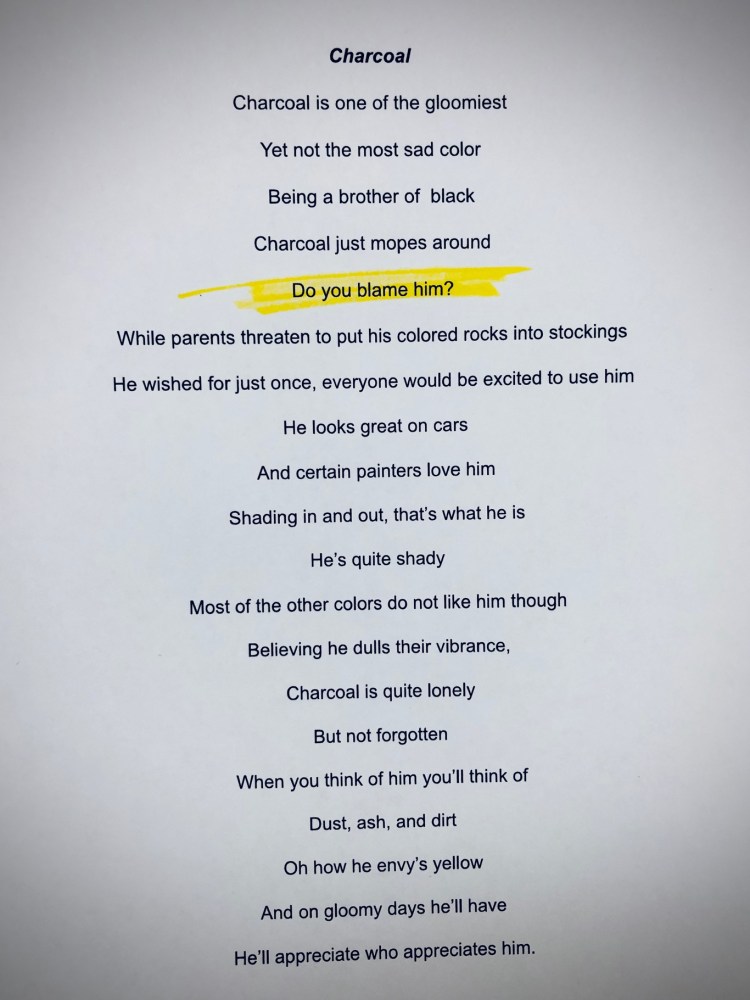
The personification on this one is effective. I especially notice the question the writer asks in his poem. Yes, the final two lines are unclear, and if we submit this for a contest later this fall, we’ll fix that, but overall, this student had success with this poem structure. This handwritten poem explores the variety of names we can apply to good ol’ purple. Get a load of “heliotrope!”
This was a fun experimental project to try, and I intend to refine it for next time.
One idea I’ve already thought about adding: asking students to find copyright-free images to illustrate their poems, similar to the photos of the yellow leaves and rust corrosion I included above the mentor poems in this post. To be sure, that would add a multi-media dimension to this project.
In closing, so many of my high school students are grappling with the challenges of learning at home and keeping up with myriad assignments… while also continuing to maintain part-time jobs and household responsibilities. It was my hope that this poem would allow them to play with language and color during this most unusual of fall seasons.
For more ELA teaching ideas, news about student writing contests — plus more poetry ideas — enter your email below to receive my monthly newsletter. In return, you’ll receive this Treasured Object Poem guideline sheet to teach your students how to write these highly personal and expressive poems. It’s one of my absolute favorite poetry projects!
Processing…
Success! You're on the list.
Whoops! There was an error and we couldn't process your subscription. Please reload the page and try again.